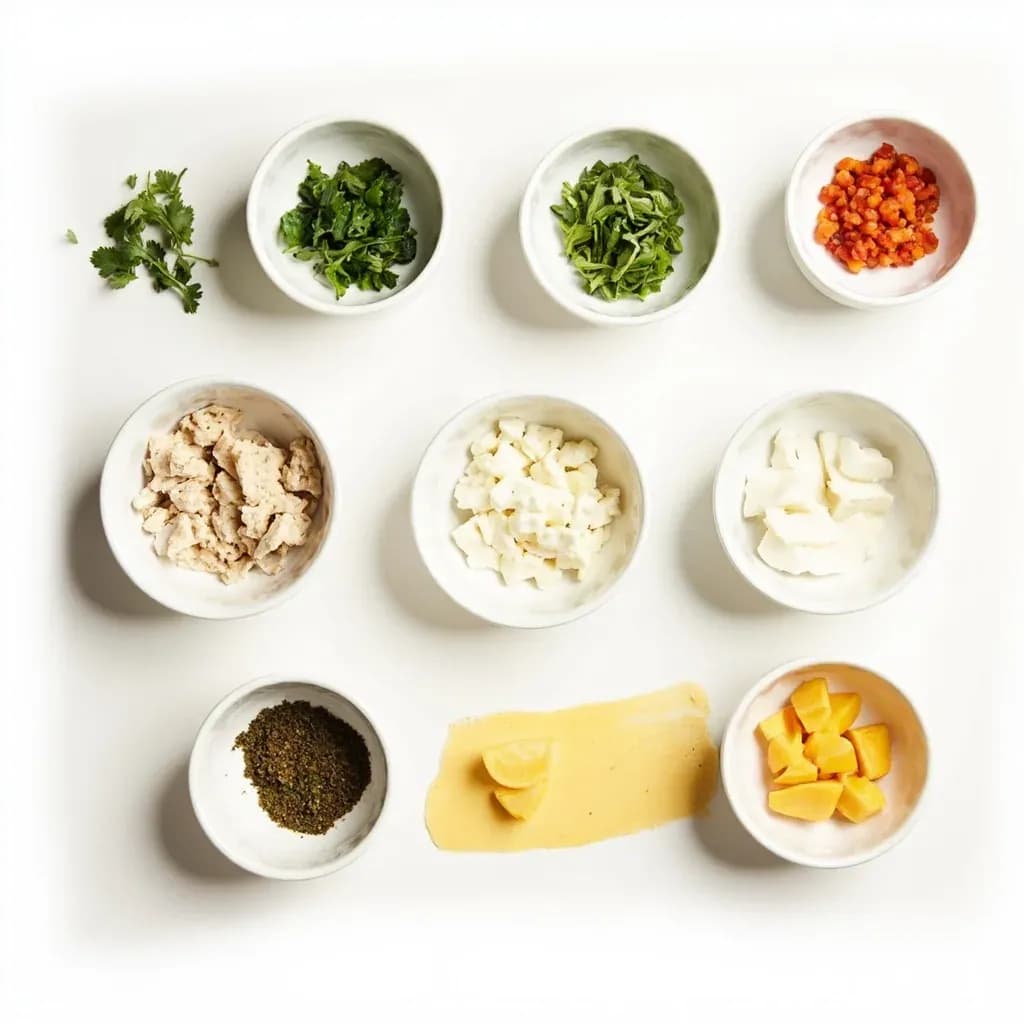
Prep & Assembly
Mise en Place
Measuring, prepping, and arranging all ingredients before cooking begins.
Mise en place, French for everything in its place, is the practice of washing, cutting, measuring, and arranging every ingredient and tool before you start to cook. It keeps fast-moving dishes from falling apart and reduces mistakes and waste during service. Professional kitchens treat it as non-negotiable because once the pan is hot there is no time to dice an onion.
Mise en place is best understood as a kitchen philosophy rather than a single prep step: read the recipe fully, measure and cut every component to its final form, and arrange it within arm's reach before any heat is applied. The phrase, French for "putting in place," was codified in Auguste Escoffier's Le Guide Culinaire (1903) alongside the brigade de cuisine, and it remains the organizing principle of every professional kitchen. The discipline is what allows a line cook to add a sauce, a protein, and a garnish in the correct order during a short ticket window without stopping to chop an onion.
In practice, mise en place is most valuable where time is shortest and stakes are highest: high-heat cooking (sauté, stir-fry, grill, deep-fry), multi-component plated dishes, and any pastry work that depends on gram-level accuracy and tempered ingredients. It is also the single highest-leverage habit a home cook can adopt, because most overcooking and most last-minute improvisation trace back to a step that should have been done before the pan got hot. Knife consistency and the willingness to cut correctly on the first pass are the real differentiators between a beginner's mise and a professional's.
A common misreading is that mise en place is something you do once, before service. In a working kitchen it is a continuous state: containers are swept, refilled, re-iced, and re-labeled between tickets for the entire shift. The same principle scales down — at home, a clean board, a labeled deli container of minced garlic, and a damp towel under the cutting board turn a weeknight stir-fry from stressful to controlled.
- Difficulty
- Easy
Types & varieties
Every component of a dish is measured, portioned, and arranged before any heat is applied; standard in fine dining and pastry.
Used on à la carte service lines; components are prepped in batches and replenished throughout service so a station is never out of any single item.
The brigade approach: each station (saucier, poissonnier, pâtissier, garde manger) holds its own organized array of prepped product and tools.
For à la carte orders, cooks often pull and portion ingredients for a single ticket before firing; the dish's full mise is still set, just scaled to one cover.
Mid-service review of the station: checking levels, replacing depleted items, wiping rims, refreshing ice baths, and resetting towels — part of the philosophy, not a separate technique.
How to do it
- 1
Read and brief
Read the full recipe or ticket including the plating spec. Note cooking times, finishing touches, and garnish so nothing is forgotten. In a brigade, the chef de partie briefs the line on the dish and any 86'd items before the pass opens.
- 2
Inventory and gather
Pull every ingredient, and pull it in usable form (whole onions, not pre-diced). Stage them in one area before you start breaking anything down. Verify quantities against expected covers.
- 3
Set up the station
Place the cutting board on a damp towel, the chef's knife, a bench scraper, a garbage bowl, a sanitizer bucket, and a clean towel at arm's reach. Lay out ramekins or quarter pans in the order ingredients will be used.
- 4
Portion proteins and bulk items
Weigh and portion proteins to the per-cover weight, trim to spec, and arrange in single layers on parchment-lined trays. Portion stocks, sauces, and oils into labeled squeeze bottles or small containers.
- 5
Wash and dry produce
Wash greens and hardy vegetables first; pat dry thoroughly. Wet produce on a cutting board is a safety and texture problem, especially for high-heat cooking.
- 6
Mince, dice, slice to final size
Cut every aromatic and vegetable to the final size called for in one pass. Group by cook order: long-cook items (mirepoix, soffritto) in one container, quick-cook aromatics (garlic, ginger) in another, garnishes in a third.
- 7
Measure dry and flavor components
Pre-measure spices, salt, sugar, thickeners, and any leaveners. Combine spice blends (rub, curry powder, herb mix) into a single container per use.
- 8
Prepare finishing components
Pre-squeeze citrus, portion butter, temper chocolate, make compound butters, hold herbs on the stem in a cup of water, and stage sauce garnishes (toasted nuts, crispy shallots, chives) in covered containers.
- 9
Heat and equipment check
Pre-heat ovens, combi ovens, water baths, grills, and fryers while you finish the mise. Confirm pans, sheet trays, tongs, spoons, and timers are at the station. Set a thermometer if any cook relies on internal temperature.
- 10
Final sweep
Wipe rims, check levels, confirm each container is full, labeled, and in the right order. Trash goes out; the board is clean; towels are fresh. The station is ready to fire.
- 11
Maintain during service
Refill (sweep) the mise between tickets: replenish low items, re-ice anything that needs to be cold, refresh towel and sanitizer, and re-portion as batches are used up. Mise en place is a continuous state, not a single pre-cook ritual.
The continuous nature of the station
The most important reframing for any cook learning professional habits is that mise en place is never finished. A station opens with a full array of containers in the order ingredients hit the pan; after every few tickets, the cook sweeps — refilling low items, wiping rims, refreshing an ice bath, swapping a damp towel, and pulling fresh product from the lowboy. This is why the discipline scales: the same loop that runs all night on a restaurant line can run once before a single home-cooked meal.
- Group containers left-to-right or clockwise in the order they enter the pan
- Keep a labeled squeeze bottle for each sauce or oil in regular rotation
- Treat 'clean as you go' as part of the mise, not a separate chore
- Refill before a container runs empty, not after — running out mid-ticket is the failure mode the system exists to prevent
Mise en place in pastry and baking
Pastry takes the discipline further than the savory line because baking is less forgiving: a 10% error in flour weight or a butter that is 5°C too warm will change the final texture. The pastry mise typically includes weighing every ingredient to the gram, sifting dry goods, and bringing butter, eggs, and dairy to a specific temperature before mixing begins. Tempered chocolate, rested doughs, and pre-portioned add-ins (chocolate chips, fruit, nuts) are all held ready in covered containers so the actual mixing moves without pauses.
Common pitfalls to design against
Most mise en place failures are predictable: a cutting board set on a wet counter that slides, two unlabeled containers of white powder next to each other, delicate herbs cut an hour too early and now black at the edges, a seared crust pre-cooked and held until it has steamed itself soft. The answer to each is a station designed to make the mistake hard to commit — a damp towel under the board, a Sharpie at arm's reach, herbs on the stem in a cup of water until the last second, and a hard rule against pre-cooking anything that does not hold.
Common uses
Tips & pitfalls
- Read the recipe in full, including the plating notes, before touching a knife — most missed steps are missed in the read-through, not the cook.
- Cut to the final size and shape on the first pass; re-chopping to fix an uneven dice costs more time than cutting correctly once.
- Use one prep container per ingredient, not piles, and group them in the order they hit the pan (left-to-right or clockwise).
- Label anything that looks similar: salt vs. sugar, two vinegars, two chiles. Tape and Sharpie on deli containers is the pro move.
- Hold delicate herbs (basil, chervil, cilantro) whole on the stem in a cup of water until the last minute — pre-chopped, they bruise and oxidize fast.
- Do not pre-cook things that lose quality on hold: seared crusts go soggy, fried items go limp, cut avocado browns. Prep raw, finish to order.
- Keep wet items (marinades, washed greens) on one side of the station and dry items (measured spices, portioned flour) on the other — cross-contamination and clumping are real risks.
- Taste as you prep — a raw portioned sauce, a brine, a dough — so corrections happen before service, not on the pass.
Good to know
- Origin
- French professional kitchen tradition, codified by Auguste Escoffier in Le Guide Culinaire (1903) alongside the brigade de cuisine
- Etymology
- French, literally 'putting in place' or 'setting in place'
- Typical time share
- Often 50–70% of total recipe time; on a service line, a station's mise is refreshed continuously between tickets
- Core containers
- Ramekins, small stainless bowls, quarter pans, hotel pans, squeeze bottles, and lidded deli containers
- Where it matters most
- Any high-heat or fast-moving cook (sauté, stir-fry, grill, deep-fry) and any multi-component plated dish
- Common misnomer
- It is not a single pre-cook step but a continuous state maintained throughout service
- Pastry counterpart
- In pastry, mise en place typically also includes weighing to the gram, sifting dry goods, and tempering components to specific temperatures
- Skill level
- Beginner in concept, professional in execution — knife consistency and speed are the real differentiators
Also called
Prep · Everything in Its Place
Dishes that rely on it
Related

Whisk
Beat ingredients smooth and aerated with a looping wire motion

Sift
Pass dry ingredients through mesh to aerate and remove lumps

Strain
Pour through mesh to separate solids from liquid for a smooth result

Filter
Pass liquid through fine material to clarify out the smallest particles

Rice
Press cooked potatoes through small holes for fluffy, lump-free texture

Mash
Crush soft cooked food into a rustic, creamy purée

Grind
Crush food into a coarse to fine texture, from spices to meat

Grate
Shred food into fine bits against a sharp-toothed surface