Knife Skills
Chopping
Cutting food into rough, irregular pieces quickly with a knife.
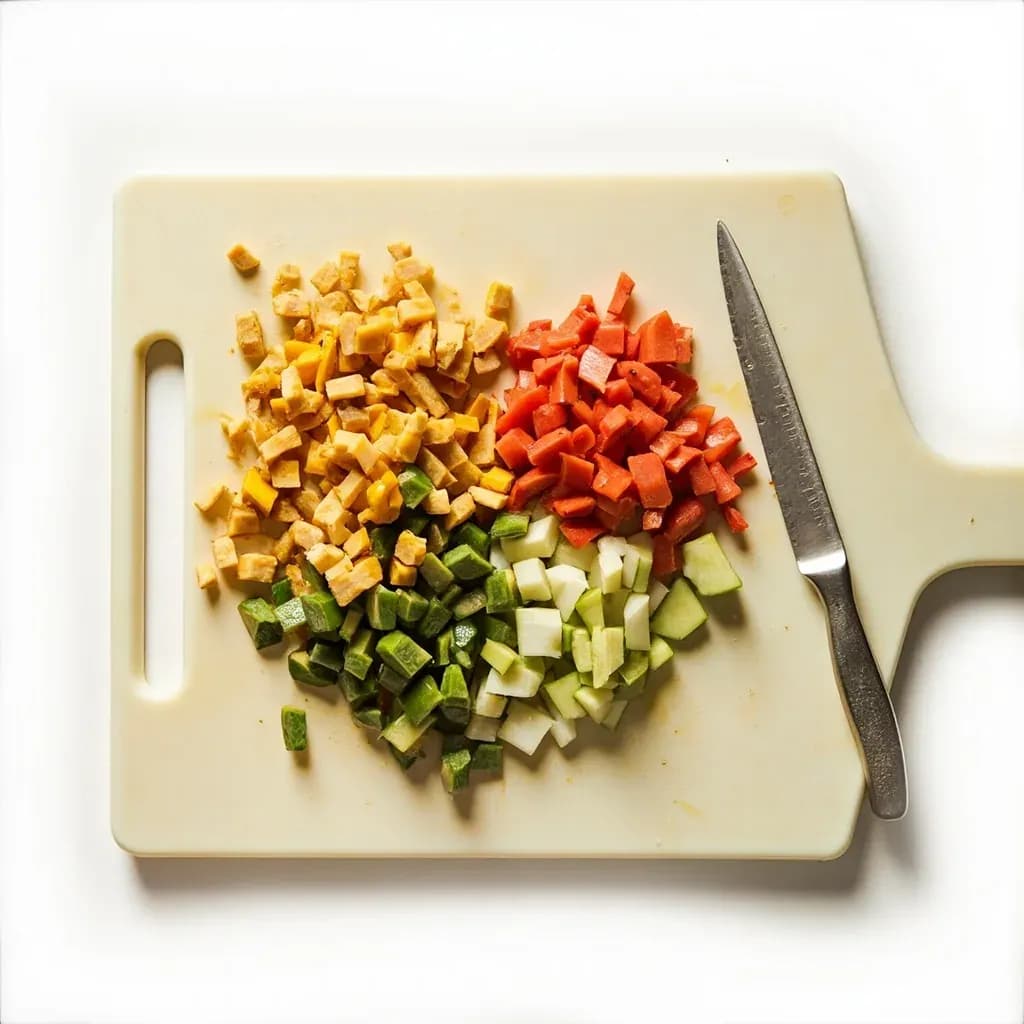
Chopping is the everyday knife action of cutting food into pieces that are roughly the same size but not precisely uniform, faster and looser than dicing. It's used when exact shape doesn't matter, such as a rough chop of vegetables headed for stock or a blended sauce. Different traditions chop with a Western chef's knife, a Bengali bonti floor blade, or a heavy cleaver.
Chopping is the workhorse cut of the home kitchen — the everyday stroke you'll perform more than any other, in which a sharp blade is rocked through food to produce pieces of broadly similar size but deliberately irregular shape. Unlike a dice or a brunoise, a chop doesn't ask for uniformity; it asks for speed and for pieces that are "roughly the same," which is exactly why it suits the long list of jobs where the food will cook down, dissolve, or be hidden in a sauce.
The cut matters because it sets the pace of your prep. Most recipes that call for a chopped ingredient — onions for a mirepoix, carrots for a stock, tomatoes for a long-simmered ragù — don't care whether every piece is identical; they care that the pieces are small enough to release flavor at the right rate and large enough to hold some texture. The rocking motion at the heart of a chop is also the motion that builds speed: once the tip stays anchored and the heel rises and falls, you can feed food forward in a rhythm that doubles or triples the pace of a straight up-and-down chopping stroke.
In practice, chopping lives on a spectrum from rough to fine. A rough chop of 1–2 inch hunks goes into stock pots and braises where the food will disappear; a fine chop approaching ¼ inch borders on a mince and is what you want for shallots in a vinaigrette or garlic headed into a quick sauté. Reading the recipe's context — how long the food will cook, whether it should hold shape on the plate — tells you where on that spectrum to land.
- Difficulty
- Easy
Types & varieties
Large, very irregular pieces, 1–2 inches; for stocks, broths, and long-cooked stews where the food softens and disappears into the liquid.
Medium irregular pieces, about ¾ inch; common for soups, braises, and roasted vegetables where some texture remains.
Roughly ½ inch irregular pieces; the everyday default for mirepoix-style prep, sautés, and sauces.
Smaller pieces, around ¼ inch, approaching a mince; for shallots in vinaigrette, garlic for quick sautés, and garnishes.
A double-knife or mezzaluna technique for piles of herbs, parsley, or chives; the rocking blade is sometimes applied directly to the herbs in a bowl.
How to do it
- 1
Set up your station
Place a damp towel or non-slip mat under a stable cutting board. Select a sharp chef's knife (8–10 inch). Make sure the cutting area is dry and clear of clutter.
- 2
Square up the food
Round or wobbly items (onions, zucchini, potatoes, butternut squash) get an initial flat cut on one side so they sit flush on the board. For long items like leeks or celery, line them up parallel to the edge of the board.
- 3
Adopt the claw and grip
Curl the fingers of your non-dominant hand into a claw, knuckles forward, thumb tucked behind. Pinch the blade between thumb and forefinger just ahead of the bolster, and wrap the remaining three fingers around the handle.
- 4
Anchor the tip and rock
Rest the tip of the knife on the board. With a smooth up-and-down rocking motion, raise and lower the heel of the blade while the tip stays put. Let the edge slice through the food; the knife should glide rather than be forced.
- 5
Feed and re-gather
Slide the food forward with the guiding claw in small increments. After every few strokes, use the flat of the blade to scoop the cut pieces back into a tight mound so the next cuts hit a clean target.
- 6
Check size and finish
Scan the pile. Pieces clearly larger than the rest get a single pass through the knife to bring them down. Don't try to make them identical — uniform shape is the job of a dice, not a chop.
- 7
Scoop and transfer
Slide the flat of the blade under the pile, support it with the guiding hand if needed, and carry the food directly to the pot, pan, or bowl.
Reading the recipe: rough vs. fine
The distinction that matters most in practice is where on the spectrum the recipe needs you to land. A chop headed into a stock pot, a long-braised ragù, or a chicken that will simmer for 90 minutes can be generous and rough — 1 to 2 inch pieces — because the food will break down on its own and you want enough bulk to release flavor gradually. A chop destined for a 30-second sauté, a pan sauce, or anything that will be tasted in its own right (a salsa, a garnish, an omelet filling) needs to be finer, in the ¼ to ½ inch range, so the pieces cook through and meld with the other ingredients rather than sitting in the pan as raw chunks.
- Long simmer (45 minutes or more): rough chop, 1–2 inches, no need for precision.
- Medium cook (15–45 minutes, like a braise or roast): coarse chop, about ¾ inch.
- Quick cook (under 15 minutes): standard to fine chop, ¼–½ inch, so pieces soften in time.
- Raw or barely cooked (salsas, garnishes, vinaigrettes): fine chop, approaching a mince, for even distribution.
Chop vs. dice
In a professional kitchen the line between 'chopped' and 'diced' is enforced because uniform pieces cook at the same rate and look the part on the plate. In home cooking, a chop's irregularity is rarely a problem and is often a virtue: it gives rustic texture to stews, allows larger pieces to soften while smaller ones break down into the sauce, and saves the time you would spend aiming for perfect cubes. Reach for a dice when the food is the visual center of the dish (a vegetable garnish, a composed salad, a brunoise-topped soup) or when uneven cooking would be a real flaw (a quick sauté of dense vegetables like carrots).
Common uses
Tips & pitfalls
- Sharpen the knife before you start; a sharp edge slides through onion skin and tomato flesh instead of crushing it, and a dull blade is the single most common cause of cut fingers.
- Plant the tip on the board and rock rather than lift; a true chop is a controlled rocking motion, not chopping up and down off the surface.
- Curl your fingertips into a claw so the knuckle — not the fingertip — guides the blade.
- Square up round items (onions, potatoes, butternut squash) with a flat cut first so they sit stable and don't rock under the knife.
- Sweep the cut pieces back into a tight mound after every few strokes; scattered pieces are the main reason home cooks slow down and lose control of size.
- Use a wide blade to scoop and transfer in one motion; a long, thin slicing blade makes this awkward and tends to send pieces skittering off the board.
- Don't chase a perfect dice — a chop is meant to be irregular; over-correcting slows you down and often causes more waste than it saves.
- If a recipe says 'chopped' without further detail, assume a coarse to standard chop (½–¾ inch) unless context — a quick sauté, a raw garnish — suggests otherwise.
Good to know
- Definition
- A basic knife cut producing rough, irregular pieces, generally ½ to 1 inch, with no requirement for uniform shape or size.
- Knife used
- Chef's knife (8–10 inch blade); a santoku works well too; a wide blade makes scooping the cut food easier.
- Typical motion
- Rocking stroke with the knife tip acting as a pivot on the board while the heel rises and falls — the workhorse movement of everyday prep.
- Piece size range
- Roughly ½ to 1 inch for a standard chop; rough or rustic chop reaches 1–2 inches; fine chop approaches ¼ inch, where it borders on mincing.
- Skill level
- Beginner-friendly; one of the first knife skills taught because precision is forgiving and speed builds quickly.
- Related cuts
- Brunoise and small/medium/large dice are uniform versions; chiffonade is the equivalent for leafy greens and herbs; paysanne is a flat rustic slice.
- Board
- Wood or high-density plastic, large enough to keep the knife fully on the surface; place a damp towel or non-slip mat under the board for stability.
- Safety note
- A sharp knife is safer than a dull one: it slices cleanly rather than skating off the food or requiring force.
Also called
Chop (Tagliare) · Rough Chop · Hand-Chopping
Dishes that rely on it
Related

Chop
Cut into rough, irregular pieces — the everyday workhorse cut

Dice
Cut into uniform cubes for even cooking and a tidy look

Mince
Cut as fine as possible so flavor melts evenly into the dish

Slice
Cut into even, flat pieces for consistent cooking and presentation

Julienne
Cut into thin matchsticks for fast cooking and elegant garnish

Brunoise
Cut into tiny, precise cubes — the finest dice in the kitchen

Chiffonade
Roll and slice leafy greens into delicate ribbons

Batonnet
Cut into tidy sticks, thicker than julienne — think classic fries