Prep & Assembly
Refining (Grinding)
Grinding chocolate or paste to a fine particle size so it feels smooth rather than gritty.
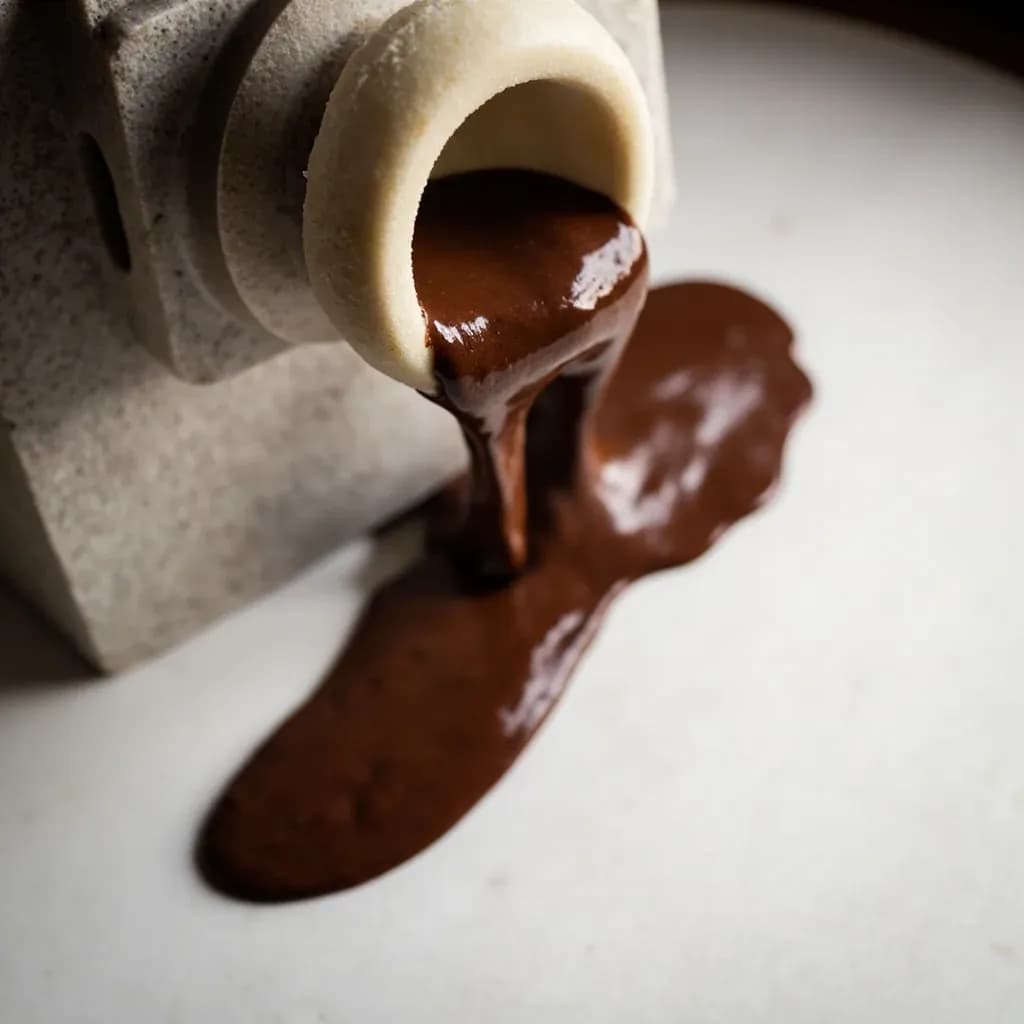
Refining grinds an ingredient, most often chocolate, between rollers or in a stone melanger until the particles drop below the threshold the tongue can detect. This produces a silky, smooth mouthfeel and is essential in bean-to-bar chocolate and nut butters. Refining is usually paired with conching, which further develops flavor and texture over many hours.
Refining is the mechanical reduction of solid particles in a fat-rich paste to a size below the threshold of human perception. In chocolate, nut pastes, and similar confectionery work, "refining" means driving particle size down to roughly 20–30 microns — fine enough that no individual grit can be felt on the tongue or seen as speckle on a finished surface. The work is done by shearing the material between stones, rollers, or beads until every cocoa nib, nut fragment, or sugar crystal has been broken to a uniform, sub-sensory size. It is the step that turns a coarse cocoa-and-sugar slurry into a paste that can be conched, tempered, and set into glossy chocolate.
The reason refining matters is sensory. Human tooth enamel and palate papillae register particles above about 25–30 microns as individual grits; the eye sees them as a dull or speckled surface on a finished bar or bonbon. The 30-micron target that has been the chocolate industry's working standard since the mid-19th century was set empirically by sensory testing and refined alongside the development of the roller refiner. Go too coarse and the chocolate feels sandy; go too fine (below roughly 15 microns) and the surface area becomes so vast that the cocoa butter cannot fully coat each particle, producing a chalky, dry, "floury" bar that melts slowly and feels heavy on the palate. The window is narrow, and staying inside it is the entire point of the step.
Refining is not the same as conching. Conching — Rodolphe Lindt's 1879 invention — is a separate, subsequent step that works on already-refined chocolate to drive off volatiles, round out flavor, and bring the cocoa butter into a fluid, workable state. Some small-batch machines (notably stone melangers run for many hours) blur the two stages by grinding and agitating simultaneously, which is acceptable for craft work but obscures what each step is contributing. Knowing where refining ends and conching begins is the difference between a maker who can troubleshoot texture and one who cannot.
- Difficulty
- Hard
Types & varieties
Slow, continuous grinding between two granite or natural-stone wheels; the craft standard for chocolate and nut pastes, producing very fine, rounded particles.
Sequential steel or ceramic rollers spinning at increasing speeds; the industrial standard, with tight control of particle size.
Rotating drum charged with steel or ceramic beads; efficient for large batches and very low particle size, common in industrial chocolate and compound coatings.
Refining a pre-cooked fruit or sugar paste with added water or syrup to keep friction low and prevent scorching or sticking; standard for fruit purées and pâte de fruit bases.
Used for sugar, salt, and dry spices; a mill or mortar reduces the material to a fine, even powder without added fat or liquid.
How to do it
- 1
Prepare the material
Roast, crack, or otherwise break the ingredient down to a coarse, uniform size — roughly 3–5 mm. Remove skins, shells, and fibrous material. For chocolate, pre-blend roasted cocoa nibs with sugar and cocoa butter into a coarse paste so the refiner is not asked to break whole nibs.
- 2
Set up the refiner
Choose the equipment for the job: a melanger for slow, fine craft work; a three-roll mill for fast, controlled production; a ball mill for high-volume fine grinding. Bring the machine to temperature and pre-coat the rollers or stones with a thin film of the same material to prevent contamination and slippage on the first pass.
- 3
First pass (coarse reduction)
Feed the pre-mixed material in slowly. On a roll mill, set the rollers wide and run one or two passes. In a melanger, let the stones do their work for the first 6–12 hours without scraping — coarse material needs contact time with the grinding surface to break down.
- 4
Tighten and refine further
On a roll mill, decrease the roller gap after each pass (typically 3–5 passes total). In a melanger, continue grinding for 24–48 hours. Scrape down the sides and base every 4–6 hours and return the material to the grinding zone — fine material hides there and stalls the process if left.
- 5
Monitor temperature
Check the mass every pass or every few hours. If temperature climbs above ~45 °C (113 °F) for chocolate or nut pastes, pause and let the machine cool, or reduce feed rate. Excessive heat melts cocoa butter prematurely, creates a greasy inefficient grind, and can drive off volatile flavors you want to keep.
- 6
Check particle size
Use the rub test (a small sample rubbed between thumb and forefinger until no grits remain), a micrometer or laser particle-size analyzer for precision, or sieve through a 75-micron (200-mesh) screen. Acceptable for chocolate: nothing left on the screen and no perceptible grits between the fingers.
- 7
Discharge and proceed
Scrape the refined material from the rollers, drum, or stone basin. Transfer immediately to the next stage — conching in chocolate, or tempering and setting for pastes. Seal airtight if storing: finely ground chocolate and nut pastes pick up moisture and ambient odors very quickly.
Refining vs. Conching
These two steps are often conflated, especially in craft chocolate, but they do different things and should be understood separately. Refining is a size-reduction problem: breaking solid particles down until none are perceptible. Conching is a flavor and rheology problem: agitating refined chocolate, usually warm, for hours or days so that volatile acids and moisture escape, flavors round out, and cocoa butter coats every particle to give fluidity and gloss. Lindt developed the conche specifically to work on chocolate that was already refined — without fine particles to begin with, conching has little to improve. A long melanger run smudges the two stages together, which works at small scale, but a chocolate maker who wants to fix a grainy bar or a dull finish needs to know which step is at fault.
Choosing equipment
Match the machine to the batch size, the material, and the precision you need. Roll refiners and ball mills are fast, repeatable, and give the tightest particle-size control, but they are industrial investments. Stone melangers are the craft workhorse: slow, gentle, and forgiving, and they refine while also beginning the conching work. A high-power food processor can refine nut pastes to an acceptable 25–30 microns for home use, though it will not reach the fine end of the range. For dry materials (sugar, spices), a dedicated dry mill, blade grinder, or mortar and pestle is the right call — adding fat to dry refining is what turns it into chocolate refining.
- Roll mill: industrial chocolate, tight control, fast
- Stone melanger: craft chocolate, nut pastes, small batches
- Ball mill: large batches, very fine target sizes
- Food processor (heavy blade): home nut butters and coarse pastes
- Dry mill or mortar: sugars, salts, spices
Common uses
Tips & pitfalls
- Do a 'rub test' — rub a small sample between thumb and forefinger; when it feels completely smooth with no grits, refining is done
- Target roughly 30 microns for everyday dark chocolate; aim for 20–25 microns for premium or single-origin bars
- Keep the mass below ~45 °C (113 °F) during refining, or cocoa butter will smear and the mill will lose efficiency
- In a home melanger, scrape down the edges and under the stones every 4–6 hours — fine material hides there and stalls the grind
- Pre-crush or pre-mix to a coarse paste (5 mm or smaller) before loading the refiner; this dramatically reduces total refining time
- Don't over-refine — chocolate below about 15 microns loses its quick melt and tastes powdery and dry
- Sieve through a 75-micron (200-mesh) screen as a final check; residue on the screen means you need another pass
- For nut pastes, add 5–10% of the nut's weight in cocoa butter or neutral oil to keep the mass fluid and the mill cool
- Clean the refiner thoroughly between batches — cross-contamination is the single most common cause of off-flavors
- Avoid adding liquid at room temperature mid-refining in chocolate; sudden moisture causes the mass to seize on the rollers
Good to know
- Target particle size
- 25–30 microns; 20–25 microns for premium or single-origin chocolate
- Sensory detection threshold
- Particles above ~25–30 microns read as gritty or sandy on the palate
- Over-refining threshold
- Below ~15 microns chocolate feels floury, chalky, and slow to melt
- Standard equipment (pro)
- Two- or three-roll refiner, ball mill, stone melanger, wet grinder
- Standard equipment (home)
- Premier or Spectra stone melanger, high-power food processor, wet-grinder attachment
- Working time
- 12–72 hours in a melanger; minutes per pass on a three-roll mill (3–5 passes typical)
- Heat risk
- Friction can push temperature above 45 °C (113 °F), melting cocoa butter or releasing nut oils
- Historical origin
- Roller-refined cocoa liquor was patented by Joseph Storrs Fry II in 1864; the method was refined through the 1880s
Also called
Grinding · Particle Refining · Melanging
Dishes that rely on it



Related

Whisk
Beat ingredients smooth and aerated with a looping wire motion

Sift
Pass dry ingredients through mesh to aerate and remove lumps

Strain
Pour through mesh to separate solids from liquid for a smooth result

Filter
Pass liquid through fine material to clarify out the smallest particles

Rice
Press cooked potatoes through small holes for fluffy, lump-free texture

Mash
Crush soft cooked food into a rustic, creamy purée

Grind
Crush food into a coarse to fine texture, from spices to meat

Grate
Shred food into fine bits against a sharp-toothed surface