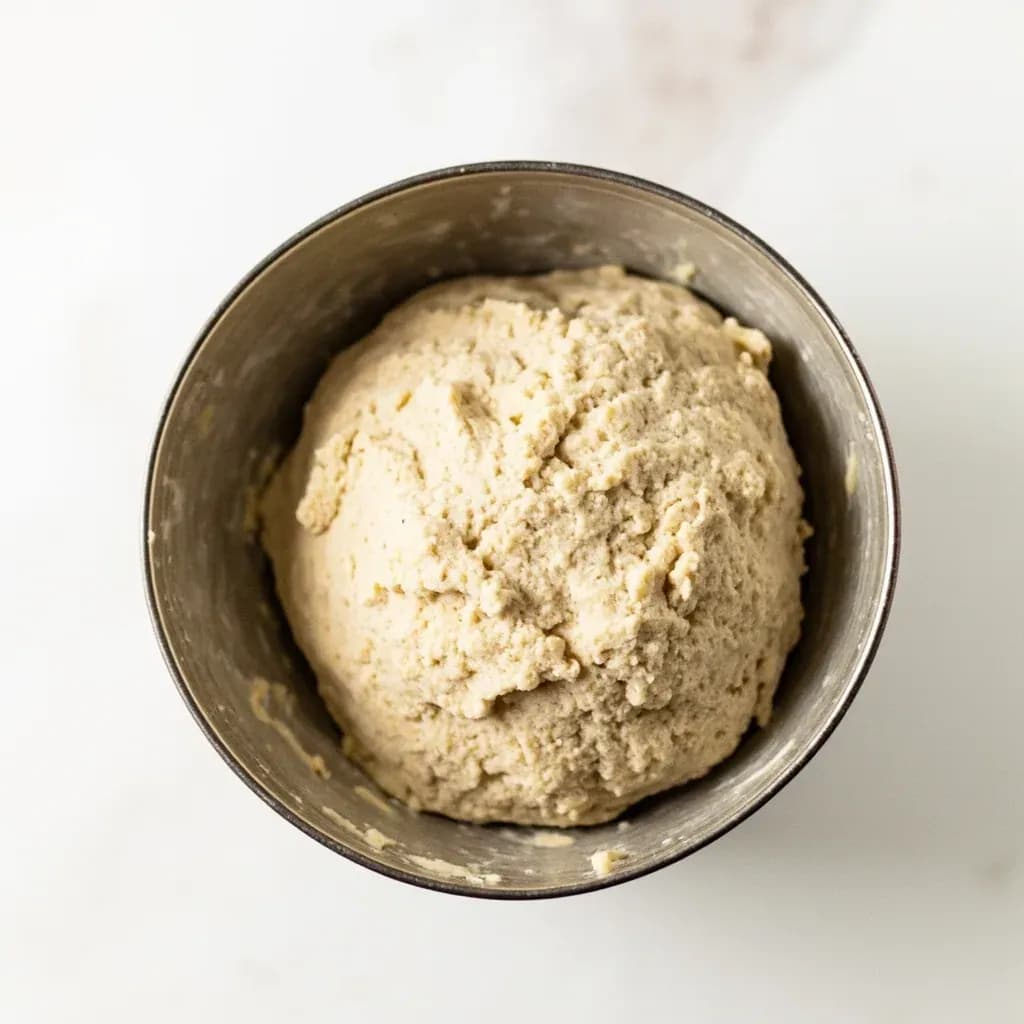
Prep & Assembly
Hydration Adjustment (Bassinage)
Tuning dough water content, including adding water late via bassinage, to control texture and crumb.
Hydration adjustment manages the ratio of water to flour in a dough, expressed as baker's percentage, to dial in the final crumb and handling. Bassinage is the technique of withholding some water and mixing it in after the gluten has developed, allowing wetter, more open doughs without losing structure. Bakers tweak hydration to suit flour strength, climate, and the bread style they want.
Hydration adjustment is the deliberate control of a dough's water-to-flour ratio throughout mixing, with bassinage being the specific French convention of holding back a portion of the formula water and adding it late. The technique is what separates doughs you can shape from doughs that pool on the bench, particularly as hydration climbs past 65%. In practice, it lets the baker reach a final hydration of 65–85% without ever passing through a sticky, unworkable intermediate stage.
The underlying logic is straightforward: flour absorbs water unevenly and gluten organizes gradually. Front-loading all the water produces a slack, shaggy mass before the protein network has developed enough to carry it. By reserving 10–30% of the water and adding it after the gluten has begun to set, the baker gives the dough a window to strengthen at a manageable stiffness, then raises hydration in controlled steps to the final target. Bassinage also doubles as a safety valve against flour-batch variability — different mills, harvests, and storage conditions change absorption rates, and holding back the last 5–10% of water lets you finish by feel rather than by formula.
The method is the default in most artisan boulangeries for any dough above roughly 65% hydration — baguettes, ciabatta, focaccia, pain de campagne, and high-percentage sourdoughs. It is often skipped for home pan loaves because lower-hydration doughs tolerate all-at-once mixing, but for any bread where crumb openness and a glossy, extensible dough are the goal, late water addition is the standard professional approach.
- Difficulty
- Medium
Types & varieties
Hold back ~10–15% water; dough finishes around 65% hydration for an open but manageable crumb.
Hold back 20–30% water to reach 75–85% hydration; relies on a wet, bubbly dough and long folds.
Combine with a rye or whole-wheat soaker; add reserved water after the initial mix to soften bran.
Used in viennoiserie doughs (croissant, brioche) when butter integration and tight final hydration matter; reserved water is added before butter incorporation.
Substitute ice water for the late addition to pull dough temperature down in warm kitchens.
How to do it
- 1
Calculate and reserve
Decide the target baker's percentage hydration for the final dough. Total the formula water, then weigh out 10–30% of that water into a separate container and set it aside. Keep it cold if dough-temperature control matters.
- 2
Build the initial dough
Combine flour, salt, yeast or levain, and the remaining 70–90% of the water in the mixer bowl. Mix on low just until no dry flour remains — a shaggy, slightly stiff mass is the goal.
- 3
Develop gluten briefly
Run the mixer on second speed for 2–4 minutes (or perform a few stretch-and-folds by hand) until the dough forms a cohesive ball and clears the sides of the bowl. It will still feel firm compared with the final target.
- 4
Begin the bassinage
Drop to first speed. With the mixer running, slowly stream in roughly half of the reserved water. Let the dough absorb it fully — it will sag, look glossy, and may briefly tear before coming back together.
- 5
Pause and assess
Stop the mixer. Scrape down the hook and bowl. Pinch a piece of dough: it should feel tacky but extensible, not crumbly. If it is still tight, continue; if it is already at the feel you want, hold the rest of the water back.
- 6
Add the remaining water in stages
Stream in the rest of the reserved water in two more pours, mixing on low for 30–60 seconds between each. Wait until each addition is fully incorporated — no puddles, no dry pockets — before adding the next.
- 7
Finish and verify
Mix briefly on second speed to a smooth, soft, slightly sticky dough. Do a windowpane test: a thin membrane should stretch without tearing, indicating the gluten can now support the higher hydration.
- 8
Adjust if needed
If the dough is still stiffer than the target, add water a tablespoon at a time. If it has gone too slack, dust the work surface with a small amount of flour during the first fold — but do not knead extra flour in, as it disrupts the hydration balance.
Reading the Dough Through Bassinage
Late water addition is as much an observation exercise as a mixing step. The baker is reading the dough at every pour, and the reserved water is the tool that lets the formula respond to what the dough is actually doing. The cues below are what separate a textbook bassinage from one that lands the target hydration on the nose.
- Look at the bottom of the bowl, not just the top surface — a dough that looks hydrated on top can still have dry flour clinging to the bottom of the hook path.
- When the dough begins to clear the sides but still clings slightly to the bottom, it is ready for the first reserved-water pour.
- If the dough tears and streaks instead of stretching as water goes in, stop and rest 5 minutes — the gluten has not yet caught up with the hydration.
- A properly bassinaged dough will feel tacky but extensible, and a small piece will stretch thin enough to read light through without breaking (the windowpane test).
- The last 5% of reserved water is the insurance — add it only after the dough has been pinched, stretched, and judged at the bench.
Common uses
Tips & pitfalls
- Weigh, do not measure: hydration is a ratio, so volumetric water will throw the calculation off.
- Hold back more water than you think you need — it is far easier to add the last 5% than to flour a dough that has gone slack.
- Add the reserved water in two or three small pours rather than one splash; the dough needs time to accept it.
- Run the mixer on the lowest speed during bassinage; high speed whips in air and overheats the dough.
- Use bassinage as a temperature tool: swap tap water for ice water in summer to keep the final dough at 24–26°C / 75–78°F.
- Don't conflate bassinage with autolyse: autolyse is a no-knead rest of flour and water before salt and yeast are added; bassinage is the late water addition that takes the dough to its final hydration.
- Common mistake: adding the reserved water too early, before the gluten network can carry the extra moisture — you'll get a sticky, slack dough that tears.
- Common mistake: treating bassinage as a license to ignore flour strength — weak flours still need a lower final hydration to hold shape.
Good to know
- French term
- Bassinage (the act of moistening / adding water late)
- Also called
- Late water addition, reserved-water method
- Primary use
- High-hydration bread and viennoiserie doughs
- Typical hydration range
- 65–85% baker's percentage (final dough)
- Water held back
- Roughly 10–30% of total formula water, depending on target hydration
- Mixer speed for addition
- Low (first speed on a spiral) so the dough can absorb gradually
- Pairs with
- Autolyse, stretch-and-fold, slap-and-fold
- Difficulty
- Beginner to intermediate; mostly a matter of timing and observation
- Time cost
- Adds 2–10 minutes of mixing and a short rest to the schedule
Also called
Hydration Control · Hydration Calculation (Baker's Percentage) · Bassinage · Double Hydration
Dishes that rely on it

Related

Whisk
Beat ingredients smooth and aerated with a looping wire motion

Sift
Pass dry ingredients through mesh to aerate and remove lumps

Strain
Pour through mesh to separate solids from liquid for a smooth result

Filter
Pass liquid through fine material to clarify out the smallest particles

Rice
Press cooked potatoes through small holes for fluffy, lump-free texture

Mash
Crush soft cooked food into a rustic, creamy purée

Grind
Crush food into a coarse to fine texture, from spices to meat

Grate
Shred food into fine bits against a sharp-toothed surface