Transform & Preserve
Jam & Jelly Setting
Boiling fruit, sugar, and pectin to the gel point so a preserve sets to a spreadable consistency.
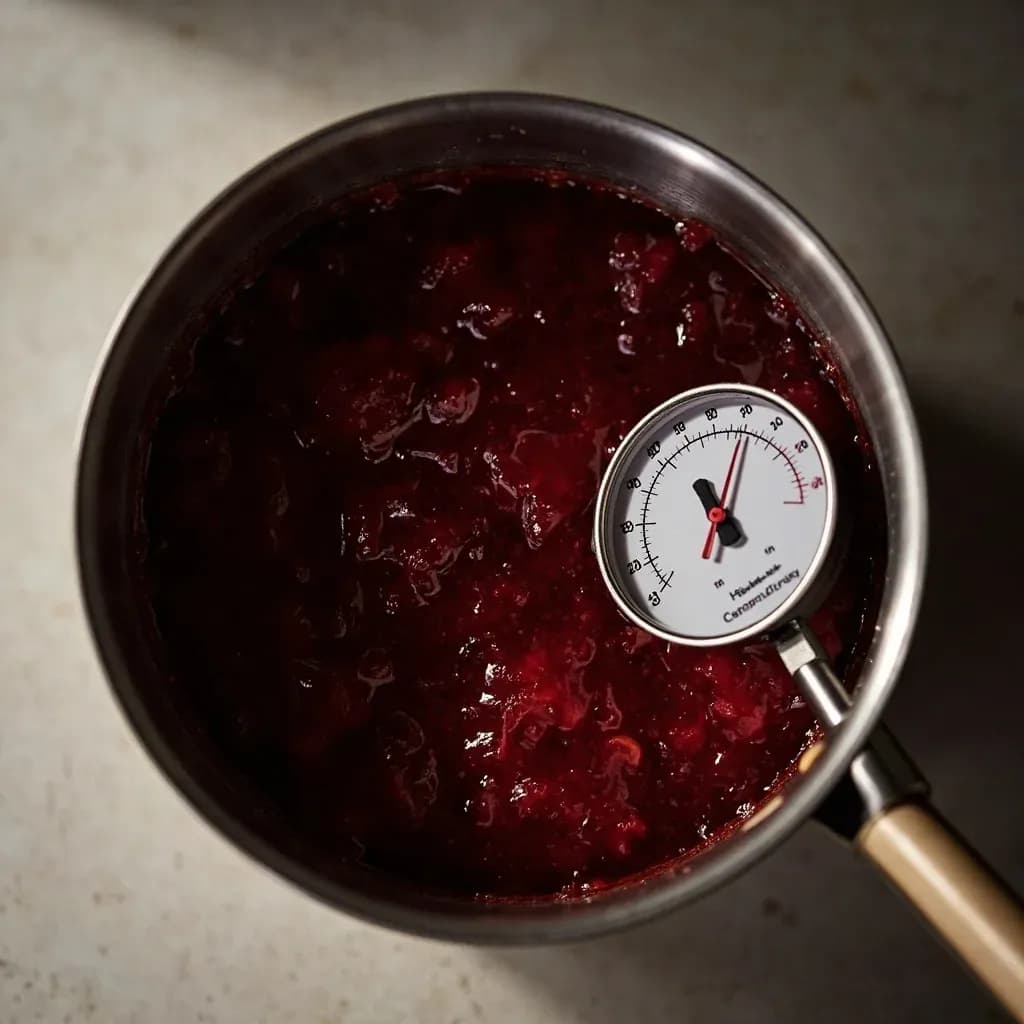
Jam and jelly setting boils fruit and sugar, sometimes with added pectin, until it reaches the setting point where pectin, acid, and sugar form a gel. The mixture is taken to about 105 degrees Celsius or tested with a cold-plate wrinkle test to confirm it will firm up on cooling. Hitting the right point is crucial, since undercooked preserves stay runny and overcooked ones turn rubbery.
Jam and jelly setting is the controlled cook that transforms fruit, sugar, and pectin into a stable gel — the structural trick that turns a saucepan of loose fruit juice into something that holds its shape on toast. The gel forms when pectin molecules, a soluble fiber naturally present in fruit, link together in a three-dimensional web that traps water and suspended fruit solids. That linkage only happens under specific conditions: enough pectin, enough acid (a pH between roughly 3.0 and 3.5), and enough sugar to compete for the available water. Cook the fruit too little and the web never forms; cook it too long and heat hydrolyzes the pectin back into a dark, stiff syrup that has lost its set.
The cook itself is short — usually 20 to 45 minutes of hard boiling for a 4- to 6-jar batch — and is governed by a single physical event: reaching the gel point, about 220°F / 104°C at sea level. That temperature is the only objective signal a home cook has, because pectin gels look almost identical to non-gelling syrup until they cool. Everything else — fruit selection, sugar level, lemon juice, jar preparation — is groundwork for that moment.
Done well, a homemade preserve captures ripe fruit in a way no commercial jar can: brighter color, sharper fruit flavor, and a softer, more spreadable set. Done badly, it either runs off the bread or shatters when you try to spread it. The difference is almost always technique, not ingredients.
- Difficulty
- Medium
Types & varieties
Crushed or chopped fruit cooked with sugar and pectin; opaque, with fruit pieces suspended in a soft gel.
Made from strained, clarified fruit juice; clear and firm, with no fruit solids.
Whole or large pieces of fruit suspended in a light gel; looser set than jam, with more intact fruit.
Jam-like preserve made with two or more fruits, often including dried fruit, citrus, and nuts.
Citrus-based preserve that includes sliced peel suspended in a clear gel.
Fruit pulp cooked down with sugar until thick and spreadable; smooth, not gelled.
Savory preserve of fruit, vinegar, sugar, onion, and spices; loose, not gelled.
Uses no- or low-cook pectin with raw or briefly cooked fruit; sets in the refrigerator or freezer, not by boiling.
How to do it
- 1
Prepare fruit and equipment
Wash, hull, peel, and pit fruit as needed; measure by weight, not volume. Sterilize jars by simmering in a water-bath canner for 10 minutes (or holding in a 225°F oven for 10 minutes) and keep them warm. Have lids, a wide-mouth funnel, a ladle, and a slotted spoon at the ready. Lay a metal plate or two in the freezer for the wrinkle test.
- 2
Combine fruit, sugar, acid, and pectin
For low-pectin fruits (strawberry, peach, blueberry, cherry, rhubarb), pre-mix commercial pectin with about a quarter of the sugar and stir it into the fruit before adding the rest. For high-pectin fruits (apple, quince, currant, gooseberry, citrus), pectin can be omitted entirely. Add 1–2 tablespoons of lemon juice per pound of fruit to bring the pH into the gelling range — especially important for sweet, low-acid fruits like strawberries and peaches.
- 3
Bring to a full rolling boil
Heat over medium-high, stirring to dissolve the sugar and prevent scorching on the bottom. Once the mixture boils, raise the heat and maintain a vigorous rolling boil that cannot be stirred down. This fast evaporation is what concentrates the pectin and sugar to the gel point without overcooking the fruit's aromatics.
- 4
Cook to the gel point
Boil for the time specified in the tested recipe, usually 10–25 minutes after the sugar goes in. Watch the thermometer for 220°F / 104°C at sea level and hold it there for one full minute. Confirm with the cold-plate test: a drop on the chilled plate that, after a minute in the freezer, wrinkles when you push it with a fingertip is set.
- 5
Skim foam and rest
Pull the pot off the heat. Skim the pinkish surface foam with a slotted spoon (a small knob of butter, about ½ teaspoon, stirred in at the boil also suppresses foam). Let the jam stand 5 minutes so that suspended fruit pieces distribute evenly through the gel before you jar it — pouring immediately leaves the fruit piled at the top.
- 6
Fill jars and seal
Ladle the hot jam into warm sterilized jars, leaving ¼-inch headspace. Wipe the rims with a damp cloth — any sugar residue will prevent a seal — then apply lids and screw on the rings just finger-tight. For shelf-stable storage, process in a boiling water-bath canner for 5–10 minutes (longer above 6,000 ft elevation). For refrigerator jam, cool to room temperature, lid, and use within 3 weeks.
- 7
Cool, check seals, and label
Let the jars rest undisturbed for 12–24 hours. Press the center of each lid — it should not flex or pop. Remove the rings, wipe the jars, and label with fruit and date. Store sealed jars in a cool, dark pantry; refrigerate any that did not seal and use those first.
Pectin, Acid, and Sugar: How the Gel Forms
Two structurally distinct pectins do the work, and matching the right one to your recipe is the single biggest decision you make before the pot goes on the stove.
- High-methoxyl (HM) pectin — the standard in Sure-Jel, Certo, and classic Ball recipes — sets only when both sugar (at least 55% of the final weight) and acid are present. This is why lemon juice is added to low-acid fruits, and why HM-pectin jams cannot be made with significantly less sugar.
- Low-methoxyl (LM) pectin (Pomona's and other calcium-activated pectins) sets with calcium ions instead of sugar, making it the right choice for reduced-sugar, honey-sweetened, or savory preserves.
- Naturally occurring pectin concentration varies sharply by fruit. Apples, crabapples, quince, currants, gooseberries, and citrus (especially the white pith and seeds) are high in pectin; strawberries, cherries, blueberries, peaches, rhubarb, and figs are low and almost always need added pectin or a high-pectin fruit blended in.
- Acid is non-negotiable for HM pectin. Lemon juice or citric acid lowers the pH into the 3.0–3.5 window where pectin molecules can cross-link. Without it, even a sugar-rich mixture will stay syrupy.
- Overcooking is the silent gel-killer: extended boiling hydrolyzes pectin, breaking the very bonds you spent the cook trying to form. Undercooking is the more common beginner mistake, but a long, slow boil past the gel point is the surer route to a stiff, dark jam that has lost its spreadability.
Reading the Set
Temperature is the most reliable indicator, but it pays to confirm with a second test because thermometers drift and recipes vary.
- Thermometer test: 220°F / 104°C at sea level, adjusted for altitude. The mixture should register on the thermometer for one full minute to be sure you are not reading a passing bubble.
- Cold-plate wrinkle test (the home cook's gold standard): drop ½ tsp of boiling jam onto a metal plate that has been in the freezer. Return to the freezer for 60 seconds, then push the puddle with a fingertip. A set jam wrinkles and holds its shape; an unset one runs back together like syrup.
- Sheet or flake test off a chilled metal spoon: dip a cool spoon, let the jam sheet off the edge, and watch the drops. Two drops that merge and sheet off as one flake signals a set; drops that fall separately mean keep cooking.
- When in doubt, take the pot off the heat while you test — every extra minute above the gel point costs flavor and color.
Common uses
Tips & pitfalls
- Use a wide, heavy-bottomed 8- to 10-quart pot — more surface area means faster evaporation, brighter color, and a fresher fruit flavor than a tall, narrow saucepan can deliver.
- Do not double a jam recipe; pectin will not set reliably in an oversized batch because the proportions of acid, sugar, and pectin to fruit change. Make two small batches instead.
- Choose ripe-but-firm fruit: under-ripe fruit can turn gummy, while over-ripe fruit has lost pectin and acid and will struggle to set.
- Stir gently and constantly toward the end of the cook — once the mixture is mostly sugar, the bottom of the pot scorches in seconds.
- If the jam is under-set, do not throw it out; re-cook it within 24 hours with a squeeze of lemon juice and another teaspoon of pectin. Over-cooked jam is stiff and dark but perfectly safe to eat.
- Match pectin type to your sugar level: HM pectin needs the full sugar, while Pomona's or other LM pectins are made for low-sugar and honey-sweetened preserves.
- Label jars with the date and fruit — color and flavor fade noticeably after about a year of pantry storage, even in a properly sealed jar.
- Pour hot jam into warm jars, not cold ones; a cold jar hitting the hot mixture can crack the glass and break the seal.
Good to know
- Gel point at sea level
- 220°F / 104°C — about 8°F above the boiling point of water
- High-altitude adjustment
- Subtract roughly 2°F per 1,000 ft above 2,000 ft elevation; water boils at a lower temperature
- Required acidity
- pH between roughly 3.0 and 3.5 for high-methoxyl pectin to gel
- Typical ratio
- About 1 part sugar to 1 part prepared fruit by weight for traditional cooked jam
- Yield
- Roughly 1 cup finished jam per cup of prepared fruit
- Active time
- 20–45 minutes of boiling for a small batch (4–6 half-pints)
- Storage (sealed, water-bath canned)
- 12–18 months in a cool, dark pantry
- Storage (opened or refrigerator jam)
- Up to 3 months refrigerated
- Difficulty
- Moderate — technique-dependent, but forgiving with a tested recipe and a thermometer
Also called
Bringing to Setting Point · Setting Point · Gelling
Related

Confit
Cook slowly submerged in fat for silky tenderness and keeping

Cure
Draw out moisture with salt and time to preserve and concentrate

Pickle
Steep in acidic brine for bright, tangy, crunchy preservation

Ferment
Let friendly microbes transform food into tangy, complex flavor

Marinate
Soak in a seasoned mix to flavor and tenderize before cooking

Brine
Soak in salt water so meat stays juicy and seasoned throughout

Dehydrate
Slowly dry out moisture to concentrate flavor and extend shelf life

Cold-Smoke
Perfume cured food with smoke without cooking it through