Heat & Fire
Pan-Cooking Fermented Batter (Canjeero/Kisra)
Spreading and cooking a thin fermented grain batter on a hot griddle into soft, spongy flatbread.
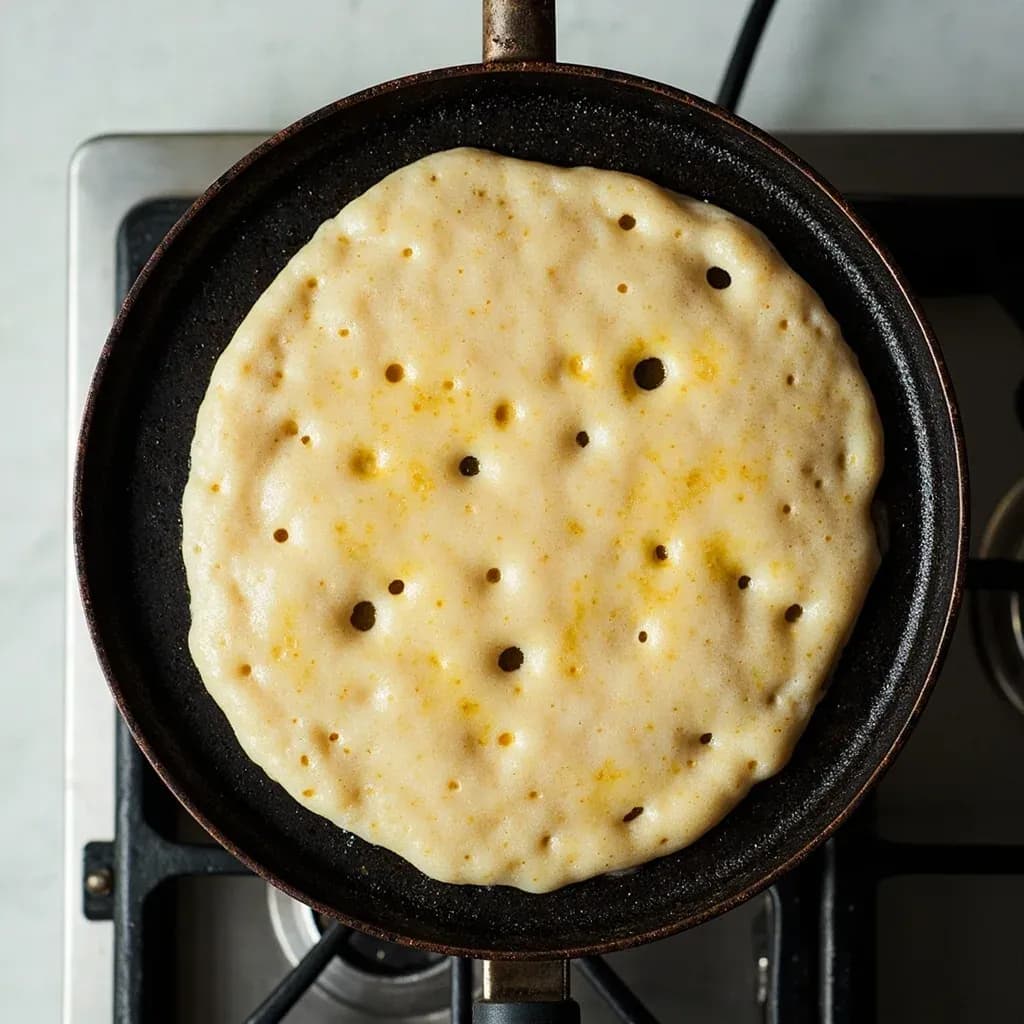
This technique pours and spreads a thin, naturally fermented batter onto a hot griddle to make spongy flatbreads like Somali canjeero and Sudanese kisra. The fermentation gives the bread a tangy flavor and an airy, hole-pocked surface as bubbles burst during cooking. The batter is cooked on one side only until set, producing a soft, pliable bread for scooping stews.
Pan-cooking a fermented batter produces a family of soft, tangy flatbreads from the Horn of Africa and southern Arabia — canjeero and lahoh on the spongy end, kisra on the thin end. The method looks like pancake or crêpe work, but the fermentation is doing real work: wild yeasts and lactobacilli produce gas and acid that lift the batter, sharpen flavor, and create the bread's signature texture. Cooking it on a hot, dry, ungreased griddle sets the underside while the top is either steamed under a lid (for the honeycomb style) or left open to dry into a flexible sheet (for the thin style).
The two outcomes hinge on a single decision at the stove. Trapping steam with a lid condenses water vapor onto the raw top, gelatinizing the starch and setting a network of air pockets — that is the honeycomb crumb of canjeero and lahoh. Leaving the pan open lets the top dry to a matte, pliable skin and keeps the bread thin and translucent at the edges, as with Sudanese kisra. Both are made from essentially the same batter; the difference is entirely in griddle handling.
The technique is sometimes confused with Ethiopian injera, but the resemblance is surface-level. Injera is made from teff, fermented longer and more aggressively for a much stronger sourness, and cooked into a single large bread. The breads here are smaller, milder, and the griddle work — especially steaming under cover — gives the technique its own character.
- Difficulty
- Medium
Types & varieties
Somali spongy flatbread made from wheat; soft, slightly elastic crumb with a honeycomb top. Eaten with stews, ghee, or honey.
Yemeni and Somali counterpart to canjeero; essentially identical method, sometimes slightly thicker and softer, traditionally served with a bowl of stew into which pieces are dipped.
Sudanese thin flatbread made from sorghum; one-sided cook on an ungreased griddle, pliable, used to scoop mullah (stews) or wrap ful.
Djiboutian and Somali variant very close to canjeero, often eaten at breakfast with butter and sugar or with savory stews.
How to do it
- 1
Mix a smooth, thin batter
Combine flour (wheat for canjeero/lahoh, sorghum for kisra) with water at roughly 1:1 by weight. Whisk until completely smooth — no lumps — then pass through a fine sieve. The consistency should be that of heavy cream: it coats a spoon but pours in a steady ribbon.
- 2
Ferment the batter
Cover loosely with a cloth (not an airtight lid) and leave at warm room temperature, 24–30°C, for 8–24 hours. The batter is ready when it smells gently tangy, shows small bubbles across the surface, and has increased in volume. For a faster ferment, stir in ¼ tsp active dry yeast per cup of flour.
- 3
Stir and adjust consistency
After fermentation, stir the batter gently to redistribute the bubbles — do not beat out all the air. If it has thickened, whisk in a tablespoon or two of water until it flows like cream again. Skim off any dark liquid that has pooled on top.
- 4
Heat an ungreased griddle
Place a flat griddle over medium heat and let it preheat for 3–4 minutes. Do not grease. Drop a teaspoon of batter in the center: it should sizzle softly, spread slightly, and begin to set at the edges within a couple of seconds.
- 5
Pour and spread thinly
Pour a ladle (60–90 ml) of batter onto the center. Working quickly, either tilt the pan in a circular motion or use the back of the ladle to sweep the batter into a thin round roughly 20–25 cm across. The layer should be almost translucent — thinner than a crêpe for kisra, slightly thicker for canjeero.
- 6
Cover for the spongy style (canjeero/lahoh)
Immediately place a lid over the pan. Steam cooks the top and creates the honeycomb surface. Cook 60–90 seconds; the top will look set and slightly moist but not wet. Lift off with a flat spatula — do not flip.
- 7
Cook uncovered for the thin style (kisra)
Leave the pan open. Cook 60–120 seconds until the surface is matte and dry, the edges curl up slightly, and the underside shows light brown spotting. Do not flip — peel the bread off while still flexible.
- 8
Stack and keep soft
Transfer each finished bread directly into a covered container or wrap the stack in a clean kitchen towel. The residual steam keeps the breads pliable. Cook the remaining batter the same way, adding more only when the previous round has been lifted off.
The Spongy vs. Thin Fork
Every other choice in this technique — flour, hydration, ferment length — can stay the same. What changes between canjeero/lahoh and kisra is whether you trap or release the steam rising off the batter. The two outcomes feel like different breads, but they come off the same bowl of batter.
- Covered (canjeero, lahoh, oshikiliti): a tight lid holds vapor against the raw top. The starch gelatinizes from above at the same time the underside sets, producing a honeycomb of small bubbles. Lift, do not flip; the cooked face is underneath.
- Uncovered (kisra): vapor escapes freely and the top dries to a matte, papery skin with translucent edges. The bread stays thin and flexible, never spongy. Peel off while still pliable — overcooking turns it brittle.
- Temperature matters more in the uncovered path because there is no lid to buffer the surface; the griddle must be hot enough to set the underside in under two minutes without scorching.
- Visual cue: canjeero and lahoh are ready when the top looks set and slightly moist; kisra is ready when the surface has lost its wet sheen and the edges begin to lift on their own.
Reading the Ferment
The ferment is short by bread standards but does real work, and learning to read it is the single biggest skill in this technique. A properly fermented batter smells gently tangy — yogurt-adjacent, not vinegar — and shows a constellation of small bubbles across the surface rather than one big dome.
- 8–12 hours: mild tang, less lift in the final bread — fine for kisra, slightly flat for canjeero.
- 18–24 hours: deeper flavor, more aggressive bubbles, the classic honeycomb for canjeero. Going past 30 hours risks harsh acetic acid.
- Cool kitchens (below 22°C): the ferment slows dramatically; a pinch of dry yeast or a tablespoon of reserved batter from a previous batch will restart it.
- Warm kitchens (above 30°C): the batter can over-acidify and collapse. Move it to a cooler spot, or shorten the ferment to 6–8 hours.
Common uses
Tips & pitfalls
- Do not oil the griddle for an authentic finish — the batter needs direct contact with hot dry metal to set the right texture. A well-seasoned cast-iron tawa or a smooth clay disc is ideal.
- Whisk the batter thoroughly and strain it through a fine sieve; any flour lumps will show as dense, gummy spots in the finished bread.
- Cover the pan the moment you finish spreading for canjeero/lahoh. The trapped steam is what builds the honeycomb top — without it, the surface stays flat and pancake-like.
- For kisra, do not flip. Cook the underside until dry and lightly spotted, then peel; the cooked face stays matte and flexible.
- Test griddle temperature with a small drop of batter — it should spread, bubble at the edges, and set within 2–3 seconds. Too hot and it scorches before spreading; too cool and the batter runs thin and pale.
- If fermentation stalls in a cool kitchen, add a pinch of dry yeast or a tablespoon of previously fermented batter to kick-start activity. Do not exceed 30°C, which can sour the batter harshly.
- Stack cooked breads in a clean tea towel or covered pot to keep them pliable; they stiffen quickly as they cool uncovered.
- Avoid lifting the lid mid-cook on spongy breads — the steam escaping is exactly what gives the airy surface, and peeking costs you the honeycomb.
Good to know
- Technique family
- Pan-cooked fermented flatbread batter, distinct from oven-baked or unleavened griddled breads.
- Primary flours
- Wheat for canjeero and lahoh; sorghum (sometimes blended with millet or wheat) for kisra.
- Fermentation time
- 8–24 hours at warm room temperature; a longer ferment deepens the mild sourness.
- Cooking surface
- Flat ungreased griddle — cast iron, carbon steel, or a traditional clay disc (dara, doqa).
- Cooking temperature
- Medium heat, roughly 180–200°C at the surface; batter should sizzle gently, not scorch.
- Cook time per bread
- 60–120 seconds; spongy breads are covered to steam the top, thin breads cook one side only.
- Batter consistency
- Thinner than American pancake batter — about the flow of heavy cream, coating a spoon but pouring freely.
- Yield
- About 1 cup of dry flour yields 4–6 medium flatbreads.
Also called
pan-cooking-batter · kisra-spreading · Canjeero Cooking
Related

Sear
Blast the surface hot for a deep-browned, savory crust

Sauté
Cook quickly in a little fat over lively heat, tossing as you go

Stir-Fry
Toss bite-sized pieces over roaring heat for fast, smoky cooking

Pan-Fry
Crisp food in a shallow layer of hot fat, turning once or twice

Deep-Fry
Submerge in hot oil for an all-over crackling crust

Roast
Cook uncovered in dry oven heat for browned edges and tender centers

Bake
Cook with steady, surrounding oven heat — the soul of bread and pastry

Broil
Hit food from directly above with fierce overhead heat