Transform & Preserve
Piercing (Blue Aeration)
Spiking aging cheese with needles to admit air so blue mold can grow inside.
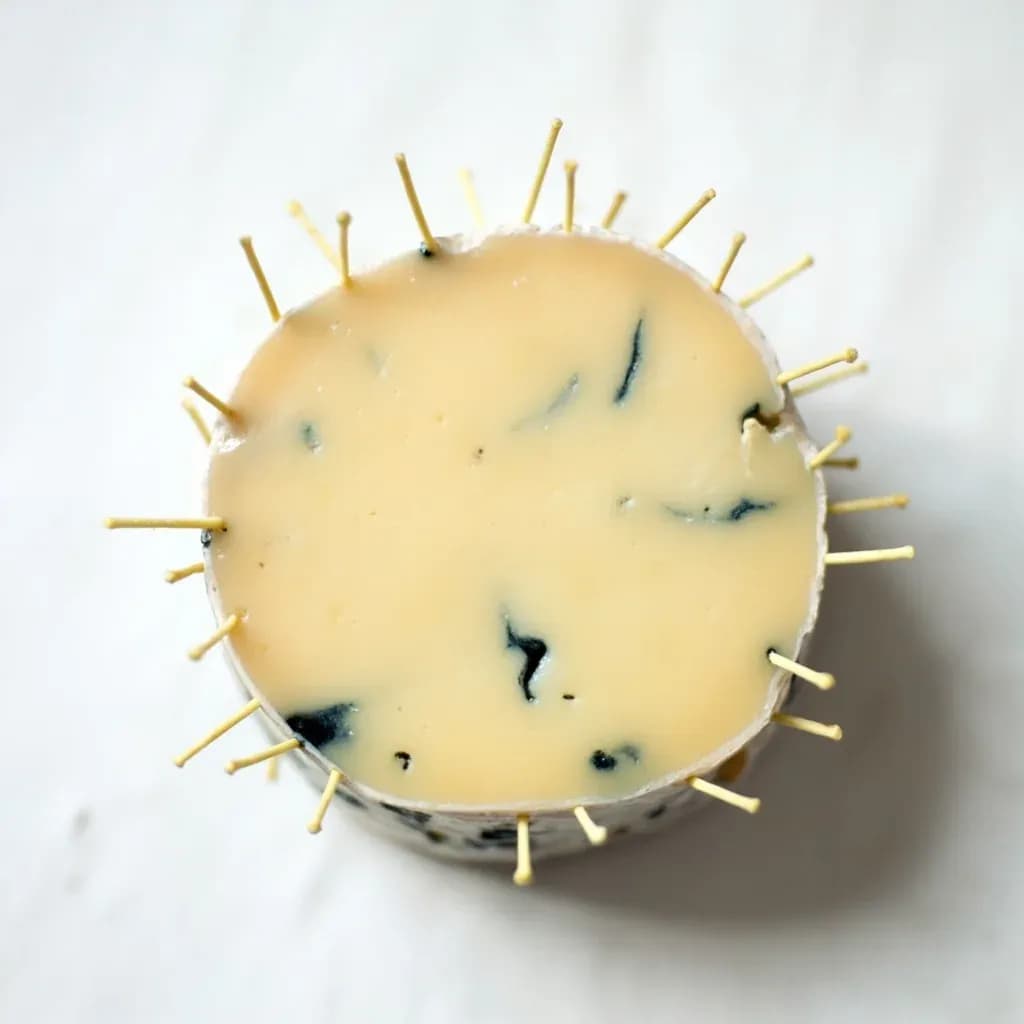
Piercing punches channels into a wheel of blue cheese with long needles, letting oxygen reach the interior so the Penicillium roqueforti can develop its characteristic blue-green veins. Without piercing the mold cannot spread beyond the surface. Timing and the number of holes shape how aggressively the veining and flavor develop.
Piercing, known in French as aiguillage, is the deliberate puncturing of an aging blue-cheese wheel with thin steel needles so that oxygen reaches the interior. The paste inside a young blue is essentially anaerobic, and the Penicillium roqueforti (or closely related) cultures seeded into the milk lie dormant until air arrives. Each needle prick becomes a tiny chimney: oxygen diffuses down the channel, the mold revives and sporulates, and the characteristic blue-green veining grows back along the walls of the hole. The same channels also vent carbon dioxide built up during early fermentation, which keeps the flavor clean rather than gassy or sour.
Beyond letting the blue in, piercing is one of the cheesemaker's main texture levers. A sparse pattern of thick piercings yields large, dramatic pockets of blue and a crumbly, open paste, the way traditional Roquefort and Bleu d'Auvergne are meant to look. A dense grid of fine holes, the Stilton or Gorgonzola Dolce approach, produces fine marbled veining running through a creamier body. In that sense piercing is as much a design decision as a biological necessity: the maker chooses, hole by hole, what the cut face of the cheese will reveal.
Timing and conditions matter as much as the holes themselves. Pierce too early and the soft curd tears around the needle, leaving ragged cavities and lost yield; pierce too late and the mold may have died off in the still-anaerobic core. Done right, in a cool, humid cave around 10–13 °C and 90–95% relative humidity, the new channels stay open and the bloom follows within weeks.
- Difficulty
- Medium
Types & varieties
The traditional Roquefort method: a cheesemaker pushes a single thick steel needle through the loaf by hand, repeating across the surface. Slow, but gives full control over each channel and is still practiced in Roquefort-sur-Soulzon caves.
Modern industrial approach used for Gorgonzola, Stilton, and large-scale blue production; a grid of needles plunges into the whole face of the wheel in one pass, producing uniform spacing.
Fewer, larger channels, as in traditional Roquefort and Bleu d'Auvergne; encourages big pockets of blue and a crumbly, open paste.
Many small, evenly distributed channels, as in Stilton and Gorgonzola Dolce; produces fine, marbled veining and a creamier texture.
How to do it
- 1
Bring the wheel to the right stage
After salting and a short rind-drying period, the wheel should feel firm to the touch, with a thin dry rind, internal pH roughly 4.8–5.0, and a faint whitish bloom of Penicillium roqueforti visible on a cut face. Too soft and the needle will tear the curd; too dry and the mold may no longer be viable. This is the moment to pierce.
- 2
Prepare needles and room
Sterilize stainless-steel needles (about 2–3 mm thick) in hot water or a food-safe sanitizer, then air-dry. Work in the cool, humid aging room, typically around 10–13 °C and 90–95% RH, so exposed paste does not dry out or pick up stray contaminants.
- 3
Plan the piercing pattern
Visualize or mark a grid across the flat face of the wheel. Use a sparse grid with larger spacing for an open, Roquefort-style paste, or a dense fine grid for the marbled veining of Stilton or Gorgonzola Dolce. Channels must run all the way through, not stop partway.
- 4
Pierce the wheel
Drive the needle straight through from one flat face to the other and withdraw cleanly. On a hand rig, work row by row; on a mechanical rig, a single plunge with a needle bed does the whole face at once. Avoid twisting the needle, which enlarges the channel and admits too much air.
- 5
Flip and pierce the opposite face
Most production lines pierce both flat faces so the channels meet in the middle. Piercing only one side leaves uneven veining, bluer near the pierced face and paler on the opposite side.
- 6
Return the wheel to the cave
Place the pierced wheel on a clean board in the same cool, humid aging room. Air now reaches the interior, the mold reactivates, and within roughly 2–6 weeks the channel walls turn blue-green as the mold sporulates.
- 7
Monitor and re-pierce if needed
Some styles, notably Stilton, call for a second lighter pass partway through aging to catch any zones that stayed anaerobic. Cut and inspect; if large areas remain pale and chalky, a follow-up pass with a finer needle will open them up.
Why the cheese needs to be wounded
A fresh blue wheel is a sealed, low-oxygen environment. P. roqueforti is a facultative anaerobe, meaning it can survive without air, but it cannot sporulate or produce the pigments and ketones that give blue cheese its color and pungency until oxygen arrives. Salting closes the surface; rind formation tightens it further. Without piercing, the wheel will simply age into a chalky, sour, white interior. The needle holes are not decorative; they are the moment the cheese is allowed to become what it is meant to be.
- Oxygen reactivates dormant P. roqueforti along the channel walls.
- Spores form in the aerated zones, giving the visible blue-green color.
- Methyl ketones and other flavor compounds are produced only after aeration.
- Built-up CO2 escapes through the same channels, preventing off flavors.
Reading the style through the holes
Looking at a cut wheel of blue cheese tells you almost everything about how it was pierced. A Roquefort cut shows broad, irregular blue streaks running through a pale, crumbly ivory paste, the signature of hand-driven thick needles at sparse spacing. A Stilton shows dozens of fine blue threads radiating evenly from a creamy white interior, the work of a dense mechanical grid. Gorgonzola Picante sits between the two: structured veins but with a firmer, more crumbly body. The geometry of the holes is, in effect, the recipe.
Common uses
Tips & pitfalls
- Pierce only when the wheel is firm enough to hold its shape but still internally moist. Too soft tears the curd and ruins the channel; too dry and the mold cannot reactivate.
- Sanitize needles between every wheel. Reused or dirty needles are a common vector for yeast and off-mold contamination such as Geotrichum.
- Drive the needle straight through from one flat face to the other. Angled piercings leave unvented zones on the uphill side and produce patchy veining.
- Do not over-pierce. More holes mean more rind-like oxidation along every channel, which dries the paste and can push flavors toward ammoniacal or metallic notes.
- Work in a cool, humid aging room (about 10–13 °C and 90–95% RH). Cold humid air lets the channels stay open without crusting over.
- Expect a brief slowdown in rind growth right after piercing as the new channels breathe and lower surface CO2. This is normal and self-corrects within a few days.
- Watch for a faint white bloom of P. roqueforti on a cut face before punching. The mold should look alive but oxygen-starved, the cue that aeration will restart growth.
- If the finished wheel comes out pale on one side, the cause is almost always a missed face during piercing rather than a problem with the culture.
Good to know
- Purpose
- Admit oxygen to the cheese interior so blue-green molds, principally Penicillium roqueforti and the closely related P. glaucum used in some French styles, can revive and produce veining and flavor.
- French term
- Aiguillage, from aiguille (needle), the traditional name in Roquefort and other French blue-cheese caves.
- When performed
- After salting and a short rind-drying period, generally 2–6 weeks into aging, once the wheel is firm enough to hold a clean hole but still moist internally.
- Tools
- Long thin stainless-steel needles, typically 2–3 mm in diameter; traditional rigs use a single thick needle, modern dairies use mechanical beds with dozens to hundreds of needles on a grid.
- Pattern
- Needles are driven straight through the wheel from one flat face to the other at regular spacing; density and hole size are set per cheese style.
- Side effect
- The channels also vent CO2 accumulated during early fermentation, which keeps blue flavor development clean.
- Cheeses that require it
- Roquefort, Gorgonzola (Picante and Dolce), Stilton, Bleu d'Auvergne, Fourme d'Ambert, Cabrales, Danablu, Cashel Blue, Point Reyes Bay Blue, Maytag Blue.
- Not used for
- Surface-ripened blues and bloomy-rind cheeses like Brie and Camembert, where the mold lives on the rind rather than inside.
Dishes that rely on it
Related

Confit
Cook slowly submerged in fat for silky tenderness and keeping

Cure
Draw out moisture with salt and time to preserve and concentrate

Pickle
Steep in acidic brine for bright, tangy, crunchy preservation

Ferment
Let friendly microbes transform food into tangy, complex flavor

Marinate
Soak in a seasoned mix to flavor and tenderize before cooking

Brine
Soak in salt water so meat stays juicy and seasoned throughout

Dehydrate
Slowly dry out moisture to concentrate flavor and extend shelf life

Cold-Smoke
Perfume cured food with smoke without cooking it through