Transform & Preserve
Plugging (Trier Sampling)
Boring a core sample from a cheese or cured meat to check ripeness without cutting it open.
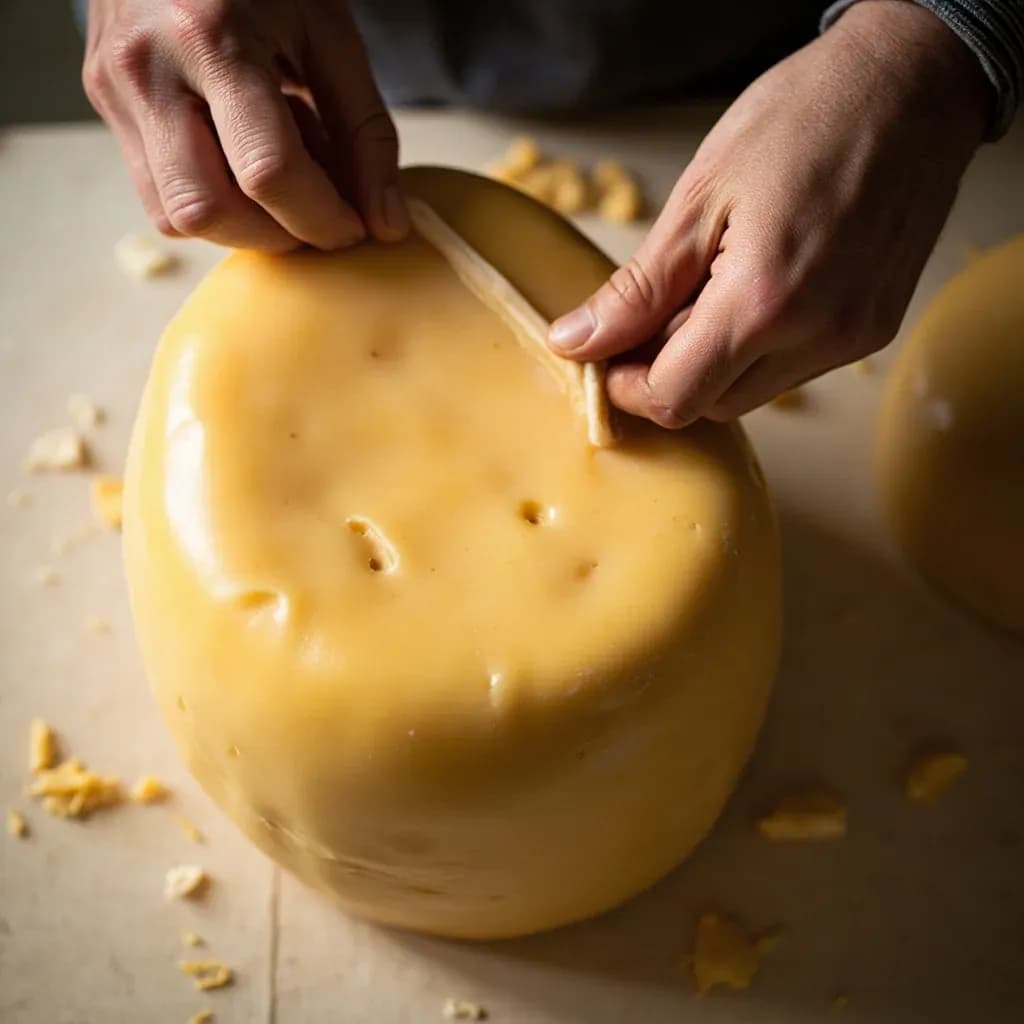
Plugging uses a cheese trier or iron, a curved hollow tool, to bore a small cylindrical core from a wheel of cheese or a cured ham so the maker can smell, taste, and inspect the interior at depth. The plug is examined, sometimes tasted, then pushed back to reseal the hole, letting affineurs and producers track ripening without sacrificing the whole product. It is the standard quality-control method in aging cellars.
Plugging is the cheesemaker's and affineur's way of looking inside a wheel without opening it. A trier — a half-cylinder steel barrel with a short handle — is pushed into the paste, twisted, and withdrawn carrying a slim core that reveals the cheese's true color, texture, moisture, and aroma. The plug is then slid back into its own hole and the spot sealed, so the wheel stays whole and continues to age. It is the standard way to read the interior of a 40-kilo wheel of Parmigiano-Reggiano or a long-aged Comté without sacrificing the form.
That single core answers questions the rind and the knock test cannot. The cut face of a wheel tells you about the rind, the paste just under it, and the work of the affineur; it cannot tell you whether the center is still chalky and underdone, whether tyrosine crystals have formed in the right places, or whether an off-aroma has crept in from the wrong mold. A core taken from the heel gives that read in seconds, and it is the moment a cellar decision is made: more time on the board, wrap and ship, or send to the cook pot.
The same principle, with a different tool, governs the Spanish calado used on jamón ibérico and other dry-cured hams. A sharpened sliver of bone — traditionally the pig's own fibula, called a punzón — is slid deep into the ham near the hip joint and withdrawn; the aroma clinging to the bone tells a trained catador how far curing has progressed and whether the piece is sound. The philosophy in both cases is identical: read the interior without ruining it.
- Difficulty
- Medium
Types & varieties
Classic T-shaped grip with half-cylinder barrel; the standard for affineurs sampling large wheels like Parmigiano or Comté.
Open scoop design that exposes more of the core for quick aroma and visual reading; common in cellar work.
Extended shaft for reaching the center of very large or tall wheels (e.g., 80+ kg Alpine forms).
Compact version used at retail counters and cheese counters to sample a wedge or small wheel for customers.
The Spanish cured-ham equivalent: a sharpened sliver of bone (typically the fibula) inserted to the marrow near the hip; aroma on withdrawal indicates depth of curing and any off-notes.
A modern hybrid with a built-in probe for reading internal temperature alongside the visual and aroma check.
How to do it
- 1
Choose the sampling point
Identify a spot on the heel or the thickest part of the wheel, away from the rind, the cut face, and any previous sampling holes. For very large wheels work from the side; for small wheels sample in the top third.
- 2
Position the trier
Hold the trier at a shallow angle of roughly 30–45° from the surface, never straight in, so the half-cylinder barrel can extract an intact plug and the hole will reseal cleanly.
- 3
Insert with steady pressure and a quarter-turn
Press the barrel into the paste while giving a gentle twist; let the tool's cutting edge do the work rather than forcing it. Stop when the barrel is roughly half-inserted — long enough to read the interior, short enough to keep the core intact.
- 4
Withdraw the plug
Pull the trier straight back out with a slight twist. The core should sit inside the half-cylinder barrel; if it crumbles, the cheese is too young or too dry, and the read is still useful.
- 5
Read the core
Look at the cross-section for color, evenness of paste, crystal flecks, and moisture. Smell the core directly — first for clean cultured-milk notes, then for deeper aged notes, and finally for any off-aromas such as ammonia, butyric, or yeasty notes. A tasting sliver can be taken with a clean knife or tasting spoon if desired.
- 6
Replace and seal
Slide the extracted plug back into its own hole and press it flush with the heel. For wheels that will continue to age, seal the spot with a thin coat of butter, lard, or food-grade wax to exclude oxygen and surface molds.
- 7
Record and rotate
Note the wheel number, date, sample location, and your reading. On long-aged wheels choose a different sampling point next time and avoid going deeper than necessary — repeated deep sampling degrades the wheel.
Reading the Core
What to look for when the plug comes out:
- Color: even straw-to-amber from edge to center; a dark ring just under the rind is normal oxidation, a dark band running inward suggests a fault.
- Texture: a clean, slightly moist break for a well-aged paste; chalky and crumbly means the wheel is too young or too dry; rubbery and gummy means underdone at the core.
- Crystals: tiny white flecks that crunch between the teeth are tyrosine — welcome in long-aged Comté, Parmigiano, and aged Gouda.
- Aroma: start with clean cultured-milk and butter, then look for deeper notes (broth, hazelnut, caramel, dried fruit); flag ammonia, butyric acid, or yeasty/solvent notes as faults.
- Moisture: the core should glisten slightly; bone-dry cores indicate over-aging or rind failure, weeping cores indicate too much moisture for the age.
Plugging and the Knock Test
In a working cellar, the trier is almost always used after a knock test — a wooden mallet tapped against the heel to listen for the dull, even thud of a sound paste. A hollow, rattling, or off-key note is a coarse filter: it suggests cracks, voids, or advanced drying. The trier is the refinement that tells you what the sound meant, and what to do about it. Sound alone sorts the obviously bad wheels; the plug sorts the rest.
Common uses
Tips & pitfalls
- Sample at the heel or thickest part of the wheel, not near the rind or a previous hole — that gives a representative read of the paste.
- Insert the trier at a shallow angle, not perpendicular, so the plug can be slid back in cleanly with minimal disruption.
- Smell the core immediately on withdrawal; aged cheese aromas change within seconds as volatiles dissipate.
- Always return the same core to its original hole and press it flush; then seal with a light smear of butter, lard, or food-grade wax if the wheel will continue to age.
- Rotate sampling points over time on long-aged wheels; re-probing the same hole invites surface mold and rind damage.
- For very dense cheeses like Parmigiano, warm the trier briefly in hot water and dry it first — a warm blade slides in with less cracking of the paste.
- Clean and dry the trier between wheels to avoid cross-contamination, especially between different rinds (natural, waxed, cloth-bound).
- In the calado technique, push the bone in to a consistent depth and withdraw smoothly; the aroma layer closest to the bone tells the most about curing progress.
Good to know
- Tool names
- Trier, cheese iron, cheese scoop; French tyrode or sonde à fromage; German Käsebohrer
- Typical plug diameter
- Roughly 1–2 cm, depending on trier size and cheese scale
- Best for cheese types
- Hard and semi-hard aged wheels — Parmigiano-Reggiano, Grana Padano, Comté, Gruyère, aged Cheddar, Manchego, Gouda aged 18+ months, Alpine cheeses
- Cured-meat variant
- In Spanish charcuterie, a slim sliver of bone (the pig's own fibula) is driven into the jamón near the hip; the technique is calado and the bone a punzón or calador
- Why the plug is replaced
- Returning the core and sealing the hole prevents oxygen ingress and surface mold, which would otherwise spoil an otherwise sound wheel
- Time required
- Under one minute per sample once the tool is in hand
- Reusability
- The tool is reusable indefinitely; cores taken for sensory inspection are typically not consumed
Also called
Trier Sampling · Cheese Iron Sampling · Boning
Dishes that rely on it

Related

Confit
Cook slowly submerged in fat for silky tenderness and keeping

Cure
Draw out moisture with salt and time to preserve and concentrate

Pickle
Steep in acidic brine for bright, tangy, crunchy preservation

Ferment
Let friendly microbes transform food into tangy, complex flavor

Marinate
Soak in a seasoned mix to flavor and tenderize before cooking

Brine
Soak in salt water so meat stays juicy and seasoned throughout

Dehydrate
Slowly dry out moisture to concentrate flavor and extend shelf life

Cold-Smoke
Perfume cured food with smoke without cooking it through