Transform & Preserve
Curing
Preserving meat or fish with salt, sugar, smoke, or air to draw out moisture and concentrate flavor.
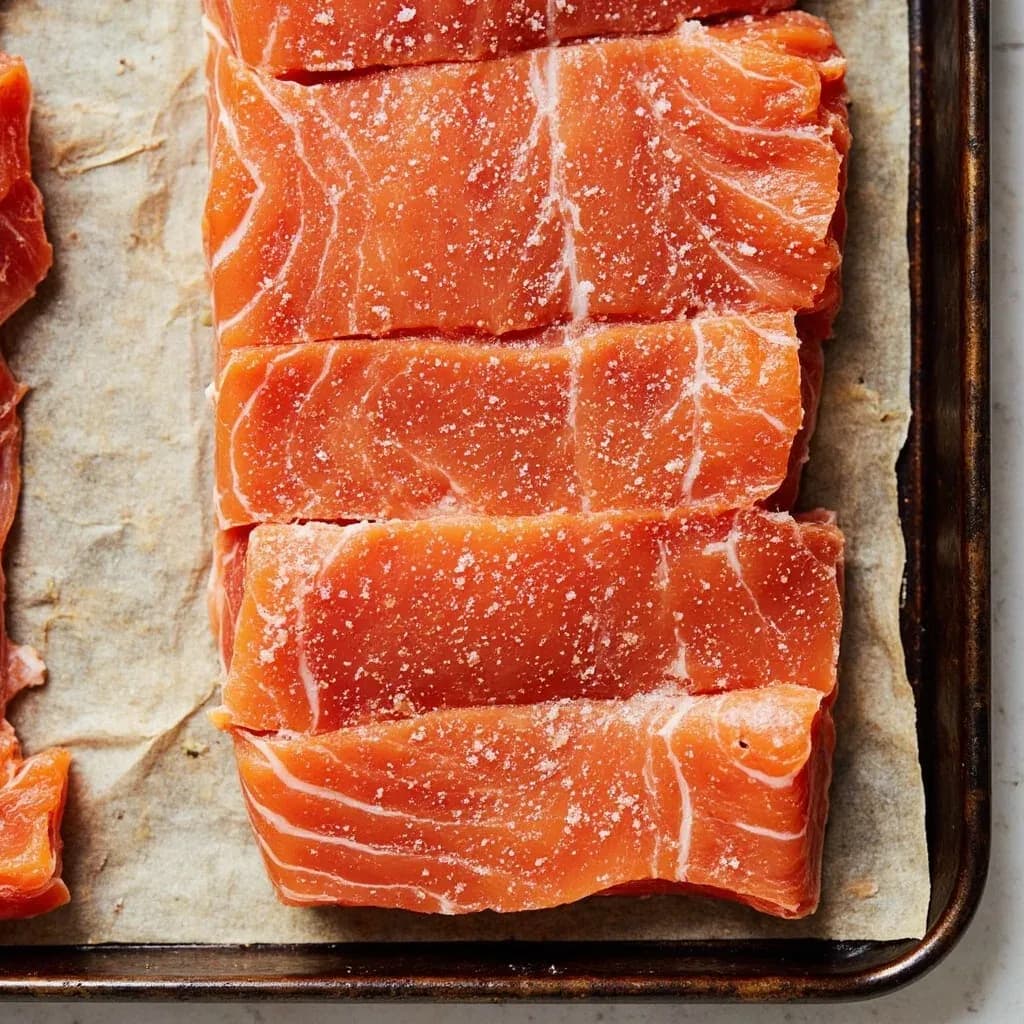
Curing preserves protein by packing or coating it in salt and sometimes sugar, which draws out water, inhibits bacteria, and concentrates flavor over days or weeks. Methods include dry-curing, salt-sugar gravlax-style cures, smoke-curing, and air-drying for products like biltong, salo, and cecina. The salt is essential not just for taste but for safety, since it creates an environment where spoilage organisms cannot thrive.
Curing is the controlled application of salt, often with sugar, nitrite or nitrate, and sometimes smoke, to preserve and transform meat and fish. Salt works by osmosis: it pulls moisture out of cells, lowering water activity to a level where spoilage bacteria and pathogens cannot grow. At the same time, salt denatures muscle proteins, which is why cured meat firms up, darkens, and tightens in texture — and why a properly cured ham can be sliced tissue-thin without falling apart. Curing is one of the oldest food technologies known, used in Mesopotamia, Egypt, and Rome for millennia, but the modern practice rests on a precise understanding of salt concentration, temperature, and (in many products) the chemistry of curing salts.
What distinguishes curing from a simple salt rub or a marinade is intent and ratio. A cure is calculated to a target percentage of the food's weight, then given time to penetrate fully so that no spot is saltier than another. This is the idea behind equilibrium curing, and it is what makes modern home curing both safer and more forgiving than the pack-cure-and-hope methods of older cookbooks. Curing also frequently leads into other techniques — cold smoking, air drying, fermentation — which is why a single pork belly can become bacon, pancetta, or guanciale depending on what happens after the salt goes on.
- Difficulty
- Hard
Types & varieties
Salt (and usually nitrite/nitrate plus seasonings) rubbed directly onto the food. Used for pancetta, prosciutto, jamón, bresaola, and guanciale.
Food submerged in a saltwater solution; the method behind corned beef, gravlax, lox, and many traditional wet-cured hams.
Cure solution pumped deep into thick cuts via needle or stitch pump; standard for commercial hams because it gives fast, even penetration.
Heavy sugar alongside salt, as in gravlax (with dill) or candied salmon; sugar moderates saltiness and rounds the flavor.
Dry cure followed by cold smoking, as for bacon or speck — salt penetration paired with smoke chemistry and a protective surface.
The final phase of long dry cures; controlled humidity and airflow shrink the meat and concentrate flavor (jamón ibérico hangs 24+ months).
Smoke applied under about 85°F (30°C); preserves and flavors without cooking the food. Often the last step after curing.
Smoke applied at temperatures high enough to cook the food, typically starting around 145°F (63°C); used for sausages, kippers, and other products where smoke and heat both matter.
How to do it
- 1
Choose the cut and curing method
Decide on a dry cure (good for whole muscles, small to large cuts) or wet cure/brine (good for thick dense cuts, fish, or when you want fast, even penetration). Match the cut to the method: pork belly for bacon, pork loin for pancetta-style loins, salmon for gravlax, brisket for corned beef, leg for prosciutto-style ham.
- 2
Calculate the cure by weight
Weigh the meat in grams. For a modern equilibrium dry cure, calculate 2.0–2.5% salt and 0.25% Prague Powder #1 (or 0.5% Prague Powder #2 for long cures) of the meat's weight. Optionally add 0.5–1% sugar for flavor and browning. Combine all curing agents thoroughly before applying — uneven mixing is the most common home-cure mistake.
- 3
Apply the cure evenly
Pat the meat dry. Rub the cure mixture over every surface, working it into seams and fat pockets. For cuts thicker than 2 inches, slit the meat in a few places and push cure into the openings so the center does not cure slower than the outside. Place the meat in a non-reactive container (glass, stainless, food-grade plastic) or a vacuum bag.
- 4
Refrigerate and turn
Store at 34–40°F (1–4°C). Turn the meat every 24–48 hours so the liquid that pools on the underside redistributes over the top. Small cuts under 2 inches thick cure in 3–7 days; thicker roasts need 1–3 weeks; whole hams need 1–6 weeks depending on density.
- 5
Check for completion
Slice a thin piece from the thickest part of the cut. Salt should be evenly distributed — no raw, soft, or translucent interior surrounded by an overly salty exterior. Texture should be firm throughout, and color (with curing salts) should be a uniform rosy pink to red in red meats, or a clean translucent amber in pork without nitrites.
- 6
Rinse, dry, and form a pellicle
Rinse off surface salt under cold water and pat thoroughly dry with paper towels. For dry-cured whole muscles destined for smoking or air-drying, hang or rack the meat uncovered in the refrigerator for 12–48 hours to form a pellicle — a tacky, dry skin that smoke and air can work on without the meat weeping.
- 7
Smoke, dry-age, or finish as the recipe dictates
Cold-smoke under 85°F (30°C) for bacon, salmon, or speck; or transfer to a 55–60°F curing chamber at 60–75% humidity for months-long air-drying (prosciutto, jamón, salami). Once finished, store properly — most dry-cured meats keep refrigerated for weeks to months, and most can be vacuum-sealed and frozen for long storage without quality loss.
How salt actually cures meat
Salt draws water out of muscle cells by osmosis. As moisture leaves and salt enters, the water activity of the food drops below the threshold that bacteria, molds, and yeasts need to grow. At the same time, salt denatures the soluble proteins myosin and actin — they unwind, then re-bond into a tighter matrix. That matrix is what gives cured ham its characteristic firm, sliceable texture, and what lets a paper-thin slice of prosciutto hold together without tearing.
- Salt penetration follows diffusion: it moves from areas of high concentration to low, which is why turning the meat and giving time matters.
- Equilibrium is reached when salt concentration is equal throughout the piece — at that point the cure is 'done' even if you leave it longer.
- Nitrite (from Prague Powder) reacts with myoglobin to form nitrosomyoglobin, the stable pink color of cured meats. It also blocks the growth of Clostridium botulinum.
- Sugar does not preserve on its own; in fermented cures it provides substrate for the lactic acid bacteria that lower pH, and in all cures it softens harshness and promotes browning during smoking or cooking.
Choosing a curing salt
Plain salt cures safely but produces a gray, livery color in red meats and lacks the botulism protection of nitrite. Modern curing salts solve both problems. The two you will see most often are Prague Powder #1 and Prague Powder #2 — both dyed pink so they are never mistaken for table salt.
- Prague Powder #1 (6.25% sodium nitrite): for cures under about 30 days and for anything that will be cooked, smoked, or hot-processed — bacon, sausage, corned beef, smoked fish.
- Prague Powder #2 (sodium nitrite plus sodium nitrate): for long dry cures where nitrate must slowly convert to nitrite over weeks or months — prosciutto, country ham, salami.
- Use 0.25% Prague #1 (or 0.5% Prague #2) of meat weight for an equilibrium dry cure.
- Never substitute iodized table salt — iodine causes off-flavors and discoloration, and table salt's fine crystals throw off weight-based calculations.
Common uses
Tips & pitfalls
- Weigh the meat and calculate salt as a percentage of meat weight (2–3%) — never measure by volume, since salt density varies by brand and grind.
- Use the correct curing salt for the job: Prague #1 for short or cooked cures, Prague #2 for long dry cures that need slow nitrate-to-nitrite conversion.
- Keep cure and meat at 34–40°F (1–4°C) throughout the curing period to control pathogens; warmth accelerates bacterial growth faster than salt penetration.
- Trust equilibrium curing: because the salt percentage is capped at what the meat can hold, you cannot over-salt by leaving it longer — only by miscalculating the ratio.
- Rinse and pat dry cured products before smoking; residual surface salt will cause a harsh, bitter, white-flecked crust and ruin smoke absorption.
- For fish cures, refrigerate throughout and consume within 1–2 weeks; cured fish is not shelf-stable the way cured ham is, because fish fat oxidizes quickly.
- Never substitute iodized table salt for kosher or non-iodized curing salt — iodine causes off-flavors and gray discoloration in cured meats.
- Do not confuse curing with marinating. A marinade flavors the surface; a cure, calculated by weight and given time, transforms and preserves the food.
- Label every batch with the date, weight, and salt percentage — both for food safety and so you can repeat or adjust the recipe next time.
Good to know
- Origin
- Ancient; salt curing was used in Mesopotamia, Egypt, and Rome thousands of years ago and is among the oldest food preservation techniques.
- Primary agents
- Salt (sodium chloride), sodium nitrite, sodium nitrate, sugar, smoke, and time at controlled temperature.
- Modern salt target
- About 2–3% salt by weight of meat is the standard for equilibrium cures; traditional recipes often used substantially more.
- Prague Powder #1
- 6.25% sodium nitrite in salt; used for short cures and products that will be cooked or smoked (bacon, sausages, corned beef).
- Prague Powder #2
- Sodium nitrite plus sodium nitrate in salt; used for long dry-cured products like country hams and salami, where nitrate slowly converts to nitrite over months.
- Curing temperature
- 34–40°F (1–4°C) for meat during the salt phase; around 55–60°F with 60–75% humidity for the long air-drying phase of whole hams.
- Legal limit (US)
- 200 ppm sodium nitrite maximum in finished cured meat products under USDA rules.
- Equilibrium vs. traditional
- Equilibrium cures are calculated to a precise percentage of meat weight, so over-salting is impossible regardless of cure time.
Also called
Salt-Curing · Dry-Curing · Smoke-Curing · Graving · Speking
Dishes that rely on it
Related

Confit
Cook slowly submerged in fat for silky tenderness and keeping

Cure
Draw out moisture with salt and time to preserve and concentrate

Pickle
Steep in acidic brine for bright, tangy, crunchy preservation

Ferment
Let friendly microbes transform food into tangy, complex flavor

Marinate
Soak in a seasoned mix to flavor and tenderize before cooking

Brine
Soak in salt water so meat stays juicy and seasoned throughout

Dehydrate
Slowly dry out moisture to concentrate flavor and extend shelf life

Cold-Smoke
Perfume cured food with smoke without cooking it through