Transform & Preserve
Equilibrium Curing
Curing with a precise percentage of salt to the meat's weight so it can't over-salt.
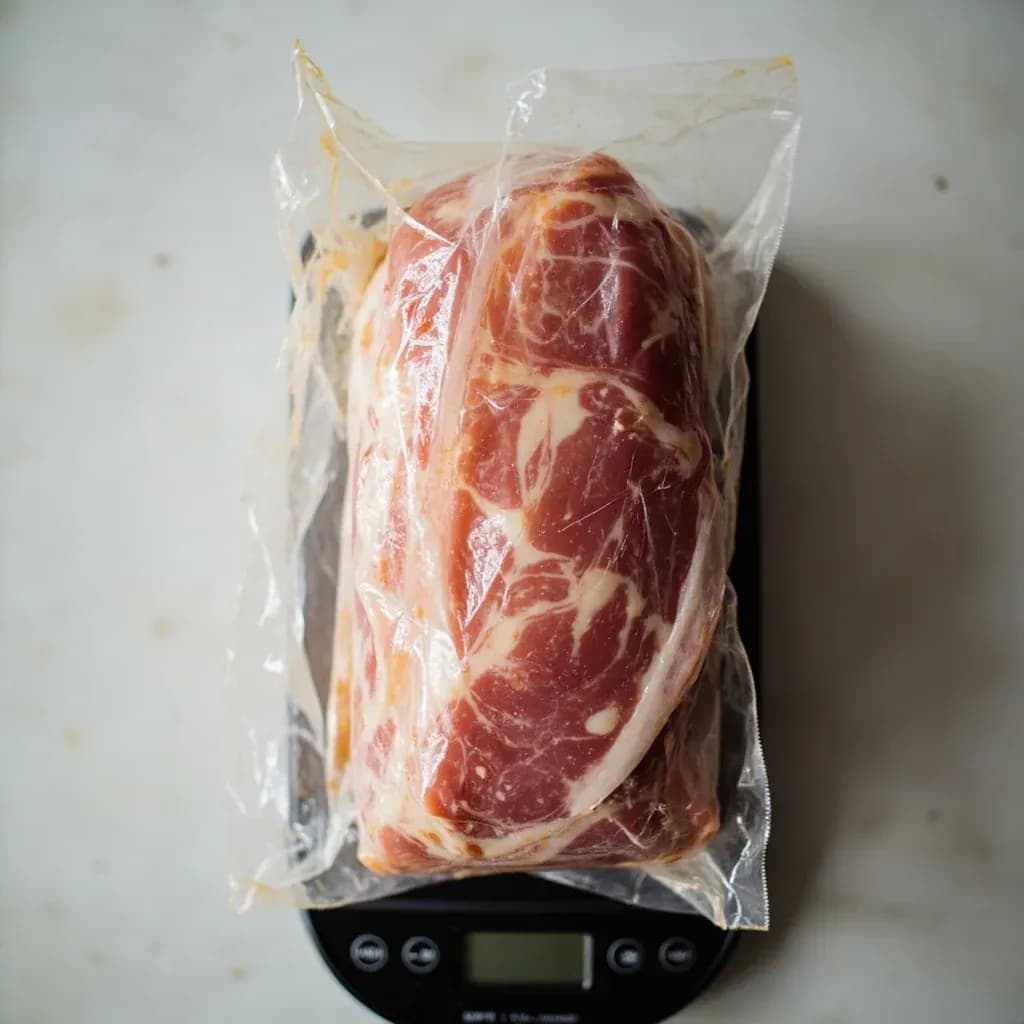
Equilibrium curing weighs out salt and cure as an exact percentage of the meat's weight, then seals it so all the salt is absorbed and the seasoning self-limits. Unlike heavy salt-box curing, it cannot oversalt because there is no excess, giving repeatable, controlled results. Charcuterie makers prize it for bacon, gravlax, and whole-muscle cures where consistency matters.
Equilibrium curing is a calculation method, not a fixed recipe. You weigh the meat, weigh out a precise percentage of salt against that weight, seal everything together, and let diffusion do the work. The meat's own moisture dissolves the salt and carries it inward, and because nothing is rinsed away or drained off, the concentration in the finished product is mathematically determined rather than guessed at. This removes the most common failure of traditional dry cures: the cure either over-salted the surface or under-salted the center.
The principle was named and popularized in Modernist Cuisine (Myhrvold, Young & Bilet, 2011), but the underlying physics — salt diffusing through protein along a concentration gradient — is straightforward food science. What makes the technique feel practical in the kitchen is its scalability. The same percentage that works on a 200 g duck breast works on a 5 kg pork loin, and timing scales to thickness, not weight. Once the calculation is internalized, the cook stops tasting and adjusting partway through, and curing becomes a set-and-forget operation.
The choice between salt-only and nitrified cures is a safety and flavor decision, not a technical one. Prague Powder #1 (sodium nitrite) at 0.25% of meat weight protects against botulism in unheated products and stabilizes the cured-meat color; Prague Powder #2 (sodium nitrate) at 0.5% is reserved for long, months-long air-dried hams where the nitrate needs time to convert to nitrite. For products that will be cooked before eating, or for short cures, salt alone is often appropriate — but regulatory rules around nitrite in unheated, shelf-stable meats differ by country, and a few minutes reading the relevant food-safety guidance is worth the effort.
- Difficulty
- Hard
Types & varieties
Plain salt calculated as a percentage of meat weight; used for guanciale and other products where the cook deliberately omits nitrite. Regulatory rules around unheated cured meats differ by country.
Salt plus 0.25% Prague Powder #1 (sodium nitrite) for short cures and smoked products, or 0.5% Prague Powder #2 (sodium nitrate) for long air-dried hams.
Adds sugar and often ground spices calculated as additional percentages of the meat weight — the standard approach for bacon, pancetta, and lomo.
Lower salt (often 1.5–1.8%) with sugar, used for salmon and other fatty fish; same diffusion principle, shorter timing because fillets are thin.
How to do it
- 1
Trim and weigh the meat
Remove silverskin and any excess surface fat you don't want cured. Weigh the meat precisely in grams on a kitchen scale that reads to the gram — this number drives every other calculation in the recipe.
- 2
Calculate the cure
Multiply the meat weight by 0.02 (2%) for plain salt. If using Prague Powder #1, also multiply by 0.0025 (0.25%); for Prague Powder #2 in a long cure, use 0.005 (0.5%). Sugar and ground spices are calculated by the same percentage method, per the recipe.
- 3
Mix the cure ingredients
Combine the measured salt, curing salt, and any sugar or ground spices in a small bowl and stir until the color is uniform. Blending dry ingredients first prevents pockets of curing salt that would over-concentrate on the meat surface.
- 4
Coat the meat
Rub the cure mixture thoroughly over every surface of the meat — top, bottom, and sides. Press gently so the salt adheres rather than falling off in the bag; a light tacky layer is what you want.
- 5
Seal for equilibration
Place the coated meat in a vacuum bag and seal at full pressure, or in a heavy zip-top bag with as much air pressed out as possible. A rigid lidded container is acceptable only if you commit to rotating the meat daily.
- 6
Cure under refrigeration
Store at 34–40°F / 1–4°C. Once a day, remove the meat, massage it in the accumulated purge, and reseal — or flip the bag — so the liquid redistributes and no spot stays dry.
- 7
Wait for equilibration
Allow roughly one day per centimeter at the thickest point. The meat is done when it is uniformly firm throughout and a thin slice from the center tastes fully seasoned with no raw or bland core.
- 8
Proceed to drying, smoking, or cooking
Do not rinse. Pat the surface dry and either slice and cook fresh, cold-smoke over a pellicle, or transfer to a hanging or racked chamber (about 50–60°F, 70–80% RH) for further drying if making air-dried charcuterie.
After the Cure: Drying, Smoking, or Cooking
Equilibrium curing is the seasoning step, not the finished product. Once the meat is uniformly firm and seasoned to the center, the cook decides what comes next. For bacon, pancetta, or a quick-cured loin, that means patting the surface dry and either slicing for the pan or resting uncovered in the fridge overnight to form a tacky pellicle before smoking. For long-aged projects, the cured piece moves to a controlled chamber.
- Cold smoking: pat the cured surface dry, rest uncovered in the refrigerator overnight to form a pellicle, then cold-smoke at under 80°F / 27°C for the time specified in the recipe.
- Air-drying: hang or rack the cured meat in a chamber at roughly 50–60°F / 10–15°C and 70–80% relative humidity for 2–6 weeks for small cuts, longer for whole hams.
- Cooked cures: slice or roll and proceed directly to roasting, braising, or pan-searing without an intermediate drying step.
- Do not rinse the cured meat unless a specific recipe explicitly calls for it; the salt balance is already exactly where it needs to be.
Common uses
Tips & pitfalls
- Weigh the meat after trimming on a scale that reads in grams — accuracy to 1 g matters more than the specific percentage you choose.
- Use salt without iodine or anti-caking agents; iodized salt can flavor the cure and cloud brine clarity.
- Massage or flip the bag once a day so the accumulating liquid (purge) redistributes across every surface — skipping this lets the bottom become unevenly seasoned.
- Calculate salt on the trimmed lean weight when working with fatty cuts like pork belly; fat absorbs essentially no salt, and basing the math on gross weight leaves the lean under-cured.
- Don't add water, wine, or other liquid 'to help the salt dissolve.' The meat's own purge is what carries the salt through diffusion — extra liquid dilutes the calculation and throws off the percentage.
- Check doneness by slicing a thin piece from the thickest part; it should taste like well-salted cooked meat with no bland center. If it does, keep going.
- Do not rinse at the end. The salt content is exactly what you want; rinsing would only reduce it unpredictably and undo the precision of the calculation.
- For air-drying after the cure, pat the surface dry and move to a chamber at roughly 50–60°F / 10–15°C and 70–80% RH for 2–6 weeks depending on the cut.
Good to know
- Salt Percentage
- Typically 1.5%–3% of trimmed meat weight; 2% is the common starting point for most charcuterie.
- Curing Salt (Nitrite)
- When using Prague Powder #1, dose at 0.25% of meat weight (2.5 g per kg).
- Curing Salt (Nitrate)
- Prague Powder #2 is used at roughly 0.5% for long-aged dry cures that need time to convert to nitrite.
- Final Salt Content
- Equal to the initial cure percentage (typically 2%) immediately after the cure; rises above 2% as water is lost during any subsequent air-drying or cooking.
- Salt Type
- Fine pure sea salt or kosher salt without iodine or anti-caking agents — additives cause off-flavors and discoloration.
- Container
- Vacuum-sealed bag is preferred; a zip-top bag with air pressed out or a rigid lidded container also works if the meat is rotated daily.
- Temperature
- Refrigerated at 34–40°F / 1–4°C throughout the curing phase.
- Time
- Roughly one day per centimeter at the thickest point; finished when the interior is uniformly seasoned and firm.
- Skill Level
- Beginner-friendly — over-salting is mathematically impossible because the salt has nowhere to go but into the meat.
Also called
EQ Curing · Equilibrium Brining
Related

Confit
Cook slowly submerged in fat for silky tenderness and keeping

Cure
Draw out moisture with salt and time to preserve and concentrate

Pickle
Steep in acidic brine for bright, tangy, crunchy preservation

Ferment
Let friendly microbes transform food into tangy, complex flavor

Marinate
Soak in a seasoned mix to flavor and tenderize before cooking

Brine
Soak in salt water so meat stays juicy and seasoned throughout

Dehydrate
Slowly dry out moisture to concentrate flavor and extend shelf life

Cold-Smoke
Perfume cured food with smoke without cooking it through