Water & Steam
Poaching Eggs in Sauce
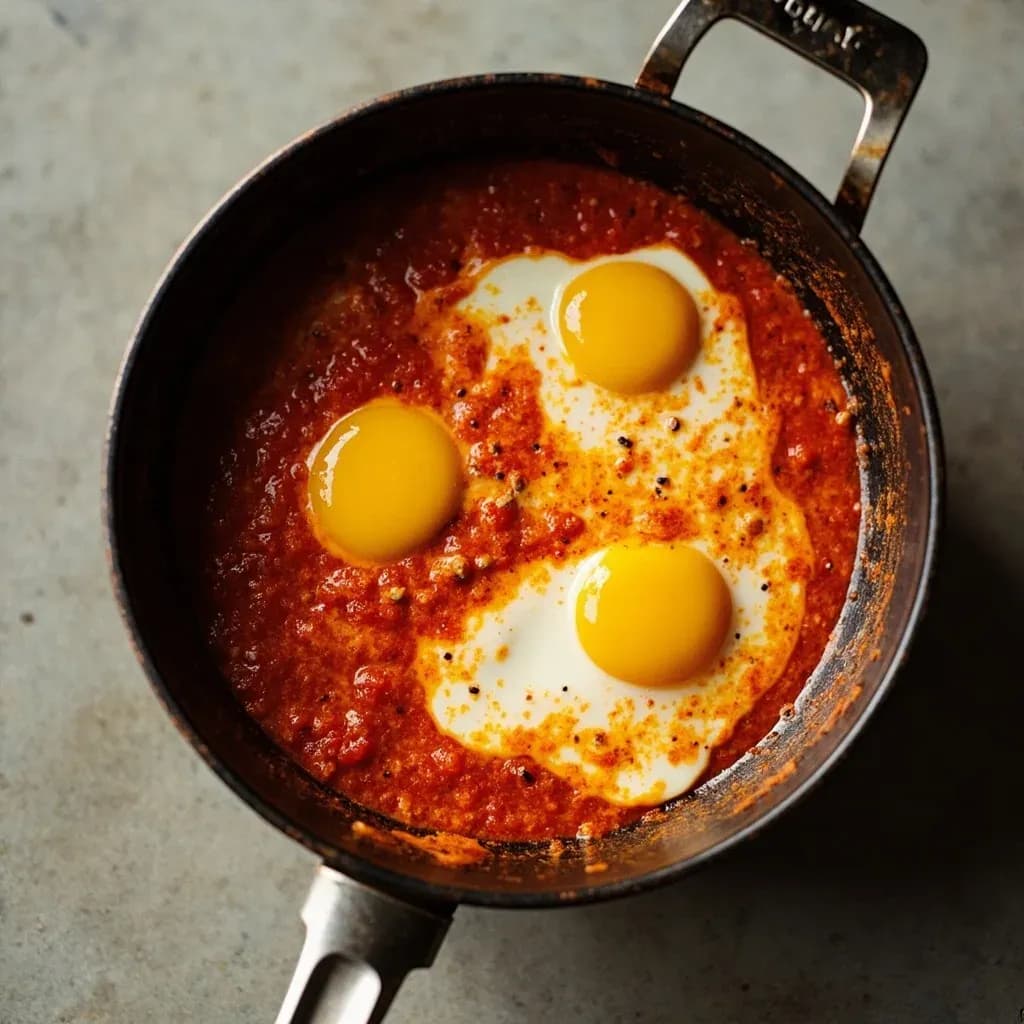
Cracking eggs directly into a simmering sauce so they set gently in the flavored liquid.
This technique poaches whole eggs by nesting them into a simmering tomato, pepper, or curry sauce rather than water. The eggs cook in indentations in the sauce until the whites are set but the yolks stay runny, soaking up the surrounding flavor. It is the backbone of dishes like shakshuka and eggs in purgatory, and the pan is usually covered near the end to set the tops with trapped steam.
Poaching eggs in a sauce is the quiet, practical marriage of shallow-poaching and braising: the egg cooks not in plain water but in a finished, seasoned liquid, and the liquid seasons the egg right back. The whites set gently from the heat conducted through the sauce while the yolks stay soft, and every drop of fat, spice, and aromatic in the pan seeps into the egg as it cooks. It is the technique behind shakshuka, uova in purgatorio, huevos rancheros, anda curry, and a long list of one-pan dishes that turn a sauce into a complete meal with almost no extra effort.
What makes the method forgiving, and what makes it fail, comes down to two opposites. Too much heat — a hard boil — toughens the white into rubber and bursts the yolk; too little leaves the white jiggly and translucent. The sweet spot is a bare, lazy simmer under a tight lid, where the trapped steam finishes the surface of the whites while the yolks stay molten. Because the eggs cook inside the flavor base rather than on top of it, seasoning the sauce aggressively matters more than seasoning the eggs, and a sauce that is too thick will scorch the bottom of the white before the top ever sets.
The technique scales without thinking about it: a single egg slipped into a ladleful of piperade, or six eggs nestled into a wide cazuela of tomato-pepper stew, all use the same principle. It has appeared independently in Mediterranean, Levantine, South Asian, and Latin American kitchens for centuries as a way to stretch a sauce into supper, and it became a global brunch touchstone largely through the late-twentieth-century spread of shakshuka. The cook's only real decisions are which sauce to use, how wet to keep it, and how runny to leave the yolks.
- Difficulty
- Easy
Types & varieties
Eggs nestled into a spiced tomato-pepper-onion sauce, often with harissa, cumin, and sweet pepper; finished with herbs and feta or labneh.
Eggs poached in a simple tomato sauce with garlic, olive oil, chili, and basil; called 'eggs in hell' when made notably spicy.
Eggs cooked in a ranchero-style tomato-chile sauce, served over tortillas; 'divorciados' uses both red and green sauces side by side.
A variant of the classic stirred dish in which yolks are left intact in a tomato-pepper base rather than scrambled through.
Soft- or hard-poached eggs added to a masala of onion, tomato, ginger, garlic, and ground spices, finished with garam masala and cilantro.
Dishes like mirza ghasemi and regional egg-in-tomato braises slip eggs into a reduced, often smoky base.
Regional preparations that nestle eggs into a thickened, nut-enriched tomato base.
Eggs poached in romesco or a quick tomato-almond sauce built on ñora or other mild dried chiles.
Whole eggs slipped into a light, lightly sweetened tomato broth; closer to a soup than a sauce but uses the same principle.
Modern home-cooking adaptation where eggs poach directly in a simmering pot of stewed legumes.
How to do it
- 1
Build the sauce
Cook aromatics, tomatoes, spices, and any vegetables or legumes down to a finished or near-finished sauce. Season aggressively at this stage, because eggs pick up very little salt once they are in the pan. The sauce should look glossy and just loose enough to flow when a spoon cuts through it.
- 2
Adjust consistency and heat
If the sauce is thicker than a thick stew, whisk in a splash of water, stock, or wine so it will conduct heat evenly. Bring it to a gentle simmer — small bubbles breaking lazily on the surface, never a rolling boil.
- 3
Shape wells for the eggs
Use the back of a large spoon or a ladle to make indentations in the sauce, one per egg, spaced 2–3 cm apart. Push the sauce up the sides so each well is a shallow crater rather than a deep hole; this keeps the white from spreading and helps the egg hold its shape.
- 4
Crack and stage the eggs
Crack each egg into its own small bowl, ramekin, or teacup. Inspect for shell and broken yolks before they go into the sauce — once in, you cannot un-break a yolk.
- 5
Slip the eggs into the sauce
Lower the heat to its lowest setting. Pour one egg at a time from the bowl into a well, holding the bowl close to the sauce so the white does not fall and splatter. Repeat with the remaining eggs.
- 6
Season the eggs
Sprinkle each yolk and white with a pinch of salt and pepper, plus any finishing spice you like — smoked paprika, Aleppo pepper, za'atar, or garam masala. Drizzle a little fat — olive oil, butter, or chili oil — over the tops for flavor and sheen.
- 7
Cover and cook to set the whites
Cover the pan with a tight lid. Cook 3–5 minutes, checking once: the whites should turn from translucent to opaque and feel just firm when nudged, while the yolks should still wobble visibly.
- 8
Finish and serve
Lift the lid, scatter fresh herbs, and bring the pan straight to the table or plate onto warm dishes with bread for dipping. If the whites need another minute, recover; if the yolks are set to your taste, serve at once — they will keep cooking in the hot sauce.
Why this technique works
An egg cooked in a sauce is a heat-transfer problem disguised as a one-pan dinner. The sauce acts as the poaching liquid, and a wet sauce — anything from a loose tomato fond to a thin curry — conducts heat to the white far more gently than hot fat or a hot oven would. The whites coagulate first because egg white proteins set at a lower temperature than yolk, which is why a 4-minute simmer produces a tender white over a still-liquid yolk without any special equipment. Meanwhile, the sauce is also the seasoning: fats carry flavor into the white from below, and water-soluble aromatics — garlic, chili, tomato acidity — soak upward into the surface as steam condenses on the lid and rains back down. Covering the pan is what finishes the top of the white evenly, because the trapped steam cooks it from above while the simmer cooks it from below.
- Egg white proteins begin to coagulate around 62 °C / 144 °F — well below a bare simmer — so even gentle heat will set them; a low-bubble, lidded simmer is what keeps the texture tender rather than rubbery.
- Yolk stays liquid until roughly 65–70 °C / 149–158 °F, which gives the white a wide window to finish setting first.
- Covering the pan for the last 1–2 minutes is what cooks the thin film of white that drapes over the yolk; uncovered, it stays translucent.
Choosing and adjusting the sauce
Almost any finished sauce that is wet enough to simmer will work, but the sauce's thickness, acidity, and fat content all change how the egg behaves. A thick stew needs a splash of water or stock to loosen it, or the bottom of the white will scorch before the top sets. A very acidic sauce — straight crushed tomatoes, for instance — will tighten the white faster and can leave the yolk slightly chalky at the edges if reduced too far; a pinch of sugar or a swirl of butter tames this. Rich, fatty sauces (cream, coconut milk, butter-bean cooking liquid) produce the most tender whites and the glossiest yolks, which is why eggs in a curry or a butter-bean ragout behave so luxuriously.
- Thin a sauce that mounds on a spoon; it should flatten and slowly fill back in.
- If the sauce tastes flat, season it now — salt added later mostly sits on top of the egg.
- For very delicate eggs, push the sauce off the heat for 30 seconds after adding the eggs; the residual heat is often enough to set a soft white.
Troubleshooting
Most failures in this technique come from heat, not from the eggs. A hard boil is the usual culprit behind tough whites and burst yolks; turning the burner to its lowest setting and putting a lid on the pan solves most of them. If the whites refuse to set on top, the sauce is too thick or the pan is too shallow — both trap less steam — and a brief covered finish will correct it. If the whites feather outward into long, ragged streamers, the eggs are old; straining the loose white through a fine mesh before slipping them in tightens the cooked result considerably.
- Boiling sauce: drop the heat, add a splash of water, recover, and cook a minute longer.
- Translucent tops: cover for 30–60 seconds to steam-finish the white.
- Runny whites streaming outward: the eggs are old; strain them or accept a rustier, looser look.
- Broken yolk: fish it out with a spoon, or commit to it and stir — some dishes (menemen, egg-drop style) treat a broken yolk as the point.
Common uses
Tips & pitfalls
- Bring the sauce to a bare simmer before adding the eggs; a hard boil will toughen whites and burst yolks.
- Make a well for each egg with the back of a spoon and push the whites close to the yolk so the egg stays compact.
- Crack each egg into a small bowl or ramekin first so you can slip it in cleanly and fish out any shell or broken yolk.
- Season the sauce, not just the eggs: salt and acid in the sauce flavor the whites as they cook.
- If the whites refuse to set on top, cover the pan for 30–60 seconds; the trapped steam finishes the surface without overcooking the yolk.
- Strain older or watery eggs through a fine mesh to remove loose white; the cooked result looks much tidier.
- Thin a too-thick sauce with a splash of water or stock so heat can transfer through to the white; otherwise the bottom overcooks before the top sets.
- Do not overcrowd the pan — four to six eggs in a 25–30 cm skillet is a practical maximum for even cooking.
- Add delicate herbs (basil, cilantro, dill) only after the eggs are done; their volatile oils burn off during the simmer.
- For very runny yolks, pull the pan off the heat slightly early and let carryover heat finish the whites.
Good to know
- Heat level
- Gentle simmer, roughly 80–90 °C / 175–195 °F; never a rolling boil.
- Typical cook time
- 3–6 minutes for set whites and runny yolks; up to 8 minutes for fully set yolks.
- Doneness cue
- Whites opaque and just firm; yolks still jammy or liquid depending on preference.
- Pan type
- Wide, shallow skillet, sauté pan, cazuela, or shallow cast-iron or enamel casserole with a lid.
- Sauce thickness
- Should coat the back of a spoon but still flow; thin with water or stock if too thick to conduct heat to the whites.
- Yield guidance
- 1–6 eggs per pan; allow one well per egg and 2–3 cm between them.
- Egg freshness
- Very fresh eggs (3–5 days old) hold their shape best; older whites spread further but can be tightened by straining.
- Key equipment
- Lidded pan, ladle or back of a spoon for wells, small bowl or ramekin per egg for controlled slipping.
Also called
eggs in purgatory · shakshuka method
Related

Boil
Cook in vigorously bubbling liquid at full rolling heat

Simmer
Hold liquid at a gentle shimmer for tender, unhurried cooking

Poach
Cook gently in barely-trembling liquid for silky, tender results

Steam
Cook in rising vapor to keep color, nutrients, and shape intact

Blanch
Plunge briefly in boiling water, then shock cold to lock color

Braise
Sear, then cook slow in a little liquid until fall-apart tender

Stew
Simmer bite-sized pieces fully submerged into a rich, unified pot

Sous-Vide
Seal and cook in precise warm water for edge-to-edge doneness