Prep & Assembly
Pulling Pork
Shredding slow-cooked meat into tender strands with forks or hands.
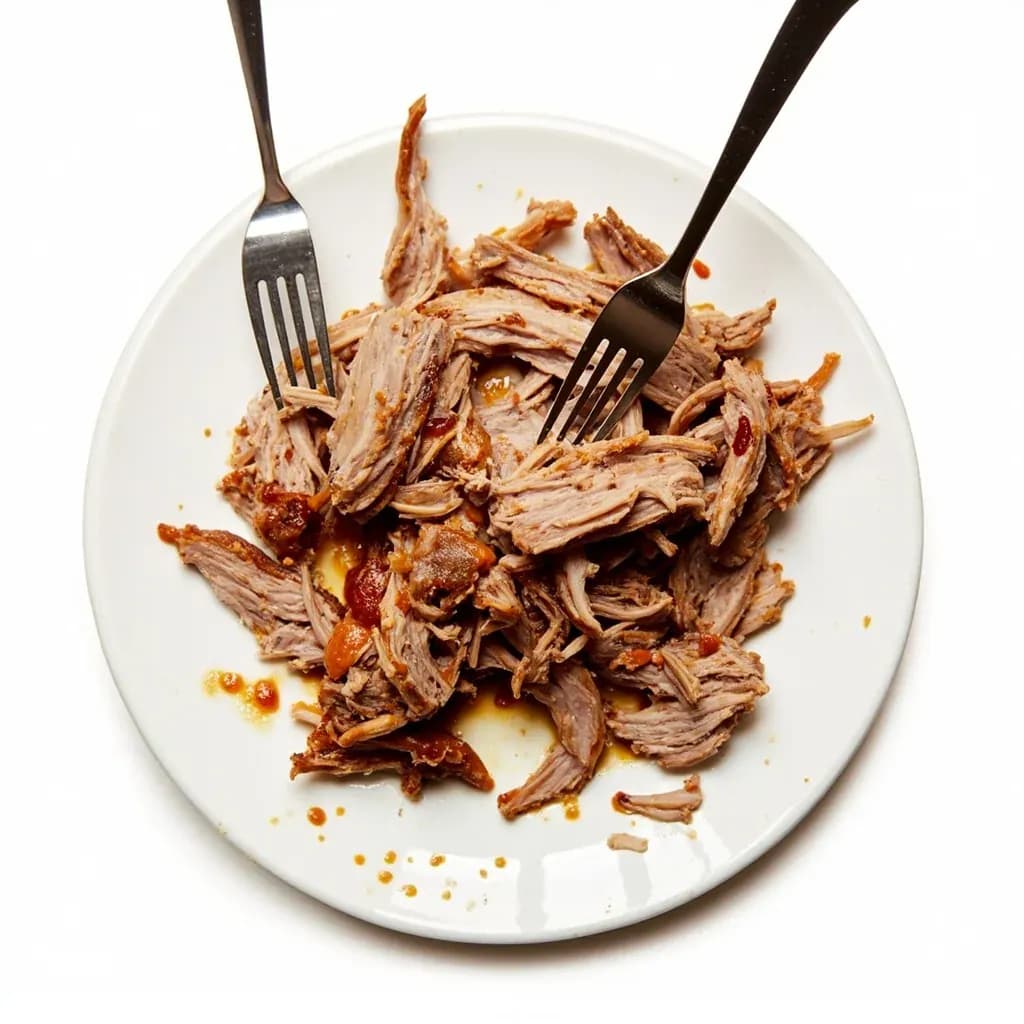
Pulling meat tears slow-cooked pork, beef, or chicken into soft strands once the collagen has fully broken down. It is the finishing step for barbecue shoulders and braises, producing the classic texture of pulled pork or desmechar. The meat should fall apart with light pressure from two forks or gloved hands, and tossing the strands back through their juices keeps them moist.
Pulling pork is the hand-shredding step that turns a fully cooked, low-and-slow pork shoulder into the loose, juicy strands that define American barbecue. The technique is simple in principle — once connective tissue has fully broken down, the meat gives up its structure with almost no effort — but it rewards attention to a few details: hitting the right internal temperature, resting properly, and pulling while the meat is still warm. What separates good pulled pork from great pulled pork is mostly the cook that comes before it; pulling is the moment where that cook is rewarded or wasted.
The strands you end up with aren't actually pulled against the grain so much as teased apart along it, in sections, picking out gristle and fat as you go. Regional barbecue traditions differ less in how the meat is shredded and more in what is shredded (whole hog versus shoulder only), what sauce or rub is added afterward, and how it is served. Understanding the pulling step matters even for cooks who never fire a smoker, because the same logic — cook to collagen-melted, rest, tear, moisten — applies broadly to slow-cooked meat destined to be shredded for sandwiches, tacos, or grain bowls.
- Difficulty
- Easy
Types & varieties
Whole-hog tradition; pulled meat dressed with a thin vinegar-and-red-pepper sauce.
Pork shoulder only, pulled and sauced with a slightly sweet ketchup-tomato-vinegar mixture.
Pulled shoulder tossed with a yellow-mustard-based barbecue sauce.
Pulled pork served either dry (rub only) or wet (with a tomato-based sauce), typically on a soft bun.
Less common for pork; when done, usually a simple rub with little sauce — pulled beef brisket is the regional icon.
How to do it
- 1
Cook the pork low and slow
Smoke, braise, slow-roast, or cook sous vide a pork shoulder until a probe slides into the thickest part with no resistance and the internal temperature reads 195–205°F. This is the window where connective tissue has fully melted but the meat hasn't yet dried out or fallen apart into mush.
- 2
Rest the shoulder
Transfer to a rimmed sheet pan or cutting board and tent loosely with foil. Let it rest 15–30 minutes so juices redistribute and the exterior is cool enough to handle. Skipping this step loses a surprising amount of moisture to the cutting board.
- 3
Remove the bone and thick fat cap
If the shoulder is bone-in, lift out the shoulder blade cleanly — it should slide free once the meat is properly rested. Slice off and discard the hard outer fat cap, but leave the softer intramuscular fat and any seasoned bark intact for flavor and moisture.
- 4
Pull the meat
Working in sections, grip the meat with bear claws, two forks, or gloved hands and tear it apart along the grain into bite-sized strands. Aim for roughly pencil-width pieces — uniform and loose, not shredded into a paste.
- 5
Trim as you go
Pick out and discard any large pieces of silver skin, cartilage, or unrendered connective tissue as they appear. A quick scan with your fingers catches what your eyes miss.
- 6
Moisten and season
Transfer the pulled pork to a clean pan and toss gently with a few spoonfuls of reserved cooking juices, rendered fat, or a light coat of sauce. Taste and adjust salt, rub, or sauce before serving — seasoning after pulling, not before, lets you see and taste the meat as you go.
Why temperature and rest matter more than the pulling itself
Pulling pork gets credit (and blame) for qualities that are really determined earlier in the cook. The texture of the finished strands — long and moist versus short and dry — is set by two things: how far collagen broke down inside the meat, and how much juice stayed behind during the rest. Understanding this changes how you think about the pulling step from a chore into a quick final adjustment.
- Collagen converts to gelatin between roughly 160°F and 205°F; below 195°F you will fight tough chunks, above 205°F the meat can dry out and turn pasty.
- A 15–30 minute rest lets juices reabsorb into the muscle so they don't flood the cutting board the moment you cut in.
- Pulling while still warm (about 140–160°F) gives long, glossy strands; cold pulled pork resists tearing and shreds short.
Choosing your tool
There is no single right tool, and experienced pullers switch depending on the job. The differences are mostly about speed, control, and how much heat protection you need.
- Bear claws are the fastest option for whole shoulders and big batches, though they offer less fine control than forks or gloves.
- Two forks give the most uniform, restaurant-style strands and let you feel for gristle, but they are slow on large pieces.
- Heat-resistant gloves let you hold and squeeze sections directly, which is the closest to the traditional pitmaster approach and best for mixed-texture batches.
Common uses
Tips & pitfalls
- Cook to 195–205°F internal — under that and the meat shreds into tough chunks, over that and it can turn mushy and dry.
- Pull while the meat is still warm (around 140–160°F); cold pulled pork becomes stringy and resists shredding.
- Remove the thick subcutaneous fat cap before pulling, but keep intramuscular fat and juices for flavor and moisture.
- Pull along the muscle grain, not across it, for longer, more even strands.
- Discard large pieces of silver skin and connective tissue — they do not break down into pleasant shreds.
- Toss pulled meat with a few spoonfuls of reserved cooking liquid or a light coating of sauce to keep strands glossy, not dry.
- Season or add sauce after pulling so you can taste the meat and adjust as you go.
- Save the bones and trimmings — they make excellent stock, beans, or Brunswick stew.
Good to know
- Technique type
- Manual shredding of slow-cooked pork
- Best cut for pulling
- Bone-in or boneless pork shoulder (Boston butt) or picnic roast
- Target internal temperature
- 195–205°F (90–96°C) for full collagen breakdown
- Rest before pulling
- 15–30 minutes, loosely tented
- Common tools
- Bear claws, two forks, heat-resistant gloves, rimmed sheet pan
- Active pulling time
- 10–20 minutes for an 8–10 lb shoulder
- Yield from a Boston butt
- Roughly 60% of raw weight after bones, fat, and moisture loss
- Origin
- American barbecue, especially the Carolinas and broader American South
Also called
Shredding Meat (Desmechar) · Pulling Meat · Shredding Meat
Related

Whisk
Beat ingredients smooth and aerated with a looping wire motion

Sift
Pass dry ingredients through mesh to aerate and remove lumps

Strain
Pour through mesh to separate solids from liquid for a smooth result

Filter
Pass liquid through fine material to clarify out the smallest particles

Rice
Press cooked potatoes through small holes for fluffy, lump-free texture

Mash
Crush soft cooked food into a rustic, creamy purée

Grind
Crush food into a coarse to fine texture, from spices to meat

Grate
Shred food into fine bits against a sharp-toothed surface