Transform & Preserve
Setting Test (Wrinkle / Sheet Test)
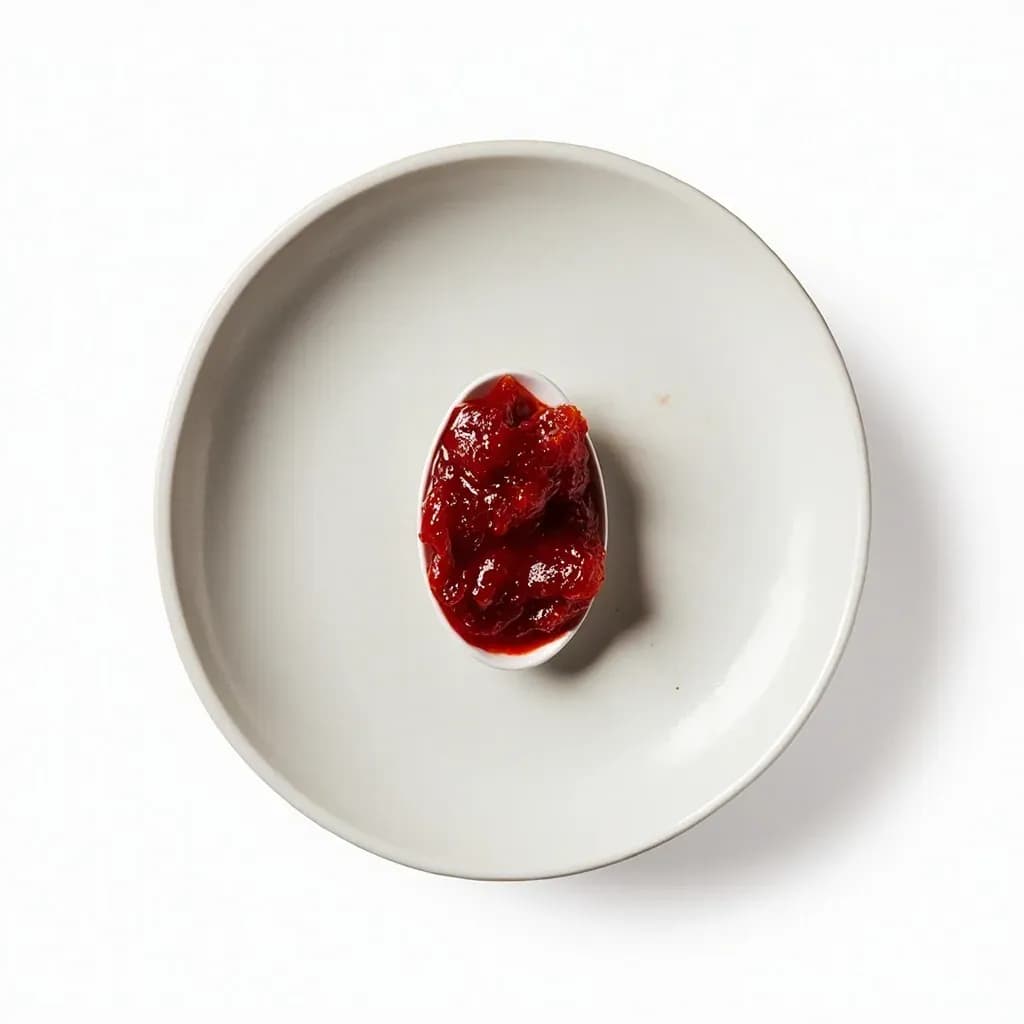
Checking whether jam or jelly has reached its gel point by chilling a spoonful and watching it wrinkle.
The setting test confirms that a jam, jelly, or marmalade has cooked enough to gel as it cools. A cook drops a little hot preserve onto a chilled plate, waits a moment, and pushes it with a finger: if the surface wrinkles or the mixture sheets off a spoon rather than dripping, the pectin set point is reached. It is the practical alternative to relying solely on a thermometer reading of around 220F.
The setting test — better known as the wrinkle, plate, or saucer test — is the cook's home method for answering the single most important question in fruit preserving: has the jam reached its gel point? A small spoonful of the boiling preserve is dropped onto a frozen plate, chilled for under a minute, and pushed with a fingertip. If the surface wrinkles ahead of the finger and holds the wrinkle when the finger lifts, the pectin has set. If the drop runs back to fill the gap, the preserve needs more cooking. The reading is fast, repeatable, and — unlike a thermometer — directly mimics what will happen inside the jar as the preserve cools.
What the test actually detects is the moment when the balance of pectin, sugar, and acid has concentrated enough through evaporation for the long pectin chains to cross-link into a three-dimensional web. That physical change shows up first at around 220°F / 104°C — roughly 8°F above the boiling point of water at sea level — and it is signalled by a characteristic slowing and glossiness of the boiling bubbles as well as the wrinkle behavior on the cold plate. It works equally well for high-pectin fruits like quince and crabapple and for low-pectin fruits like strawberry that have been bolstered with lemon juice or commercial pectin.
The wrinkle test has survived in home kitchens because it judges the finished texture, not just the temperature. A thermometer can tell you that the water has boiled off; only the cold plate can tell you whether this particular fruit, on this particular day, has enough pectin and acid to hold a soft, spoonable set.
- Difficulty
- Easy
Types & varieties
The classic method: a teaspoon of jam on a frozen plate, chilled 30–60 seconds, then pushed with a fingertip. Set jam wrinkles and holds; underdone jam re-fills the gap.
Identical principle using a chilled saucer or small ramekin placed in the freezer at the start of cooking.
A metal spoon is dipped into the boiling jam, lifted, and turned sideways. Two drops that merge and fall as a single sheet signal set; thin, separate drips mean cook longer.
Jam dripped from a ladle or wooden spoon; when two drops coalesce and 'flake' off the edge, the preserve has reached gel point.
An adjunct rather than a substitute — a candy or jam thermometer reading 220°F / 104°C at sea level confirms a passing wrinkle test but cannot detect low pectin or insufficient acid.
A small jar of the cooked jam is placed in the fridge for 15–30 minutes to confirm set before filling and processing the full batch.
How to do it
- 1
Chill the plates in advance
At the start of cooking, place 3–5 small glass or ceramic plates (or saucers) on a flat tray in the freezer. Cold ceramic chills the sample fastest and gives the most reliable read.
- 2
Cook the preserve to the recipe's window
Follow the recipe through its boil, skimming foam, until the mixture has visibly thickened and the bubbles look slower and glossier — usually the last 10–15 minutes of total cook time.
- 3
Drop a sample on a cold plate
Remove the pot from the heat. Drop about 1 teaspoon (5 ml) of jam onto a frozen plate, away from the edge, and return the plate to the freezer for 30–60 seconds.
- 4
Push with a finger
Touch the cooled drop with the tip of a clean finger and drag it gently through the middle. A finished jam wrinkles ahead of your finger and the wrinkle stays put when you lift your hand; an underdone sample runs back to fill the gap and stays liquid.
- 5
Confirm with a second plate
Always repeat on a fresh cold plate before committing — residual heat in the first plate can give a false 'not set' reading. If both plates wrinkle, the batch is done.
- 6
Cross-check (optional)
For confidence at altitude or with unfamiliar fruit, also read a jam or candy thermometer: 220°F / 104°C at sea level matches a passing wrinkle test.
- 7
Skim, fill, and process
Skim any remaining foam, ladle the hot jam into sterilized jars leaving 1/4-inch headspace, wipe rims, seal, and water-bath process per recipe or USDA guidelines (typically 10 minutes for half-pints at sea level).
- 8
Let the jars cool undisturbed for 24 hours
Jam continues to set as it cools. A preserve that looked just barely set in the pot will usually have a perfect, soft gel in the jar the next day.
How pectin actually gels
Pectin is a long-chain polysaccharide wrapped inside the cell walls of fruit. By itself in water it does very little. Once sugar reaches roughly 65% of the mixture's weight and the pH drops to about 3.0–3.4 (the acidity of lemon juice), the chains lose their electrical charge and tangle into a web that traps the sugar-water syrup. That web is the gel. The wrinkle test does not measure sugar or pH directly — it observes the moment the web becomes strong enough to resist flowing at room temperature. That is why the test works for preserves made with commercial pectin, with naturally high-pectin fruit, or with low-pectin fruit rescued by lemon juice, and why it fails gracefully when one of the three ingredients (pectin, sugar, acid) is missing.
- Sugar provides the structural matrix — too little and the web never forms, too much and the gel crystallizes.
- Acid is the trigger — without it pectin stays soluble and the preserve remains a syrup.
- Concentration by evaporation is what brings sugar and acid up to working strength; the wrinkle test marks the end of that concentration.
Reading the plate honestly
A passing wrinkle test has three qualities that together are unmistakable: the cooled drop holds its shape as a dome, the surface wrinkles cleanly ahead of the finger, and the wrinkle stays put for several seconds after the finger lifts. A drop that flattens, that re-flows to fill the track, or that stays glossy and liquid needs more cooking. Many beginners mistake a soft, trembling set for an under-set; in fact a barely-passing plate often produces a perfect, spoonable jar set after 24 hours of cooling, because the gel strengthens as it drops from boiling to room temperature.
- Wrinkle holds when finger lifts → done.
- Drop re-fills the track → cook 2–3 minutes more and retest.
- Plate reads 'not set' but thermometer reads 220°F → suspect low-pectin fruit; add lemon juice or commercial pectin.
Common uses
Tips & pitfalls
- Stash 3–5 small plates in the freezer before you start so you can test repeatedly without waiting for one to chill.
- Pull the pot off the burner while the plate chills — the jam keeps cooking from residual heat and a one-minute overshoot can push it past gel.
- A true set wrinkles as you push it and the wrinkle holds when you stop; if the surface re-flows, keep cooking.
- Test only in the last 10–15 minutes of cook time — early tests are wasted plates and give misleading reads because the sugar has not yet concentrated.
- Remember that jam firms up further as it cools; a barely-set wrinkle on the plate often produces a perfect jar set the next day.
- Over-ripe fruit has weakened pectin; if the wrinkle test lags, add lemon juice to raise acidity or stir in commercial pectin before retesting.
- Hard-water minerals can block gel formation — use bottled or filtered water if your tap is very hard and you are making jelly from juice.
- Stop cooking the moment the wrinkle test passes; re-cooking a set jam to 'fix' it usually breaks the gel and produces a thin syrup.
Good to know
- Also known as
- Wrinkle test, plate test, freezer test, cold-plate test, saucer test, sheeting test (spoon variant)
- Gel point temperature
- Approximately 220°F / 104°C, about 8°F above the boiling point of water at sea level
- Origin
- Traditional cook's test documented in 19th-century preserving manuals and still recommended by the U.S. National Center for Home Food Preservation
- Underlying science
- As water evaporates, sugar concentration rises and pectin chains cross-link in the acid-sugar solution; at gel point the mixture stops flowing freely at cool temperatures
- Altitude effect
- Boiling point drops about 1°F per 500 ft above sea level, so reaching gel point usually takes longer and a thermometer cross-check is helpful
- Test frequency
- Every 2–5 minutes once the mixture has visibly thickened and the foaming slows — usually only in the last 10–15 minutes of cook time
- High-pectin fruits
- Apples, crabapples, quinces, currants, gooseberries, and citrus peels set readily
- Low-pectin fruits
- Strawberries, peaches, rhubarb, cherries, and blueberries often need added pectin or lemon juice to pass the wrinkle test reliably
Also called
Wrinkle Test · Cold Plate Test · Sheet Test · Flake Test · Plate Test
Related

Confit
Cook slowly submerged in fat for silky tenderness and keeping

Cure
Draw out moisture with salt and time to preserve and concentrate

Pickle
Steep in acidic brine for bright, tangy, crunchy preservation

Ferment
Let friendly microbes transform food into tangy, complex flavor

Marinate
Soak in a seasoned mix to flavor and tenderize before cooking

Brine
Soak in salt water so meat stays juicy and seasoned throughout

Dehydrate
Slowly dry out moisture to concentrate flavor and extend shelf life

Cold-Smoke
Perfume cured food with smoke without cooking it through