Knife Skills
Shiraga Negi (White Hair Onion Cut)
Slicing the white of a leek or scallion into fine hair-thin threads for a delicate garnish.
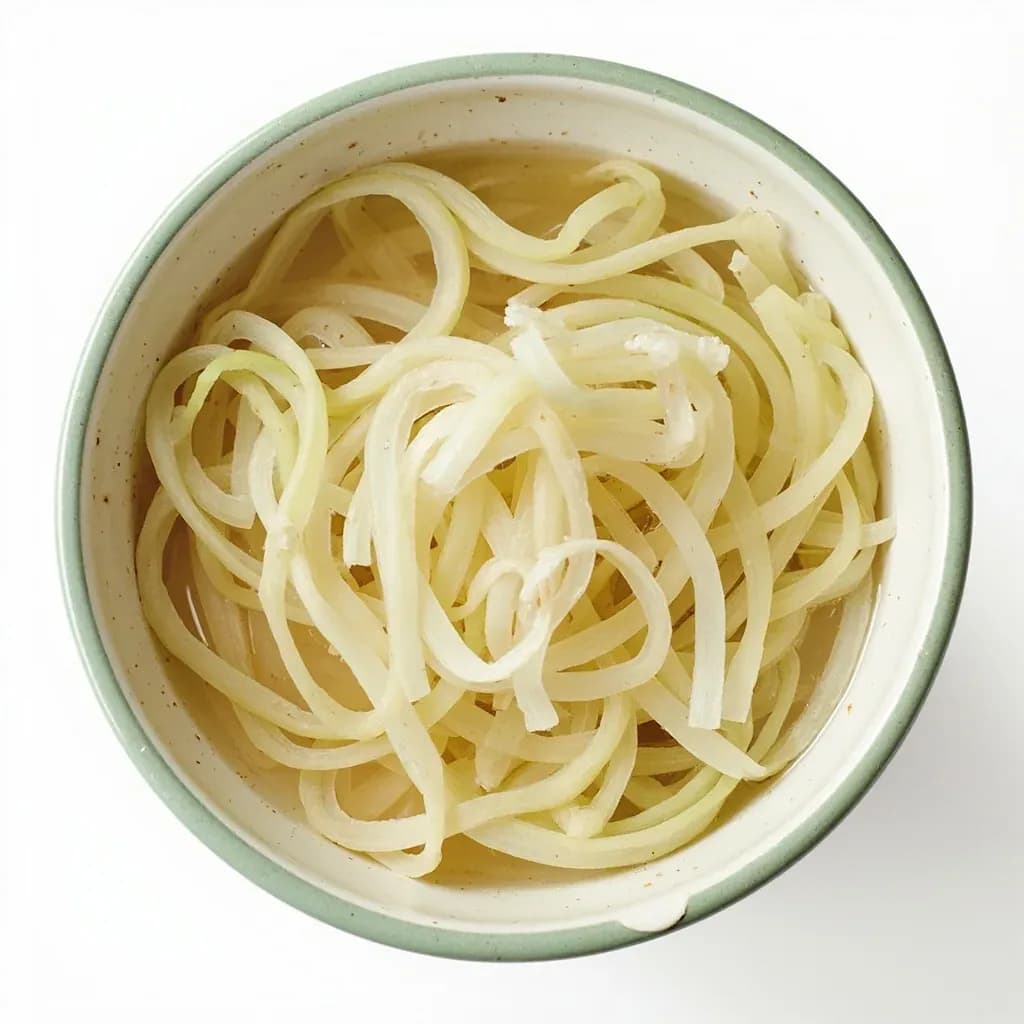
Shiraga negi, literally white-hair onion, is a Japanese cut that turns the white part of a long onion or scallion into very fine threads. The white is cut into segments, opened flat, the core removed, and the layers stacked and sliced lengthwise into hairlike strips, then soaked in cold water to curl and crisp. It is used as a fresh, pungent garnish on ramen, grilled meats, and donburi.
Shiraga negi — literally "white-hair onion" — is a Japanese knife-cut garnish in which the white base of a negi (Japanese long onion) is sliced into thread-fine filaments, shocked in ice water, and served in a feathery white mound. The cut is named for the visual resemblance: after the cold bath the threads curl and brighten into something that looks, against a dark broth or seared beef, like a tuft of fine white hair. Beyond looks, the technique transforms the onion itself: the long, thin cell walls release their sharp, sulfurous compounds quickly, so within minutes of the ice bath the threads taste clean, sweet, and gently pungent rather than biting or grassy.
The cut belongs to a family of precision Japanese knife work — most closely related to sengiri-style fine julienne — where texture and visual contrast are as important as flavor. Because the filaments are so fine, they are never meant to be chewed so much as scattered, folded, or stirred in at the last moment — a cooling, almost weightless counterpoint to rich, hot, or fatty foods. A few threads on a bowl of gyudon or a dipping sauce for cold soba are the difference between a homestyle plate and one that looks like it came from a soba-ya counter.
Practically, shiraga negi is less about difficulty than about discipline. The knife must be sharp, the onion must be cold, and the cuts must be made in two perpendicular passes so the finished threads remain attached at one margin until the final moment they are dropped into water. Done well, the threads are uniformly paper-thin, bright white, and springy; done sloppily they turn mushy, ragged, or tinged with green from carrying too much of the leaf into the cut.
- Difficulty
- Medium
Types & varieties
Made strictly from the white base of negi; threads are pure white and uniform, the form most often seen in soba shops and gyudon counters.
Allows a small amount of the pale-green portion near the white; threads show a faint green tint and carry a slightly stronger allium flavor.
A finer cross-cut of green onion rings used as a related but distinct decorative garnish; not the same technique.
Sometimes used to describe the same cut on Chinese-style Welsh onion, though the proper family name for those is aonegi.
How to do it
- 1
Select and prep the negi
Choose a firm, thick-stalked negi. Trim off the dark green tops, leaving roughly 12–15 cm of the white and pale-green portion. Slice off the root end flat so the stalk stands upright and stable on the board.
- 2
Halve (or quarter) lengthwise
Slice the stalk in half lengthwise. If the stalk is thick, quarter it lengthwise so each piece is no more than about 1.5 cm wide — wider pieces will not yield true hair-thin threads.
- 3
Score lengthwise into sheets
Lay a piece cut-side down. Make a series of very fine, parallel cuts along the length, stopping about 5 mm from the base so the piece remains attached at one end. Each slice should be roughly 0.5 mm thick; sawing or pressing will tear the fibers.
- 4
Rotate and cut crosswise into threads
Rotate the piece 90°. Now slice crosswise at the same 0.5 mm spacing, again leaving a small uncut margin at one end to hold the structure. The result is a fine fringe of paper-thin filaments.
- 5
Shock in ice water
Drop the fringed pieces into a bowl of well-iced water. Swish gently with your fingertips so the threads separate and curl. Soak 10–30 minutes until bright white and springy.
- 6
Drain and serve
Lift the threads from the water and drain thoroughly in a fine-mesh sieve, then pat lightly with a clean kitchen towel. Mound gently on the dish just before serving so the threads keep their height and curl.
The logic behind the cold bath
The ice-water soak is not a garnish habit — it is the entire reason the cut works. When the fine threads hit ice water, three things happen at once: the cells firm up (keeping the cut crisp rather than limp), the residual sulfur compounds leach out into the water (taming the raw bite), and the unequal water content along each filament causes them to twist into the signature soft curl. Skip the bath and you get a small heap of limp, sharply pungent slivers; over-soak and you get pale, waterlogged threads that bleed into whatever dish they sit on.
Choosing the right negi
Look for stalks that are thick, straight, and tightly layered at the white end. A thin or wobbly stalk is harder to halve cleanly and produces a low yield of usable threads. Japanese negi (the long, white-shouldered type) is ideal, but a fat leek, trimmed to its palest core, makes an acceptable stand-in when sliced along the grain of its layers.
Common uses
Tips & pitfalls
- Chill the negi thoroughly (30+ minutes in the refrigerator) before cutting; cold cells slice cleanly without tearing or smearing.
- Use a freshly honed yanagiba or a sharp, narrow sujihiki — a dull blade crushes the fibers and bruises the flavor.
- Trim the root end flat so the stalk stands upright; a wobbly base is the most common cause of ragged, uneven threads.
- Make the cross-cuts in one smooth pull; sawing shreds the filaments and turns the finished garnish into mush.
- Submerge the threads in ice water immediately after cutting — the cold shock is what creates the signature curl, and delay costs you both color and texture.
- Change the ice water once if preparing large quantities; cloudy water dulls the threads and slows the curl.
- Drain very well on a clean kitchen towel or in a fine-mesh sieve; excess water dilutes sauces and pools on the plate.
- Use only the white-to-pale-green portion; the deep green leaves will not whiten in the bath and will taste bitter.
- If you lack a yanagiba, a sharp, narrow-bladed sujihiki is the next-best choice; wider blades make fine cross-cuts harder to control.
Good to know
- Japanese Name
- 白髪葱 (Shiraga Negi)
- Literal Translation
- White Hair Onion
- Source Ingredient
- White base of Japanese long onion (negi, Allium fistulosum)
- Knife Typically Used
- Yanagiba or other very sharp, thin-bladed knife; sujihiki is a good substitute
- Thread Thickness
- Approximately 0.5–1 mm — paper-thin cross-section
- Yield
- About 1 cup of finished threads from one medium negi stalk
- Soak Time
- 10–30 minutes in ice water to develop the curl
- Storage
- Submerged in cold water, refrigerated, up to 24 hours; drain before serving
Also called
Shiraga Negi (White Hair Onion Cut) · White Hair Onion Cut · Negi Threads
Related

Chop
Cut into rough, irregular pieces — the everyday workhorse cut

Dice
Cut into uniform cubes for even cooking and a tidy look

Mince
Cut as fine as possible so flavor melts evenly into the dish

Slice
Cut into even, flat pieces for consistent cooking and presentation

Julienne
Cut into thin matchsticks for fast cooking and elegant garnish

Brunoise
Cut into tiny, precise cubes — the finest dice in the kitchen

Chiffonade
Roll and slice leafy greens into delicate ribbons

Batonnet
Cut into tidy sticks, thicker than julienne — think classic fries