Heat & Fire
Snake / Minion Method
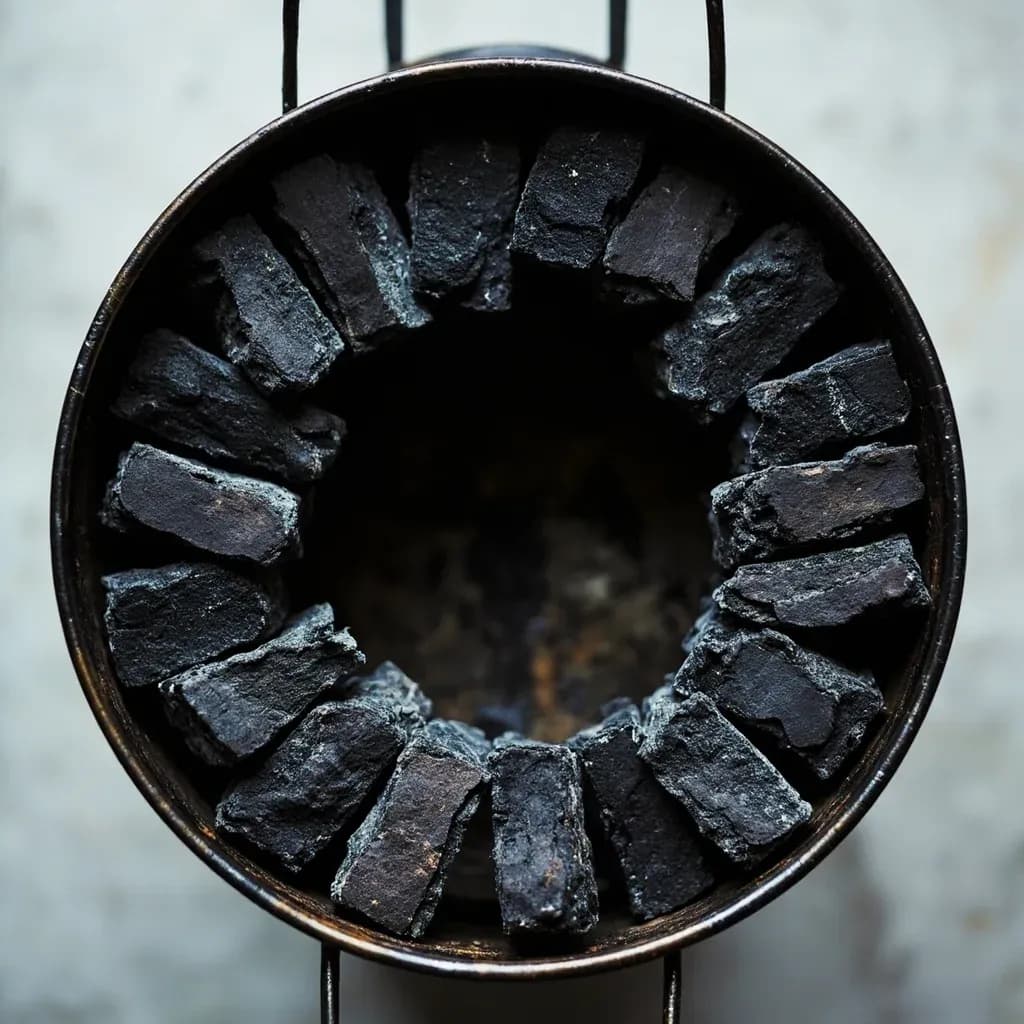
Arranging unlit charcoal in a curving line so it ignites slowly for long, steady low-heat smoking.
The snake or minion method lays unlit charcoal briquettes in an overlapping ring or line around the edge of a kettle grill and lights only one end. The fire creeps slowly along the chain over many hours, holding a low, stable temperature ideal for smoking without constant refueling. Wood chunks placed along the snake release smoke gradually as the burn reaches them, making it a favorite for long low-and-slow cooks on a basic kettle.
The Snake and Minion methods are two closely related approaches to charcoal fuel management for low-and-slow barbecue, and they share a single elegant idea: light a small starter batch of briquettes and let it slowly ignite a much larger unlit mass. As the fire creeps through the fuel, it releases a steady, predictable stream of heat — typically 225–275 °F — for six to eighteen hours, without the temperature spikes that plague a freshly lit fire and without the need to add fresh coals mid-cook. The result is a long, even burn that asks almost nothing of the cook once the cooker is set.
The Minion Method takes its name from forum user Jim "Minion" and was popularized on The BBQ Brethren around 2002; it is the standard fueling scheme for vertical bullet smokers like the Weber Smokey Mountain, where a charcoal basket is filled with unlit briquettes and a small well of lit coals is placed on top, sinking down through the mass as the fire progresses. The Snake Method adapts the same principle to a kettle grill by laying the unlit briquettes in a continuous ring around the inside of the firebox — usually two wide and two high — and lighting one end so the fire travels around the perimeter like a burning fuse.
For cooks who want an unattended, steady-temperature smoke — overnight brisket, workday pork shoulder, Thanksgiving turkey — these methods are a near-perfect answer. They trade some of the deep browning and aggressive smoke character of a hot, fast burn for consistency and ease, and they free the cook from the endless cycle of feeding logs and stoking a fire that defines offset stick-burner work.
- Difficulty
- Medium
Types & varieties
Linear ring of unlit briquettes stacked 2–3 wide around the inside edge of a kettle grill; one end is lit so the fire creeps around the perimeter.
Charcoal basket filled with unlit briquettes and a small well filled with 8–12 lit briquettes placed on top; the standard approach on the Weber Smokey Mountain and similar bullet smokers.
Snake bent into a U so the lit and unlit ends finish in convenient positions relative to vents and meat placement.
Two parallel rows of briquettes for slightly higher heat (275–300 °F) or larger cookers with more grate area.
Snake ringed around a center water/drip pan, which stabilizes temperature, adds humidity for bark formation, and catches drippings.
How to do it
- 1
Clear and prep the cooker
Remove the cooking grate and any old ash. Confirm the charcoal ring or basket is clean and that the bottom vents move freely.
- 2
Build the snake
Arrange unlit briquettes in a continuous line around the inside perimeter of the charcoal ring, 2 briquettes wide and 2 high. The line should touch itself end-to-end to form a complete ring.
- 3
Place wood chunks
Lay 4–6 hardwood chunks along the top of the snake, spacing them every 5–6 briquettes. Put 1–2 chunks at the end where you will light the fire so smoke is present from the start.
- 4
Set the water pan
Position a foil or ceramic water pan in the center of the cooking chamber and fill it with hot water. On a bullet smoker it sits on the lower rack; on a kettle it sits on the charcoal ring's inner edge.
- 5
Light the starter coals
In a chimney starter, light 6–8 briquettes until they are ashed over — gray on the outside, glowing red inside — about 12–15 minutes.
- 6
Ignite the snake
Dump the lit coals at one end of the snake, directly on the unlit briquettes and adjacent to your first wood chunk. Open all bottom vents; open the top vent about 50%.
- 7
Stabilize the temperature
Reinstall the cooking grate, close the lid, and let the cooker run 20–30 minutes. Watch the thermometer and adjust the top vent — close it to drop temperature, open it to raise — until you settle at 225–250 °F.
- 8
Load the food
Place meat on the grate once the target temperature has held steady for 10–15 minutes. Position it opposite the lit end so smoke washes over it as the fire travels around the ring.
- 9
Manage the cook
Adjust only the top vent to hold temperature. Expect the fire to reach the far side of the snake near the end of the cook; the visible heat trace is your fuel gauge.
- 10
Finish and refuel
When the snake is nearly spent and temperatures begin to drop, build a new snake or move the meat to a cooler or holding wrap. Do not add fresh unlit coals to the active snake.
Snake vs. Minion: What's the Difference?
The two names are often used interchangeably, but they describe different geometries. The Minion Method is the original: a charcoal basket heaped with unlit briquettes, with lit coals placed in a small well on top so the fire burns downward through the mass. It was developed for vertical bullet smokers where the basket sits directly under the cooking chamber. The Snake Method is a kettle-grill adaptation that uses the same slow-ignition principle but lays the unlit fuel in a horizontal ring around the perimeter of the firebox, with the fire traveling sideways around the ring. Both produce comparable results in the 225–275 °F range; the choice is dictated by cooker shape rather than cooking intent.
- Minion = top-down ignition in a full basket; standard for bullet smokers.
- Snake = sideways ignition around a perimeter ring; standard for kettle grills.
- Both are 'set-and-forget' approaches that free the cook from active fire management.
Common uses
Tips & pitfalls
- Use briquettes, not lump — briquettes are uniform in size and burn at a predictable rate so the snake progresses evenly; lump varies too much in size and density to time well.
- Stack the snake 2 briquettes wide and 2 high for a standard 22-inch kettle; go 3 wide on a 26-inch kettle or for longer cooks.
- Place wood chunks at the lit end first and spaced every 5–6 briquettes along the snake; chunks smolder and release smoke as the fire reaches them, so order matters.
- Fill a center water pan with hot water — it acts as a heat sink to smooth temperature swings and adds humidity that helps bark formation.
- Light only 6–8 briquettes in a chimney; more lit coals means a faster burn and temperatures that overshoot 300 °F.
- Open the bottom vents fully and control temperature almost entirely with the top vent — closing it 50–75% during the cook is normal and expected.
- Don't lift the lid for the first 45–60 minutes; frequent peeking starves the fire of oxygen and can stall the snake before it gets going.
- Don't add fresh unlit briquettes mid-cook to extend the burn — it disrupts the slow progression and creates a temperature spike that throws off timing and smoke quality.
- Rotate the food 180° halfway through if your cooker has hot spots; the snake produces even heat, but lid and vent geometry can bias one side.
- On very cold or windy days, fit an insulating blanket (kettle blanket, WSM insulating ring) to keep the snake from going out or running cold.
Good to know
- Also known as
- Snake/Fusee Method; closely related to the Minion Method (named for Jim Minion, popularized on The BBQ Brethren around 2002)
- Typical cook temperature
- 225–275 °F (107–135 °C)
- Burn duration
- 6–18 hours depending on briquette count, width of the snake, and vent settings
- Fuel
- Standard briquettes (Kingsford, Royal Oak, B&B) preferred over lump for predictable burn rate
- Smoke wood
- Hardwood chunks (oak, hickory, cherry, apple, pecan) placed every 4–6 briquettes along the snake; avoid chips which burn out too fast
- Cookers it suits
- Weber kettle grills, Weber Smokey Mountain and other bullet smokers, barrel smokers, and any charcoal cooker with a charcoal basket or fire ring
- Airflow control
- Bottom vents fully open, top vent 25–50% open — the top vent is the primary temperature lever
- Lighting
- Only 6–8 lit briquettes are needed to start the chain reaction
- Difficulty
- Beginner-friendly; lower management overhead than stick-burner or offset smoking
- Pre-cook setup time
- 20–30 minutes to arrange the snake and bring the grill to target temperature
Also called
snake method · minion method · fuse method
Related

Sear
Blast the surface hot for a deep-browned, savory crust

Sauté
Cook quickly in a little fat over lively heat, tossing as you go

Stir-Fry
Toss bite-sized pieces over roaring heat for fast, smoky cooking

Pan-Fry
Crisp food in a shallow layer of hot fat, turning once or twice

Deep-Fry
Submerge in hot oil for an all-over crackling crust

Roast
Cook uncovered in dry oven heat for browned edges and tender centers

Bake
Cook with steady, surrounding oven heat — the soul of bread and pastry

Broil
Hit food from directly above with fierce overhead heat