Prep & Assembly
Soaking Dried Lime (Loomi)
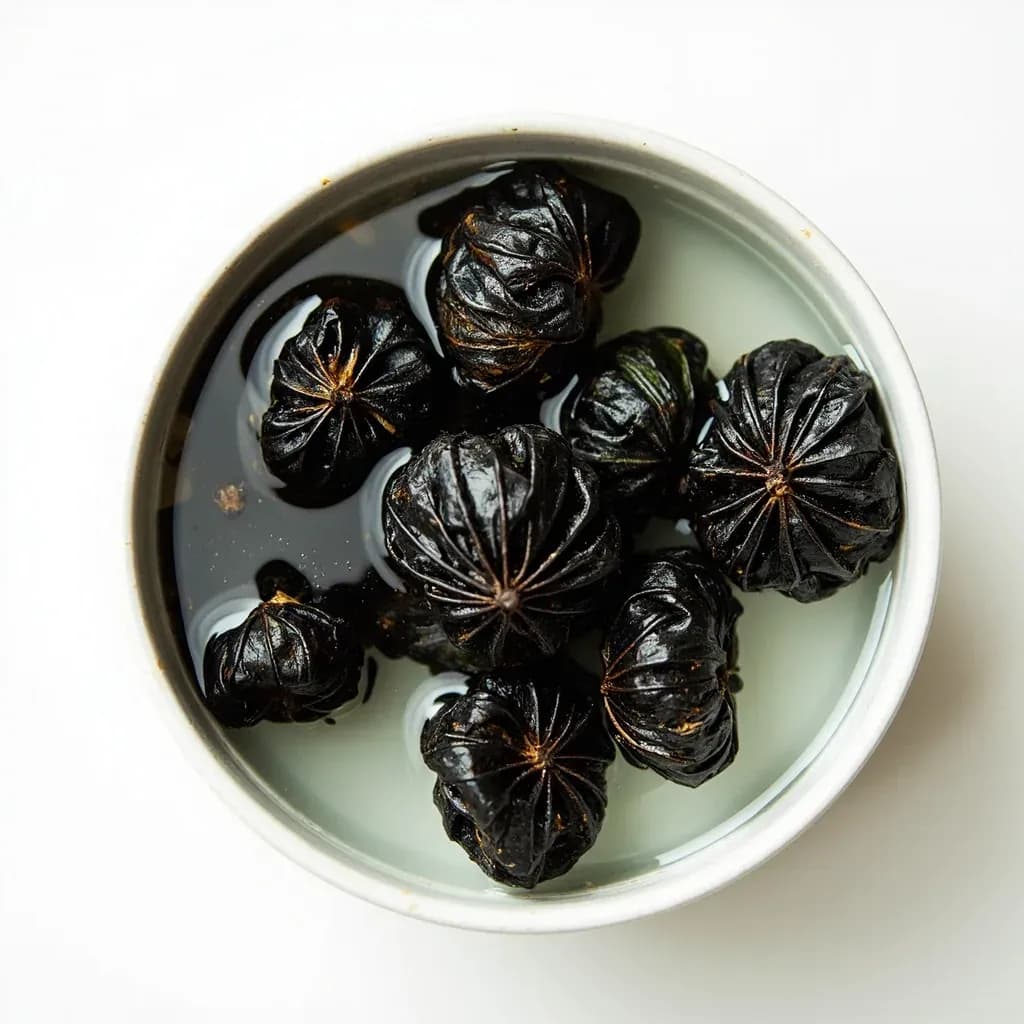
Rehydrating black dried limes to release their sour, fermented citrus flavor into a dish.
Soaking dried lime softens hard black or tan loomi in warm water so their intense sour, slightly fermented citrus flavor can disperse into stews and rice. The limes are often pierced or crushed first to speed the release, then simmered whole in Persian and Gulf dishes. Soaking tempers their tartness and prevents an overpoweringly bitter rind. They are usually removed before serving or eaten only by the bold.
Dried limes — sold as loomi, limoo amani, limoo Omani, or simply black lime across the Persian Gulf and Iran — are small citrus fruits briefly boiled in salt brine and then sun-dried for weeks until they are rock-hard, wrinkled, and nearly black. Their flavor sits well outside the register of fresh citrus: a deep, fermented sourness laced with earthy, faintly smoky, almost umami undertones, and almost none of the bright floral lift of fresh lime juice. That intensity is what makes them prized in Persian khoresh, Iraqi maraq, and Gulf rice dishes, but it is also why they must be rehydrated with intent — a whole, unpierced dried lime dropped into a pot will barely give up any of its flavor.
Soaking is the controlled softening of the dried fruit in hot or cool water so the flesh becomes pliable and the volatile acids leach out into the liquid. A 20–30 minute steep in just-off-the-boil water (or an 8–12 hour cold soak) after piercing the skin is the difference between a stew that whispers of citrus and one that tastes authentically of loomi. The soaking water itself is part of the technique: it carries a real share of the acidity and should be strained into the dish rather than poured down the sink.
- Difficulty
- Easy
Types & varieties
The default form: boiled in brine, sun-dried until nearly black. Strongly sour, fermented, and complex. The workhorse for most stews and rice dishes.
Sun-dried without the brine boil; tan to pale grey. Milder, more floral, less fermented. Used in delicate Persian rice dishes and some fish preparations.
The Iranian standard; small, dark, and very hard. Punches well above its weight in khoresh.
From Oman and the southern Gulf; similar appearance, occasionally a touch larger and slightly less bitter.
Pierced or lightly cracked limes rehydrate faster; fully split halves release flavor quickly but disintegrate during long cooking.
Pre-ground; needs no soaking. Convenient but loses volatile aromatics within months of opening.
How to do it
- 1
Rinse and inspect
Place 2–4 whole dried limes in a small bowl and rinse briefly under cool running water to remove any dust, sand, or surface salt from the drying process. Pat dry and discard any that are already cracked open, feel damp, or smell musty.
- 2
Pierce or crack each lime
Using a paring knife tip, skewer, or the point of a sturdy fork, pierce each lime 3–4 times through the tough skin, going about 5–8 mm deep. For faster rehydration, tap each lime once firmly with the back of a heavy knife or the bottom of a small saucepan to fracture the skin — aim to crack, not smash.
- 3
Cover with hot water
Transfer the pierced limes to a heatproof bowl and pour over just-off-the-boil water (around 90–95°C / 195–205°F) until the limes are covered by about 1 cm of water. Use roughly 250–375 ml of water for 2–4 limes.
- 4
Soak
Let the limes steep in the hot water for 20–30 minutes, until they have softened enough to be gently pressed with the back of a spoon and feel pliable rather than rock-hard. For a slower, more delicate rehydration, cover with cool water and refrigerate 8–12 hours instead.
- 5
Strain and reserve the liquid
Lift the rehydrated limes out with a slotted spoon. Strain the soaking liquid through a fine mesh strainer to catch any small skin or seed fragments — this liquid is flavorful and should be added to the dish along with, or in place of, some of its cooking liquid.
- 6
Use as directed
Add the rehydrated limes whole, halved, or roughly torn to the dish during cooking. For stews, drop them in 30–45 minutes before the end of cooking so the flavor permeates but the flesh does not fully dissolve. For rice dishes, nestle them in at the start of the steaming step. Remove before serving if you prefer a cleaner plate, or warn diners that the softened limes are edible.
When to skip the soak
Many Persian and Iraqi home cooks never bother soaking. For a khoresh or a tashreeb that simmers for 90 minutes or more, piercing the limes and dropping them straight into the braising liquid is perfectly effective — the long, moist heat does the rehydrating for you, and the fruit eventually softens enough to press flat with a spoon. Soaking earns its place in three situations: shorter cook times where the limes would not otherwise soften, rice dishes where the fruit steams rather than simmers, and any application where the rehydrated lime will be eaten rather than fished out at the end. The soak also gives you more control: you can taste the soaking water and judge potency before committing it to the dish, and dial the sourness up or down by how much liquid you strain in.
Common uses
Tips & pitfalls
- Always pierce or crack the limes before soaking — the skin is nearly impermeable and a whole, unpierced fruit will not rehydrate or release meaningful flavor.
- Use just-off-the-boil water for 20–30 minutes for a fast soak, or cold water refrigerated 8–12 hours for a gentler, less bitter rehydration.
- Do not discard the soaking water — strain it into the dish. It carries a significant share of the sour, fermented flavor.
- For long-cooked stews (90 minutes or more), you can usually skip pre-soaking entirely and add the pierced limes directly to the cooking liquid; they will rehydrate in the pot.
- Cap hot soaks at 30–45 minutes. Longer steeping in very hot water turns the flavor harsh and slightly bitter.
- Start with 1–2 whole limes per 4 servings. They are potent, but the flavor needs volume to register across a whole dish.
- Store whole dried limes in a sealed jar away from light and heat; humidity causes them to soften unevenly and can invite mold.
- Smell-test older stock: dried limes lose potency after about 18 months. If they have little aroma, replace them or switch to ground form.
- Do not confuse dried limes with salt-preserved limes (the Moroccan-style fruits packed in brine) — they are not interchangeable in flavor or function.
Good to know
- Also known as
- Loomi, limoo amani, limoo Omani, black lime, Persian dried lime
- Origin
- Persian Gulf region; standard in Persian, Iraqi, Kuwaiti, Omani, and broader Gulf Arab cooking
- Made from
- Small Persian or Omani limes, briefly boiled in salt brine then sun-dried 2–4 weeks
- Active time
- 5 minutes prep; 20–30 minutes hot soak, or 8–12 hours cold
- Water temperature
- Just off the boil, around 90–95°C / 195–205°F
- Soaking ratio
- Cover the limes with about 1 cm of water above them
- Typical usage
- 1–2 whole limes per 4 servings; ½–1 tsp ground per dish
- Storage
- Whole limes keep 1–2 years in an airtight container away from light and heat; ground keeps 6–12 months
Also called
Soaking Dried Lime (Loomi) · Soaking Dried Lime · Loomi
Dishes that rely on it
Related

Whisk
Beat ingredients smooth and aerated with a looping wire motion

Sift
Pass dry ingredients through mesh to aerate and remove lumps

Strain
Pour through mesh to separate solids from liquid for a smooth result

Filter
Pass liquid through fine material to clarify out the smallest particles

Rice
Press cooked potatoes through small holes for fluffy, lump-free texture

Mash
Crush soft cooked food into a rustic, creamy purée

Grind
Crush food into a coarse to fine texture, from spices to meat

Grate
Shred food into fine bits against a sharp-toothed surface