Prep & Assembly
Spinning Sugar
Flicking molten caramel into fine threads for delicate sugar decorations.
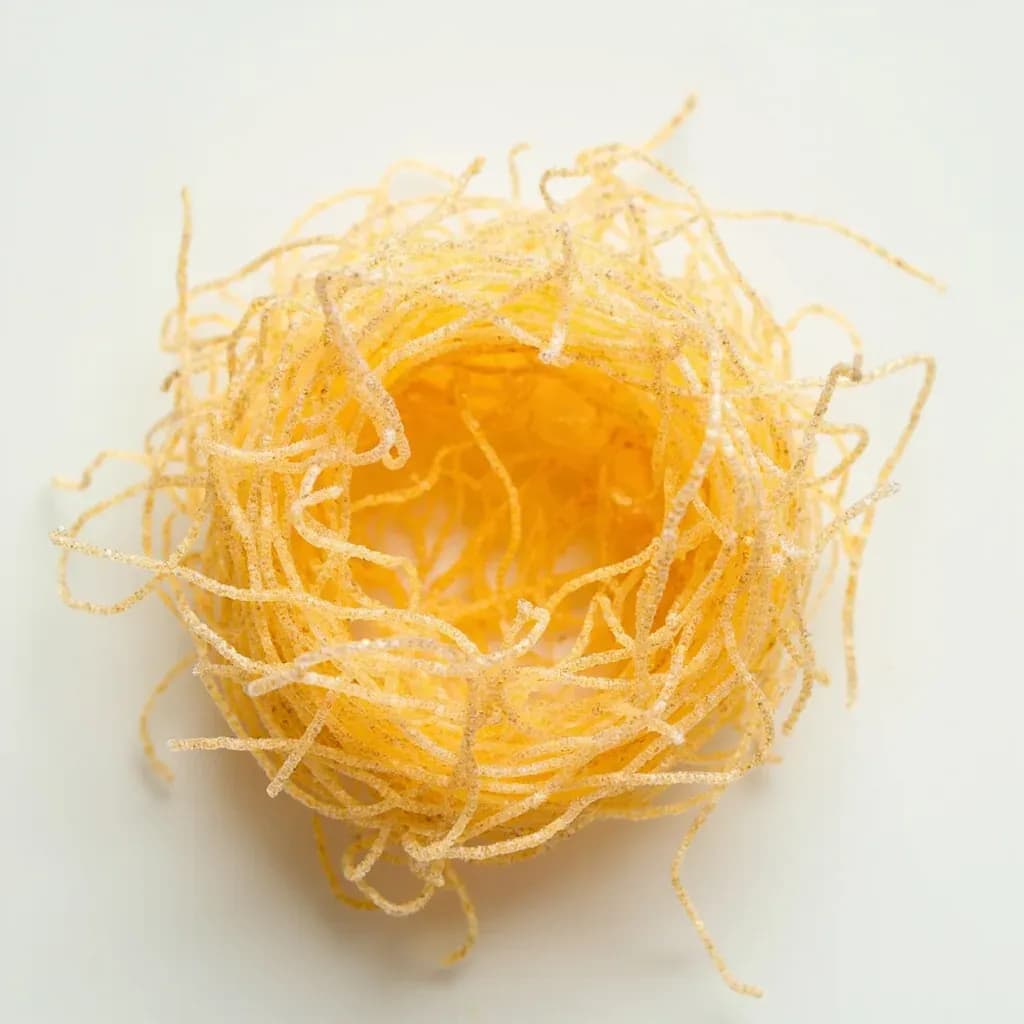
Spinning sugar drizzles cooked caramel from a fork or whisk so it falls in fine golden threads that set instantly into airy, glassy strands. Pulled and cast variants shape the same syrup into ribbons, domes, and showpieces. It demands sugar cooked to the hard-crack stage and quick handling, since the strands harden and can scorch in seconds and the hot syrup burns easily.
Spun sugar — sometimes called caramel filé or cheveux d'ange ("angel hair") — is one of the most theatrical techniques in classical pâtisserie. It transforms hard-crack caramel into gossamer-thin filaments that shatter at the lightest touch and look like frozen wisps of golden thread. Beyond its visual drama, the technique is prized for the textural contrast it brings: a brittle, glassy crunch layered against soft cream, choux, or mousse — the kind of finish that signals a pastry chef at work.
The process is straightforward in principle — cook sugar to the hard-crack stage and fling it through the air — but it punishes inattention. Temperature, humidity, and rhythm each dictate whether the result looks like a fairy-tale cloud or a clumpy mess. Practitioners work in short bursts because the syrup stiffens within seconds of leaving the pan, and they guard against moisture at every stage, since even a breath of humid air can fog the threads from glass-clear to tacky.
The technique traces to nineteenth-century French haute pâtisserie, where Antonin Carême and his contemporaries codified elaborate sugar work to crown pièces montées and croquembouches. It remains a signature skill of competition pastry chefs and an unmistakable flourish on a finished dessert plate.
- Difficulty
- Hard
Types & varieties
Plain granulated sugar cooked to hard crack; pale amber, neutral-sweet, the most traditional form.
Partial substitution of honey for sugar; adds floral aroma and a warmer color.
Sugar substitute spun at a lower temperature (~138–145 °C); clearer, whiter, and far more tolerant of humidity.
Gel-paste or powdered food coloring whisked in just off the heat for red, gold, or pastel threads.
A few drops of vanilla, orange blossom, rose, or other extract stirred in off the heat for aromatic garnishes.
Finished threads brushed with edible gold or cocoa butter powder for a shimmering finish.
How to do it
- 1
Prepare the workspace
Line the floor or counter with parchment. Set two chairs or stands about 1 m apart and rest a clean wooden dowel, broom handle, or rolling pin across them. Have two forks (or a whisk/spider) and parchment-lined trays ready within arm's reach. Keep a bowl of ice water beside you for emergencies.
- 2
Cook the sugar
Combine 400 g granulated sugar, 100 g water, and 80 g glucose syrup (plus a pinch of cream of tartar if using) in a heavy-bottomed pan. Bring to a boil over medium heat, wash down the inner walls with a wet pastry brush to dissolve stray crystals, then cook uncovered to 149–154 °C / 300–310 °F (hard crack).
- 3
Stabilize and color
Pull the pan off the heat and swirl in gel-paste color or a few drops of extract. Let the syrup settle for 15–20 seconds so it thickens slightly and cools to a safe-but-fluid working temperature; pouring at full boil produces brittle, uneven threads.
- 4
Spin the threads
Dip two forks back-to-back into the syrup, stand over the dowel, and flick the forks rapidly in a horizontal pendulum motion. The caramel flies off in fine arcs that drape over the dowel. Keep the rhythm even and sweep the forks side to side to build a curtain of uniform threads.
- 5
Collect and shape
Lift the dowel and slide the gathered threads onto parchment, or drape directly over a croquembouche cone. Loosely shape into nests, crowns, or bundles while still pliable. Do not pack the threads tightly — they need air around them to stay crisp and shatter attractively.
- 6
Repeat or reheat
Return remaining syrup to low heat to keep it fluid and spin further batches. Work swiftly; each portion firms in under two minutes. Discard any syrup that scorches or turns dark amber, as it will taste bitter and burn easily on reheating.
- 7
Store or serve
Use the threads immediately for maximum shatter, or store in an airtight container with silica gel for up to 2–3 weeks. Avoid refrigeration, which introduces condensation and softens the threads.
Humidity, timing, and the working window
Spun sugar lives and dies by a very narrow window of conditions. Three forces act on it simultaneously: the temperature of the syrup, the moisture in the room, and the time elapsed since it left the pan. Understanding how they interact is what separates confident spinning from fumbling.
- The syrup is workable for roughly 60–90 seconds after it reaches hard crack — long enough for one or two passes over the dowel, not long enough to dawdle.
- Relative humidity above 50% will fog the threads almost as soon as they hit the air; on rainy days, the same syrup that spun beautifully yesterday will turn into tacky clumps.
- Glucose syrup or a pinch of cream of tartar buys time and clarity by inhibiting crystallization in sucrose; isomalt sidesteps the problem by being far less prone to crystallization in the first place. Either approach is why professional recipes rarely spin plain wet sugar.
- Reheating stiff syrup is acceptable two or three times provided it has not scorched; once it darkens past deep amber, throw it out and start fresh.
Equipment notes
Specialty sugar spinners exist, but most pastry cooks spin with whatever is at hand. The choice of tool shapes the texture of the threads more than any other variable besides temperature.
- Two forks held back-to-back and flicked in a horizontal pendulum give fine, even filaments — the classic training method.
- A balloon whisk dipped in the syrup produces slightly thicker, more rope-like threads that drape beautifully over croquembouche cones.
- A Chinese spider or large skimmer covers more area per pass and is the fastest option for draping a tall structure.
- A dedicated sugar spinner (a handled drum with tines) yields the most uniform production work but is rarely needed outside a professional setting.
Common uses
Tips & pitfalls
- Cook in a heavy-bottomed pan and never stir once the syrup boils — agitation is the fastest route to crystallization and a grainy, opaque result.
- Add a tablespoon of glucose syrup or a small pinch of cream of tartar at the start to keep the syrup clear, fluid, and forgiving.
- Wipe the pan's inner walls with a wet pastry brush as the sugar heats to dissolve stray crystals before they seed the whole batch.
- Let the syrup rest off the heat for 15–20 seconds before spinning; pouring at full boil produces brittle, irregular threads.
- Practice the flicking motion over the dowel before dipping — a steady wrist and even tempo are what give uniform filaments.
- Layer spun threads in a loose nest rather than a tight ball so they stay crisp and shatter cleanly when bitten or broken.
- Schedule spinning for dry days or work in an air-conditioned pastry kitchen; humidity above 50% will collapse the threads.
- Soak used forks, whisks, and pans in hot water immediately; hardened caramel is nearly impossible to remove once cool.
- Keep a bowl of ice water at hand for burns — molten sugar sticks to skin and continues burning until cooled, so quick immersion matters.
Good to know
- Also known as
- Sugar spinning, caramel filé, cheveux d'ange ("angel hair")
- Sugar stage required
- Hard crack, 149–154 °C / 300–310 °F
- Origin
- French haute pâtisserie, codified in the 19th century; Antonin Carême is credited with popularizing elaborate sugar work
- Primary tools
- Two forks, balloon whisk, Chinese spider, or dedicated sugar spinner; threads collected over a wooden dowel between two supports
- Working time
- Roughly 60–90 seconds per batch before the syrup stiffens; reheating may be required
- Humidity tolerance
- Best below 50% relative humidity; damp air causes threads to soften and collapse
- Storage
- Up to 2–3 weeks in an airtight container with silica gel, kept dry
- Difficulty
- Advanced — requires precise temperature control, fast hands, and comfort working with extremely hot sugar
Also called
spun-sugar · pulled-sugar · sugar-casting
Related

Whisk
Beat ingredients smooth and aerated with a looping wire motion

Sift
Pass dry ingredients through mesh to aerate and remove lumps

Strain
Pour through mesh to separate solids from liquid for a smooth result

Filter
Pass liquid through fine material to clarify out the smallest particles

Rice
Press cooked potatoes through small holes for fluffy, lump-free texture

Mash
Crush soft cooked food into a rustic, creamy purée

Grind
Crush food into a coarse to fine texture, from spices to meat

Grate
Shred food into fine bits against a sharp-toothed surface