Prep & Assembly
Garnishing
Adding final decorative or flavorful elements to a dish before serving.
Garnishing finishes a plate with herbs, sauces, edible flowers, citrus, or crunchy elements that add color, aroma, and contrast. Beyond looks, the best garnishes echo flavors in the dish and add textural interest. Restraint matters, as a garnish should complement rather than clutter the plate.
Garnishing is the final act of plating — the deliberate placement of an edible element on a finished dish to complete its appearance, aroma, or flavor. Where the rest of cooking builds a plate from raw ingredients, garnishing solves the last problem: a missing color, a flat aroma, a texture that needs contrast, or a final seasoning to bring everything into focus. Done well, it disappears into the dish, the eye never separating garnish from food.
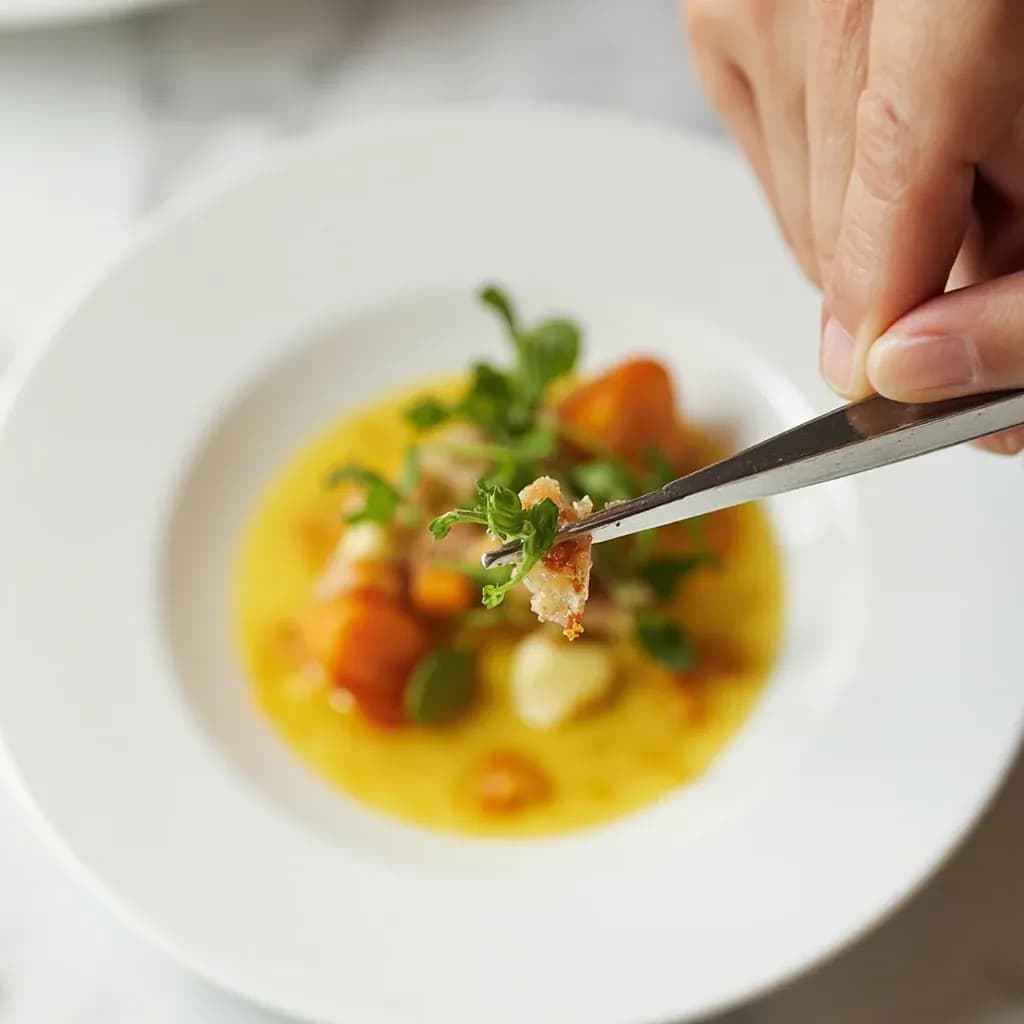
The technique runs from a single pinch of fleur de sel on a roasted carrot to the precise tweezers-driven compositions of modern fine dining, but the rules are constant. A proper garnish must be edible and should relate to the dish — echoing, complementing, or contrasting a flavor already present. It is applied at the last possible moment, since fresh herbs wilt, fried shallots soften, and foams collapse within minutes. Fresh garnishes go on at the pass; crispy garnishes go on as the plate is lifted for service.
While cooks have finished plates with herbs, flowers, and condiments for centuries — Roman, Persian, Chinese, and Ottoman cuisines all applied colored herbs, spices, and edible elements as finishing touches — garnishing as a deliberate aesthetic was elevated to high art by 1960s–70s French nouvelle cuisine under Bocuse, Chapel, Guérard, and the Troisgros brothers, then pushed further by the elBulli school and New Nordic cooking. Today it spans the classical garde-manger tradition of carved vegetables and aspic work, the modernist vocabulary of foams and gels, and the home cook's handful of chopped parsley or squeeze of lemon. The principle is the same in every setting: finish with intention, never by default.
- Difficulty
- Easy
Types & varieties
Parsley, chervil, chives, dill, basil, tarragon, plus micro radish, pea shoots, and shiso — added for color, aroma, and a fresh top note.
Nasturtium, pansy, viola, borage, squash blossom, and cornflower — used whole or as petals for color and subtle floral aroma.
Supremes, thin wheels, zest, or candied peel — bright acidity, color contrast, and a fragrant finish.
Swooshes, dots, droplets, smears, or quenelles applied with squeeze bottles, spoons, or squeeze tubes.
Fried shallots, garlic chips, wonton crisps, tuiles, rice crackers, and breadcrumb crunches — added at the last second for textural contrast.
Fleur de sel, Maldon, smoked salt, sumac, Aleppo pepper, sesame, poppy seed, or dukkah — applied by pinch or shaker for sparkle and final seasoning.
Herb-, chili-, or truffle-infused oils and balsamic or wine reductions — drizzled for sheen and concentrated flavor.
Tomato roses, radish flowers, cucumber fans, leek ribbons, scored mushrooms — classical garde-manger work.
Foams, airs, powders, gels, and crumbles developed through lecithin foams, spherification, and freeze-drying.
How to do it
- 1
Assess the plate before garnishing
Look at what is already on the plate — dominant colors, textures, the focal point, and the negative space. Decide what is missing: a color, an aromatic lift, a textural snap, or a final seasoning. The garnish should solve a problem, not add clutter.
- 2
Choose a complementary element
Select something edible that either echoes an ingredient in the dish (a chervil leaf on a chervil beurre blanc), contrasts it (a crisp tuile over a silky purée), or delivers a finishing seasoning (flaky salt, cracked pepper, finishing oil). Reject anything purely decorative or inedible.
- 3
Prep garnishes last
Pick herbs, zest citrus, fry shallots, charge squeeze bottles, or portion crispy elements only as plating is about to begin. Most fresh garnishes wilt, brown, or soften within minutes under heat, sauce, or steam.
- 4
Position with intention
Place the garnish where the eye should land — usually the highest point of the composition, the protein, or the geometric center. Use tweezers, a squeeze bottle, a spoon, or a small offset spatula for precise placement. For sauces, hold the bottle 5–10 cm above the plate and apply in a single confident stroke rather than several small ones.
- 5
Clean the rim
Wipe the plate edge with a clean, slightly damp cloth or paper towel. A pristine rim frames the work and is often the difference between amateur and professional plating.
- 6
Serve immediately
Garnishes lose their purpose — visual, aromatic, and textural — once they sit. The plate should leave the pass the moment it is finished.
Garniture vs. garnish
In classical French cuisine, 'garniture' also refers to a side dish or accompaniment that goes with a main item — 'garniture de champignons' served alongside a roast, for example. That is a related but distinct use of the word, describing what surrounds the protein rather than what finishes it. The American diner convention of lettuce, tomato, pickle, and onion on the side of a plate is another matter entirely: a service convention tied to casual restaurants, not the broader culinary technique covered here.
- French 'garniture' (side): mushrooms, braised endive, or root purée served alongside a main.
- French 'garnir' (verb): the act of finishing or adorning a dish.
- American diner 'garnish': the raw vegetable and pickle plate — a service convention, not a finishing technique.
The garde-manger tradition
Historically, the garde-manger — the cold kitchen of a hotel or banquet operation — owned most classical garnishing work: carved vegetables, aspics, terrines, and the elaborate cold presentations of formal service. That tradition is alive today in banquet halls, charcuterie programs, and competition cookery, and it remains the surest foundation for any cook who wants to learn how a garnish is built rather than merely placed.
Common uses
Tips & pitfalls
- A garnish should be edible and ideally echo or contrast a flavor already in the dish — never purely decorative.
- Less is more: a single, well-placed element almost always looks more professional than a crowded plate.
- Add delicate garnishes (herbs, microgreens, fried shallots) in the final seconds to preserve color, aroma, and crunch.
- Wipe the rim of the plate with a clean, damp cloth before sending it out — smudges and sauce splashes undermine the effect.
- Keep garnish size proportional to the portion; an oversized herb sprig will visually overpower the food.
- Plan and prep all garnishes during mise en place so they are ready the moment plating begins.
- Use plating tweezers for delicate work — fingers leave oils, crush fragile leaves, and reduce precision.
- Avoid non-edible garnishes: the parsley sprig under a steak and cellophane-wrapped picks are conventions of casual American restaurants, not serious cooking.
Good to know
- Etymology
- From French 'garniture' — to furnish, equip, or adorn — though the practice predates the word by centuries.
- Historical roots
- Ancient Roman, Persian, Chinese, and Ottoman cuisines all used colored herbs, spices, and edible elements as finishing touches.
- Modern elevation
- Refined to a fine art in 1960s–70s nouvelle cuisine by Bocuse, Chapel, Guérard, and the Troisgros brothers; expanded by elBulli and New Nordic cooking.
- When applied
- Always at plating or in the final seconds before service — never ahead of time.
- Edibility rule
- A proper garnish is edible and relates to the dish (echoing, complementing, or contrasting a flavor already present).
- Common tools
- Plating tweezers, squeeze bottles and tubes, ring molds, microplane graters, offset spoons, atomizers, and small offset spatulas.
- Temperature
- Cold garnishes (oils, gels, fresh herbs under cold sauce) hold shape and color; warm crunchy elements like fried shallots or tuiles are added last to keep snap.
Also called
Plating and Garnishing
Dishes that rely on it
Related

Whisk
Beat ingredients smooth and aerated with a looping wire motion

Sift
Pass dry ingredients through mesh to aerate and remove lumps

Strain
Pour through mesh to separate solids from liquid for a smooth result

Filter
Pass liquid through fine material to clarify out the smallest particles

Rice
Press cooked potatoes through small holes for fluffy, lump-free texture

Mash
Crush soft cooked food into a rustic, creamy purée

Grind
Crush food into a coarse to fine texture, from spices to meat

Grate
Shred food into fine bits against a sharp-toothed surface