Transform & Preserve
Honey/Syrup Soaking
Drenching baked sweets in honey or sugar syrup so they absorb moisture and sweetness.
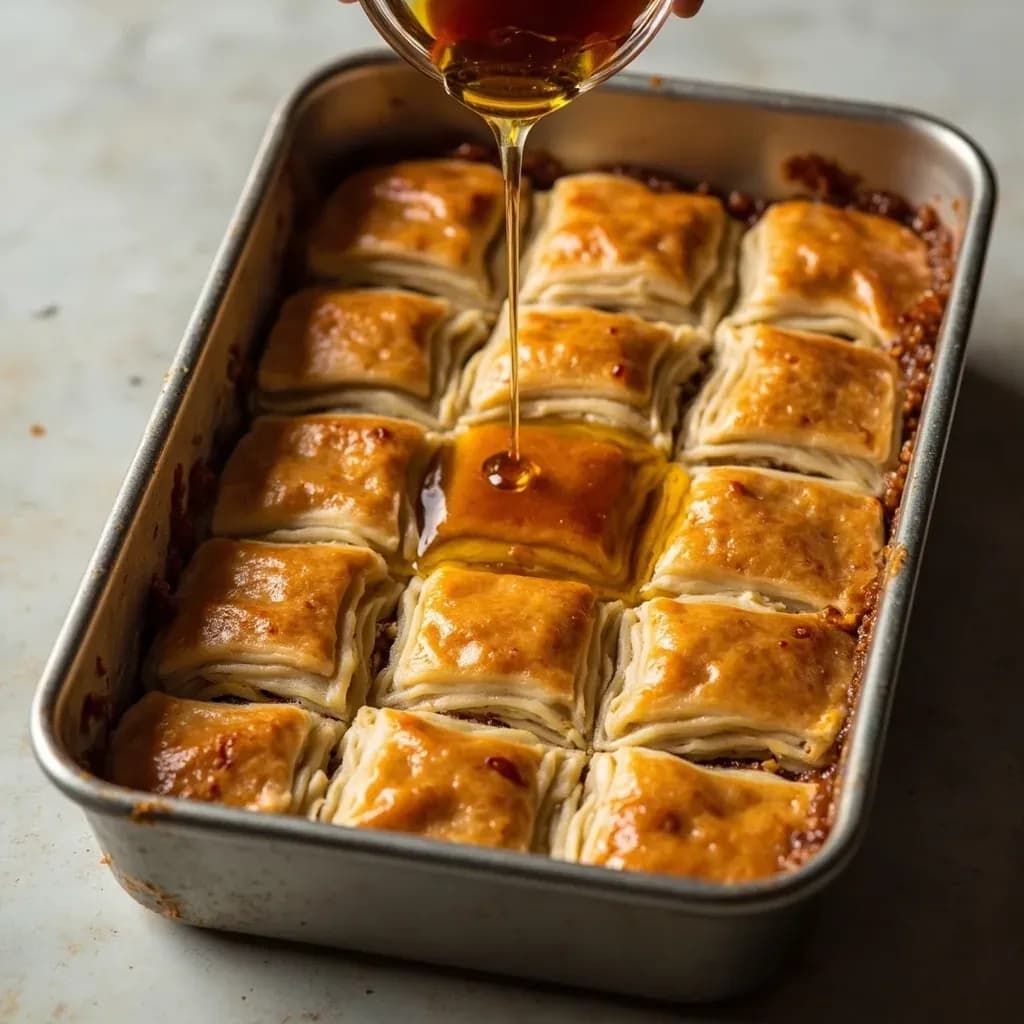
Syrup soaking pours honey or sugar syrup over baked or fried pastries so they drink it in, becoming moist, glossy, and intensely sweet, as with baklava and babà. The temperature contrast matters: pouring cool syrup over hot pastry (or vice versa) helps it absorb evenly without going soggy. The soaked syrup also acts as a mild preservative, keeping the sweets moist for days.
Syrup soaking — the French call it imbibage, the Turks şerbet, the South Asians chashni-drenching — is the act of drenching a finished baked or fried sweet with sugar syrup or honey syrup so the liquid soaks into the crumb. It is one of the oldest preservation and flavoring techniques in the pastry kitchen, and it works on a simple principle: hot cake plus cool syrup, or cold cake plus warm syrup, creates a thermal differential that drives the liquid into the starch and protein structure before the surface can seal over. The result is a dessert that is moist for days rather than dry within hours, sweeter and more aromatic than the cake alone could ever be, and shelf-stable enough to travel — which is why syrup-soaked sweets have been festival and market staples from Persia to Andalusia for the better part of a millennium.
What separates a properly soaked dessert from a soggy one is matching the temperatures of the two components and respecting the porosity of the food. A hot semolina cake straight from the oven drinks hot syrup greedily, like a sponge hitting water; a cool baba au rhum needs warm syrup to relax the gluten threads and let the liquid in without shocking the crumb. Syrup soaking is not pouring — it is pacing. A third of the syrup at a time, with pauses for absorption, prevents pooling, soggy bottoms, and dry patches on top. The technique is forgiving in spirit but exact in its two critical variables: temperature and time.
- Difficulty
- Easy
Types & varieties
Honey diluted with water and lemon; rich, floral; classic for baklava and Greek melomakarona
1:1 sugar to water; thin and penetrating; the standard soak for sponge cakes and baba
2:1 or 3:1 sugar to water; thick and glossy; used for basbousa, revani, and long-keeping sweets
Sugar syrup infused with rose water or orange blossom water; Persian, Lebanese, and Turkish classic
Simple syrup with lemon juice and often zest; bright, cutting; Greek galaktoboureko and revani
Simmered with cinnamon, cardamom, cloves, star anise, or saffron; South Asian and North African
Simple syrup spiked with rum, brandy, or orange liqueur; baba au rhum and savarin
A splash slows crystallization and adds shine; commercial baklava practice
Thick, dark sweetener with deep caramelized notes; Indian and North African sweets
How to do it
- 1
Build the syrup
Combine sugar and water in a heavy saucepan, starting at 1:1 for a light soak or 2:1 for a rich, glossy one. Add a squeeze of lemon juice or a pinch of cream of tartar to prevent crystallization, plus any whole spices, citrus peel, or a split vanilla pod. Stir once over low heat until the sugar fully dissolves — do not let it boil before the grains are gone, or you may seed crystals on the pan walls.
- 2
Flavor the syrup
Once the sugar has dissolved, drop in the aromatics that benefit from a brief simmer: cinnamon sticks, cracked cardamom pods, star anise, a pinch of saffron threads, or long strips of lemon zest. Simmer 3–5 minutes, then remove from heat and stir in the delicate additions — rose water, orange blossom water, or a splash of liqueur — so their perfume does not cook off.
- 3
Adjust consistency
For a thin, penetrating syrup suited to baba and sponge, keep the simmer gentle for 2–3 minutes. For a glossy, sticky syrup that clings to basbousa and baklava, simmer 5–8 minutes until the liquid lightly coats the back of a spoon or reaches thread stage (106–113°C / 220–235°F). Strain out the solids and bring the syrup to the temperature your item needs.
- 4
Prepare the item to be soaked
Bake or fry the cake, pastry, or dumpling until just done. For dense cakes, poke small holes all over the top with a skewer or fork, all the way through, so the syrup travels down through the crumb rather than running off the sides. Phyllo and kataifi need no holes; their layered structure soaks on contact.
- 5
Match temperatures and pour
Hot item: pour cool or room-temperature syrup slowly and evenly. Cold or warm item (baba, savarin): pour warm syrup. Distribute the syrup in stages — a third at a time, pausing 30–60 seconds for absorption — to avoid pooling and soggy bottoms. A squeeze bottle or small ladle gives the most controlled pour; a heavy, fast pour is the single most common cause of uneven soaking.
- 6
Rest and finish
Let the item rest at room temperature, uncovered or loosely covered, for at least 1 hour; overnight is better for basbousa, baba, and galaktoboureko, since the moisture redistributes and the flavor deepens. Garnish just before serving with crushed pistachios, sliced almonds, dried rose petals, a dusting of cinnamon, or a final thin drizzle of warm honey.
The principle of temperature matching
Syrup soaking behaves according to a deceptively simple rule: the hotter the item and the cooler the syrup, or the cooler the item and the warmer the syrup, the more violently the liquid is drawn in. The starch granules and protein network of a just-baked cake are still relaxed and porous; they close up as the cake cools. Hitting them with hot syrup at that moment would collapse the structure and trap steam. Hitting them with cool syrup instead creates a vacuum effect that pulls the syrup down into the crumb as the cake finishes setting. The reverse is true for cold baba: the gluten has set tight, and only warm syrup can relax it enough to penetrate. Get this pairing wrong and you get either a soggy puddle or a cake with a sweet crust and a dry heart. The one major exception is the very porous semolina cake: basbousa, revani, and their cousins are so absorbent that hot syrup poured over the hot-from-the-oven cake is absorbed almost instantly, before the structure can be damaged.
Why syrup preserves
Sugar is a humectant and a preservative in the same breath. At the concentrations used in soaking syrups, it binds free water so tightly that molds and bacteria cannot access it — what food scientists call reduced water activity. A syrup-soaked semolina cake is, in effect, a low-tech version of the confectioner's trick of binding water with sugar, and it is the reason basbousa, baklava, and melomakarona keep for weeks in a tin. Honey adds a second layer of defense through its own antimicrobial enzymes and its tendency to stay soft and slightly hygroscopic, which is why honey-soaked cookies never quite harden the way sugar-soaked ones do.
Common uses
Tips & pitfalls
- Always add a small amount of acid — lemon juice or cream of tartar — to sugar syrups. Without it, the syrup can turn gritty within hours as crystals form on cooling.
- Poke small holes with a skewer in dense cakes (basbousa, baba, savarin) so the syrup penetrates evenly rather than pooling on top and running off the sides.
- For baklava and phyllo sweets, pour room-temperature or cool syrup over cooled phyllo; hot syrup on hot pastry turns the layers gummy and chewy rather than crisp.
- For semolina cakes, pour hot syrup onto the cake the moment it leaves the oven — the crumb is at peak porosity and will soak the syrup in like a sponge.
- Never boil honey aggressively. Simmer it gently and acidulate, or it darkens, scorches on the bottom of the pan, and crystallizes on the spoon.
- Pour in thirds, pausing for absorption, rather than drowning the cake in one pass; rushing the pour is the most common cause of soggy bottoms and dry tops.
- Common mistake: applying cold syrup to a hot delicate cake. The thermal shock collapses the crumb and the syrup cannot travel evenly.
- Common mistake: cutting too soon. Syrup-soaked desserts need at least an hour, and ideally 12–24 hours, to redistribute moisture; premature slicing crushes the structure and the liquid runs out.
Good to know
- Also known as
- Imbibing, drenching, attar/sharbat soaking, chashni-drenching; French: imbibage
- Typical syrup ratio
- 1:1 to 2:1 sugar-to-water by volume; very rich syrups run to 3:1
- Acid role
- A squeeze of lemon juice or pinch of cream of tartar prevents crystallization on cooling
- Temperature rule
- Hot cake + cool/cold syrup, or cold cake + warm/hot syrup — match so absorption outruns surface sealing
- Honey handling
- Honey is typically diluted 1:1 with water and acidulated; pure honey scorches and crystallizes
- Syrup consistency
- Thread stage (106–113°C / 220–235°F) for most applications; thinner for baba and sponge
- Soak time
- 30 seconds for phyllo, 15–30 min for dense semolina cakes, hours for baba
- Shelf life
- Sugar inhibits microbial growth; syrup-soaked pastries keep 1–2 weeks at room temperature, longer refrigerated
Also called
Honey Soaking · Syrup Soaking · Soaking in Syrup
Dishes that rely on it
Related

Confit
Cook slowly submerged in fat for silky tenderness and keeping

Cure
Draw out moisture with salt and time to preserve and concentrate

Pickle
Steep in acidic brine for bright, tangy, crunchy preservation

Ferment
Let friendly microbes transform food into tangy, complex flavor

Marinate
Soak in a seasoned mix to flavor and tenderize before cooking

Brine
Soak in salt water so meat stays juicy and seasoned throughout

Dehydrate
Slowly dry out moisture to concentrate flavor and extend shelf life

Cold-Smoke
Perfume cured food with smoke without cooking it through