Prep & Assembly
Rinsing / Awakening the Leaves
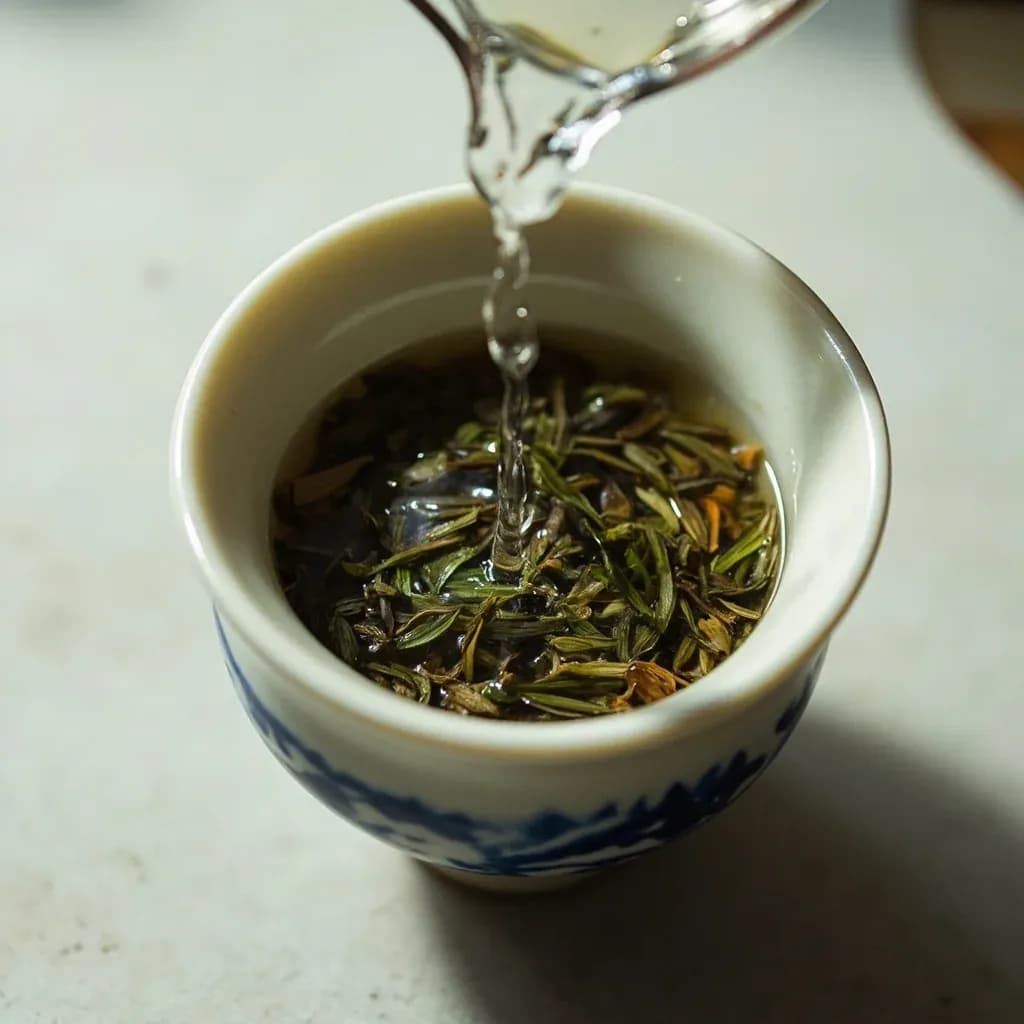
A quick first pour of hot water over tea leaves to rinse and open them before brewing.
Rinsing or awakening the leaves is the brief first infusion in gongfu and other tea ceremonies, where hot water is poured over the leaves and immediately discarded to rinse off dust and rouse tightly rolled or compressed tea. The rinse hydrates and unfurls the leaves so the next steeps release fuller flavor and aroma. It is especially common with aged pu-erh, oolong, and tightly packed teas.
Rinsing — or "awakening" — tea leaves is the brief first pour of hot water over dry tea that is poured off and discarded before the real brewing begins. In Chinese it is called xi cha (洗茶, literally "washing tea") or xing cha (醒茶, "awakening the leaves"), and it is a built-in step of the Gongfu cha method rather than an optional flourish. The pour is short — usually three to five seconds — but it does two distinct jobs at once: it rinses away storage dust, leaf fragments, and any residual flavor from packing or aging, and it coaxes tightly rolled, twisted, or compressed leaves to unfurl so the first true infusion extracts evenly.
The practice matters most for teas that arrive in awkward physical states: ball-rolled oolongs, pressed pu-erh cakes and bricks, aged white teas with dried-out leaf, and any tea that has been sitting in a warehouse or wrapper for months. For these, a rinse is the difference between a muddy, uneven first steep and a clean one. The liquid itself carries away the dull, papery, or musty notes that can blunt the top of a brewed cup, leaving the wet, fragrant leaves ready to give up their best flavor in the next pour.
For delicate teas the calculus flips. High-grade Japanese greens, first-flush Chinese green teas, and any leaf where the first steep carries the most prized aroma will lose more than they gain from a rinse, and most practitioners skip it entirely. The rinse is also distinct from the longer, days- or weeks-long process of airing pu-erh cakes in open storage — that practice shares the name xing cha in Chinese but is a storage and aging step, not a brewing step.
- Difficulty
- Easy
Types & varieties
Emphasizes cleaning; often a longer pour over dusty or very compressed leaf.
Emphasizes opening rolled or tightly twisted leaves; a faster, gentler pour.
Practically obligatory for shou (ripe) and sheng (raw) pu-erh to shed storage dust and loosen the leaf.
Shou mei and gong mei often get a 5–10 second rinse to soften dried leaf and lift mustiness.
Tightly rolled oolongs such as Dong Ding, Tieguanyin, and Wuyi rock teas open more evenly after a brief rinse.
How to do it
- 1
Heat the water
Bring water to the temperature you would use for the first infusion of the tea. For most oolongs and pu-erh that is a full boil; for aged white, drop to roughly 90–95 °C / 195–205 °F.
- 2
Load the leaves
Measure the leaves into a warmed gaiwan, teapot, or strainer. Use the same dose you intend to brew with — the rinse is calibrated to that leaf quantity.
- 3
Pour to cover
Pour just enough hot water to fully saturate the leaves. For a gaiwan, fill to just above the leaf; for a teapot, fill to about one-third.
- 4
Decant immediately
After 3–5 seconds (longer for very compressed pu-erh or brick tea, up to about 10 seconds), pour the water off completely. Do not let the leaves sit in the rinse.
- 5
Discard and begin
Tip the rinse into a waste bowl or pitcher — never the drinking cup. The leaves are now open, damp, and ready for the first true infusion.
- 6
Adjust for repeats
For a mid-session rinse (re-waking leaves that have been sitting), use slightly cooler water and the same quick pour. For a double rinse on aged pu-erh, repeat the pour-and-decant once more before timing the first real steep.
Rinse vs. airing pu-erh
The phrase xing cha gets used for two different things, and conflating them leads to bad advice. The rinse described in this entry is a brewing step measured in seconds: hot water over the leaf, decanted off, discarded. The other xing cha is a storage step measured in days or weeks, in which a pu-erh cake is broken apart or rested in open, well-ventilated air to let stale storage odors dissipate and the leaf "wake up" slowly. Both practices believe the leaf is dull or asleep; only one involves water in the cup.
When a rinse is not enough
Some teas ask for more than a single quick pour. Aged sheng pu-erh, dusty old factory bricks, and very tightly compressed tuos often benefit from a double rinse — two short pours in succession, both discarded — before the timer starts on the first real infusion. The first pour loosens the chunk; the second rinse carries off the loosened dust and starts the leaf breathing.
Common uses
Tips & pitfalls
- Discard the rinse every time — even when it smells appealing, it carries the dust and dull top notes you are trying to leave behind.
- Time the rinse by breath, not clock: one slow inhale for rolled oolong, two for pu-erh, three for a tight pu-erh brick.
- Pour from height when you want to agitate the leaf (dusty pu-erh, very compressed cake); pour low and steady when you want a gentle wake-up (aged white, twisted oolong).
- Skip the rinse for Japanese greens and most Chinese green teas — the flavor cost outweighs any cleaning benefit.
- Use a vessel with a fast, unrestricted pour, such as a gaiwan, so the leaves are not left sitting in cooling rinse water.
- For compressed pu-erh, break the cake along the leaf veins, not across them, so a short rinse still opens the chunks.
- Do not combine the rinse with the first steep — an under-steeped first infusion and a wasted rinse are the two classic mistakes.
- Aged sheng pu-erh often rewards a double rinse (two quick pours, both discarded) before the first real infusion.
Good to know
- Also known as
- xi cha (洗茶, "washing tea") or xing cha (醒茶, "awakening the leaves")
- Origin
- Chinese tea tradition; a standard step in the Gongfu cha ceremony
- Primary purpose
- Removes dust and storage residue while encouraging tightly rolled or compressed leaves to open
- Typical duration
- 3–5 seconds, up to about 10 seconds for very compressed leaf; the rinse is always discarded
- Water temperature
- Same as the first brewing temperature, or 5–10 °C / 10–20 °F cooler for delicate teas
- Best for
- Pu-erh (sheng and shou), aged white, tightly rolled oolong, compressed teas, black tea
- Skip for
- Most green teas, Japanese sencha and gyokuro, and other delicate buds where flavor loss outweighs the benefit
- Difficulty
- Easy; timing is the only real variable
Also called
Awakening the Leaves · Tea Rinse · Wash Steep
Related

Whisk
Beat ingredients smooth and aerated with a looping wire motion

Sift
Pass dry ingredients through mesh to aerate and remove lumps

Strain
Pour through mesh to separate solids from liquid for a smooth result

Filter
Pass liquid through fine material to clarify out the smallest particles

Rice
Press cooked potatoes through small holes for fluffy, lump-free texture

Mash
Crush soft cooked food into a rustic, creamy purée

Grind
Crush food into a coarse to fine texture, from spices to meat

Grate
Shred food into fine bits against a sharp-toothed surface