Transform & Preserve
Settling
Letting a liquid stand so suspended solids sink and a clearer layer rises.
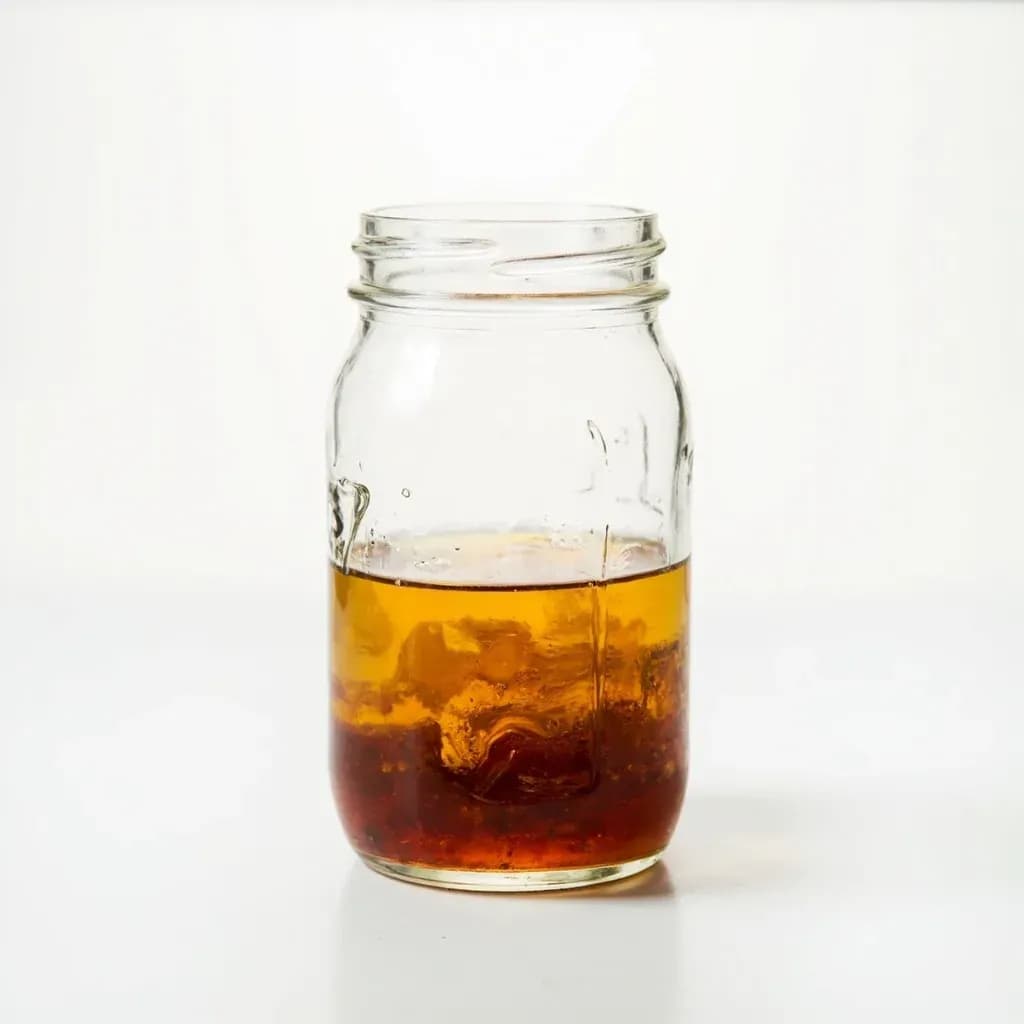
Settling lets a cloudy liquid stand undisturbed so heavier particles like sediment, starch, or lees drift to the bottom, leaving a clearer layer that can be carefully poured or siphoned off. It is used to clarify stocks, juices, wine, and starch slurries without filtering, and to separate extracted starch from its wash water. Time and stillness do the work, often aided by chilling.
Settling is one of the oldest clarification techniques in the kitchen and cellar: a liquid is left to stand while gravity pulls suspended particles to the bottom — or, less often, lets fat rise and congeal on top — leaving a clear upper layer that can be drawn off. It is passive, requires no special equipment, and adds nothing to the liquid and strips nothing meaningful away, so the flavor of a stock, juice, or wine stays largely intact.
The physics are simple but unforgiving. A particle sinks only when its own weight overcomes the drag of the liquid and the Brownian motion around it, which is why settling works beautifully on coarse suspensions (meat proteins in stock, grape pulp in juice, cracklings in rendered fat) and poorly or not at all on colloidal hazes and emulsions, where particles are too small or carry a charge that holds them in suspension. Because it preserves flavor and costs almost nothing, settling is almost always the first move in any kitchen clarification: a patient cold settle handles the bulk of the work, and a strain, filter, or egg-white raft can finish the job if a brilliant result is needed.
- Difficulty
- Easy
Types & varieties
Cooled meat, poultry, or fish stocks are chilled overnight so coagulated proteins and impurities drop to the bottom and fat solidifies on top, enabling a clean decant before degreasing.
In winemaking, juice or wine rests in tank after pressing or racking to drop tartrate crystals, dead yeast, and grape solids, often assisted by a fining agent such as bentonite or egg white.
Freshly pressed apple, grape, or other fruit juice rests in a cool place so pulp, pectin, and heavy solids sink before the clear juice is racked off for cider, jelly, or fermentation.
Rendered lard, schmaltz, or tallow is held warm in a tall vessel so cracklings sink and the clear fat can be poured or ladled off the top.
Coarse-ground coffee steeped in cold water rests briefly so the grounds compact at the bottom, allowing the concentrate to be decanted with minimal fines.
Rice-washing liquids or flour-and-water batters rest so starch granules sediment; the cloudy water is poured off and the white starch at the bottom is used in certain Chinese and Southeast Asian preparations.
Melted chocolate rests for a few minutes to release trapped air bubbles that would otherwise mar the surface of molded or dipped pieces.
How to do it
- 1
Choose the right vessel
Pick a clean container with straight sides and a flat or gently conical base; clear material lets you watch the sediment line form. Avoid narrow-necked bottles that make the final pour difficult.
- 2
Transfer gently
Pour or ladle the liquid down the inside wall of the container rather than dropping it in from a height. A slow, steady transfer avoids re-aerating the liquid or stirring up any sediment already present.
- 3
Cool if the recipe allows
Bring the liquid down to refrigerator temperature (around 4°C / 40°F) or at least to room temperature. Cooler liquid settles faster because convection currents die down, and cooling also solidifies fats so they can be lifted off in one piece.
- 4
Rest undisturbed
Set the covered container in a stable, vibration-free spot — a back corner of the refrigerator or a quiet pantry shelf. Do not move, shake, or stir. A thin broth may clear in 30–60 minutes; wine lees or juice pulp often need 12–48 hours.
- 5
Check the clarity line
Hold the container up to the light. A visible boundary should appear between the clear upper layer and the compact layer of sediment at the bottom. If the liquid still looks uniformly cloudy, give it more time or move it somewhere cooler.
- 6
Separate the clear layer
Use a ladle, small pitcher, or siphon tube to draw off the clear upper layer, leaving the last 10–20 percent of liquid and all the sediment behind. Work slowly and stop the moment sediment starts to lift toward the outlet.
- 7
Repeat if needed
For very clear applications — a bright consommé, a jelly stock, a bottle-ready wine — transfer the decanted liquid to a fresh container and let it settle a second time. Two short passes usually beat one long rest.
- 8
Store or use the liquid
Use the clarified liquid right away, or cover and refrigerate. The sediment can usually be discarded, composted, or — depending on what it is — repurposed in stocks, sauces, jams, or bakes rather than thrown out.
When Settling Works — and When It Doesn't
Settling is a physical process with a hard cutoff. A particle drops out of suspension only when its weight overcomes the drag of the liquid around it; below a certain size, that never happens in any reasonable timeframe. As a rule of thumb, settling handles particles down to roughly one micron — meat proteins, yeast cells, fruit pulp, cocoa fiber — but not the sub-micron colloids responsible for chill haze in beer, pectin cloud in some juices, or the suspended fat globules in milk and vinaigrette. Those are emulsions or near-emulsions, and gravity alone will not break them; you need a fining agent, an enzyme, a centrifuge, or a raft. Knowing the difference up front saves days of waiting on a liquid that was never going to clear.
- Settles well: meat and fish stocks, fresh-pressed juice, young wine, rendered fat, French press coffee, melted chocolate.
- Will not settle: vinaigrettes, milk, cream sauces, beer chill haze, pectin-clouded juice without enzyme treatment.
- Combine with: a chinois or coffee filter for fines, an egg-white raft for consommé, bentonite or isinglass for wine, pectinase for fruit juice.
Common uses
Tips & pitfalls
- Use a clear, straight-sided container so you can watch the sediment line form and stop the decanting at the right moment.
- Chill the liquid first — colder liquids settle faster because convection currents quiet down and the thermal motion that holds fine particles in suspension is reduced.
- Keep the vessel somewhere vibration-free; footsteps, refrigerator compressors, and slamming doors will keep fine particles in suspension indefinitely.
- Leave generous headspace; sloshing during any later move is the single most common reason a settled liquid turns cloudy again.
- Siphon or ladle from the top rather than pouring the whole vessel — pouring lifts the sediment cloud and undoes the work.
- For very clear applications, settle, decant, then settle again on the decanted liquid; a second pass is the difference between 'pretty clear' and 'brilliant.'
- Do not try to settle emulsions like vinaigrette, milk, or cream sauces — their particles are stabilized and gravity alone will not break them.
- Save the sediment unless you know it is spent: fruit pulp goes into jam, lees into sauces, and stock sediment holds a surprising amount of flavor.
Good to know
- Category
- Transform & Preserve
- Principle
- Gravity-driven separation of suspended solids from a liquid
- Typical duration
- 20 minutes to 48 hours, depending on particle size and liquid viscosity
- Temperature
- Cool (4–15°C / 40–60°F) speeds settling by damping convection and reducing thermal motion that keeps fine particles in suspension
- Equipment
- Clear, straight-sided container; ladle, siphon, or fine-mesh skimmer for separation
- Difficulty
- Beginner — passive, no special skill required
- Yield impact
- Some liquid is lost with the sediment; typically 5–15% loss depending on solids content
- Limits
- Will not remove dissolved substances or colloidal particles smaller than ~1 micron
Also called
Sedimentation · Settling Out
Dishes that rely on it

Related

Confit
Cook slowly submerged in fat for silky tenderness and keeping

Cure
Draw out moisture with salt and time to preserve and concentrate

Pickle
Steep in acidic brine for bright, tangy, crunchy preservation

Ferment
Let friendly microbes transform food into tangy, complex flavor

Marinate
Soak in a seasoned mix to flavor and tenderize before cooking

Brine
Soak in salt water so meat stays juicy and seasoned throughout

Dehydrate
Slowly dry out moisture to concentrate flavor and extend shelf life

Cold-Smoke
Perfume cured food with smoke without cooking it through