Seafood & Shellfish Breakdown
Oyster Shucking Technique
Also: oyster opening, shucking oysters, hinge-entry method, oyster knife technique
Entering the oyster through the posterior hinge with a shucking knife, severing both adductor muscles, and prying the shell open while preserving the briny liquor within.
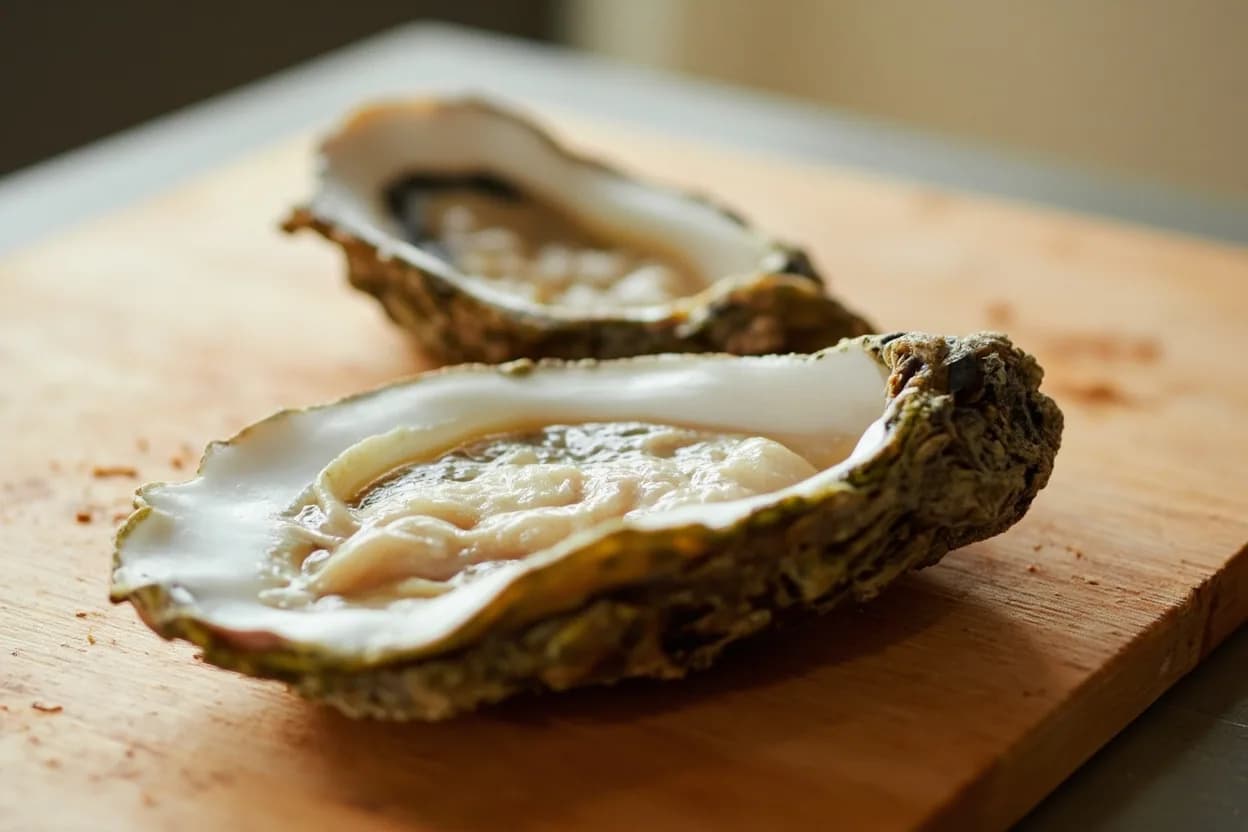
Oyster shucking is the technique of opening a bivalve mollusc by inserting a short, stout-bladed oyster knife into the hinge (posterior ligament joint) and applying rotational force to pop the shell apart, then severing the adductor muscles attaching the meat to both the flat upper valve and the deeper cup-shaped lower valve. The goal is an intact, unbroken oyster still resting in its liquor (the natural saline fluid in the shell), presented in the cup half of the shell. Two entry-point methods exist — hinge entry (standard) and lip entry (emergency technique) — with hinge entry yielding cleaner results and less shell fragmentation.
In photos
Where it comes from
Oysters are bivalve molluscs of the family Ostreidae (true oysters: Ostrea, Crassostrea, Magallana) or Gryphaeidae. The cup shell (lower valve) is curved and deep; the flat shell (upper valve) is the lid. The adductor muscle — a single muscle in most edible oysters — holds both valves shut. The hinge is the calcified ligament at the pointed posterior end of the shell. The liquor is not seawater but a saline secretion of the oyster itself, rich in minerals and glycogen.
Best for
How to cook it
- 1Fold a heavy kitchen towel into a thick pad and lay it on a stable surface; place the oyster cup-side down in the towel, pointed hinge end facing you. Grip firmly with the towel-wrapped hand.
- 2Hinge entry: insert the tip of the oyster knife into the very apex of the hinge — feel for the small gap between the two valves. Do not force. The knife should seat 3–5 mm without grinding.
- 3With the knife seated, apply firm rotational torque (twist your wrist as if turning a key) rather than levering up. You will feel and hear a distinct pop as the ligament releases.
- 4Once the hinge pops, run the knife along the inside of the flat top shell, keeping the blade angled against the shell to avoid cutting the meat. Sever the adductor from the top shell and lift the flat shell free.
- 5Flip the knife to the cup shell; find the adductor muscle (a firm white disc) and slide the knife underneath it to sever it from the cup — this frees the oyster completely so it can be slurped directly.
- 6Tilt the cup shell and inspect for shell fragments. Remove any chips with the knife tip or a small brush. Do not rinse — this dilutes the liquor irreparably.
- 7Lip-entry alternative: where the hinge is very tight, insert the knife tip at the forward lip (the wide, flat edge) between the two shells and pry upward — more likely to chip the shell but useful when the hinge won't yield.
Prep & butchery
- A good oyster knife is short (7–9 cm blade), stiff, and has a blunt tip and a guard. Never substitute a paring knife — the blade can snap under torque.
- Scrub oyster shells with a stiff brush under cold water before shucking — grit on the shell transfers to the meat.
- Refrigerate oysters cup-side down in a single layer on ice until the moment of shucking — this keeps liquor pooled in the cup.
- Sommelier/oyster bar context: the 'Boston' knife style dominates Atlantic oysters; the 'New Haven' style (short and wide) is favoured for Eastern oysters; the 'Galveston' (long and thin) suits Gulf flat oysters.
- For Gillardeau, Belon, and flat European oysters, the round shell has a less defined hinge — approach from the side of the hinge lip rather than the extreme point.
Substitutes
- Clam shucking (raw method)
Uses a clam knife (broader, more flexible blade); the adductor-severing logic is identical but entry is at the lip, not the hinge
- Scallop opening
Flat shell up; paring knife slides along the flat valve to sever the adductor — conceptually similar, anatomically much easier
Related cuts
Directly related bivalve-opening technique; uses a different knife style and lip entry
- Scallop Opening and Cleaning
Same adductor-severing principle; flat shell up is the key difference in orientation
Appears in
References
- 1.Fish & Shellfish — James Peterson (William Morrow, 1996)
- 2.The Oyster Companion — Patrick Dunn (Running Press, 2007)
- 3.Huitres: Connaissance et Dégustation — Thierry Mornet (Hachette, 2003)
- 4.The Professional Chef — Culinary Institute of America (Wiley, 9th ed., 2011)
Confidence: high
Notes
Hinge vs. lip entry: when to use each
Hinge entry is correct for virtually all species and produces the cleanest open with minimal shell damage. Lip entry — inserting at the thin gaping edge of the shell's anterior margin — is an emergency technique for shells whose hinges have been damaged or are unusually tight. It almost always chips the shell edge and should be a last resort, not a first approach. Professional shuckers at speed use hinge entry exclusively.
The sommelier/oyster-knife distinction
In France, the term 'couteau à huitres' covers a family of regional blade shapes, and the skill is culturally embedded in fine dining in a way analogous to wine service. The correct pairing of knife style to oyster species is a point of professional pride — a 'couteau de Marenne' for flat Belon-type oysters differs noticeably from the American Boston knife, both optimised for the hinge geometry of their respective target species.