Poultry — Breakdown & Cuts
Poultry Breakdown — 8-Piece & 10-Piece
Also: chicken cut-up, whole chicken breakdown, fryer pieces, 8-cut chicken
Knowing exactly where each joint sits — and how to halve a breast cleanly — transforms a whole chicken into uniform pieces that cook evenly and cost half the price of pre-cut.
The standard whole-chicken cut-up produces either 8 pieces (2 drumsticks, 2 thighs, 2 breast halves, 2 wings) or 10 pieces (same plus each breast half split crosswise into 2, giving 4 breast portions). The sequence proceeds from removing the legs and thighs as a unit, separating them at the hip joint, then removing the wings at the shoulder joint, and finally splitting the carcass along the backbone and sternum to yield two breast halves.
In photos
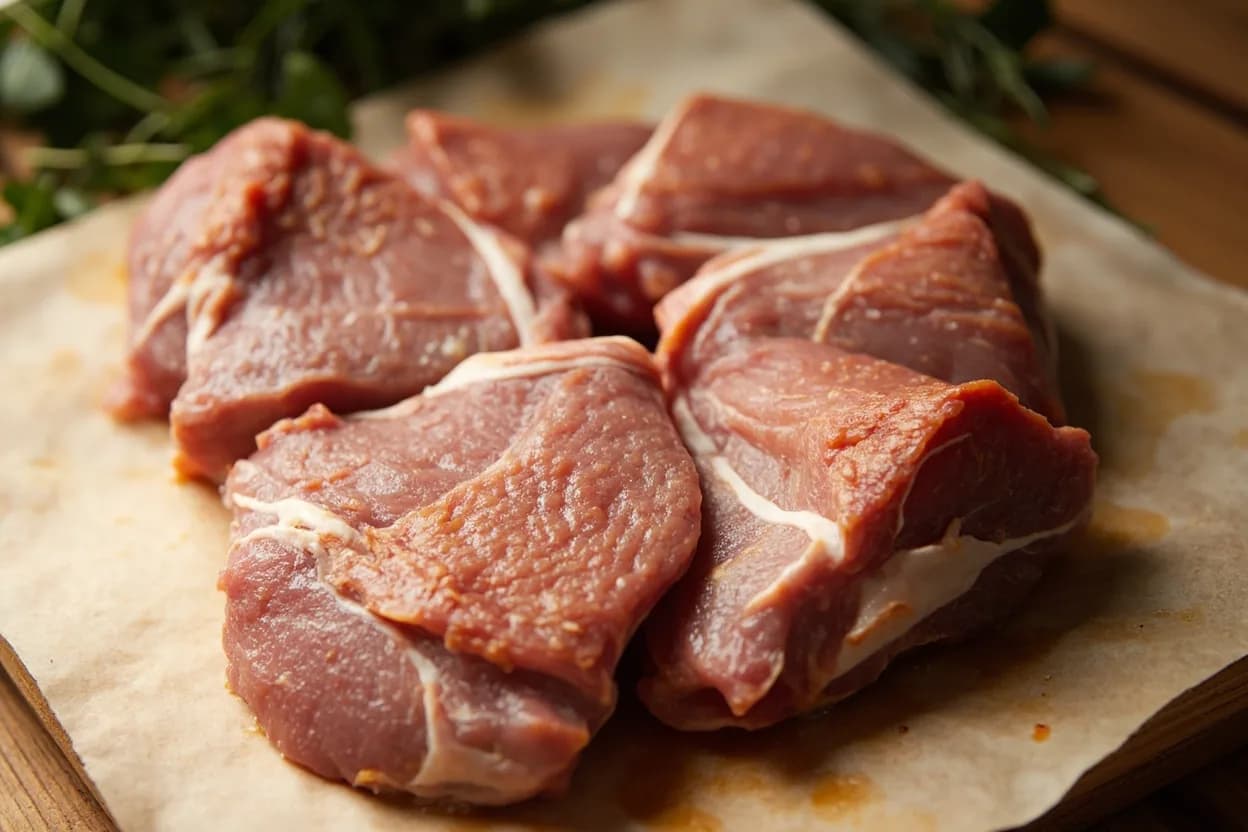
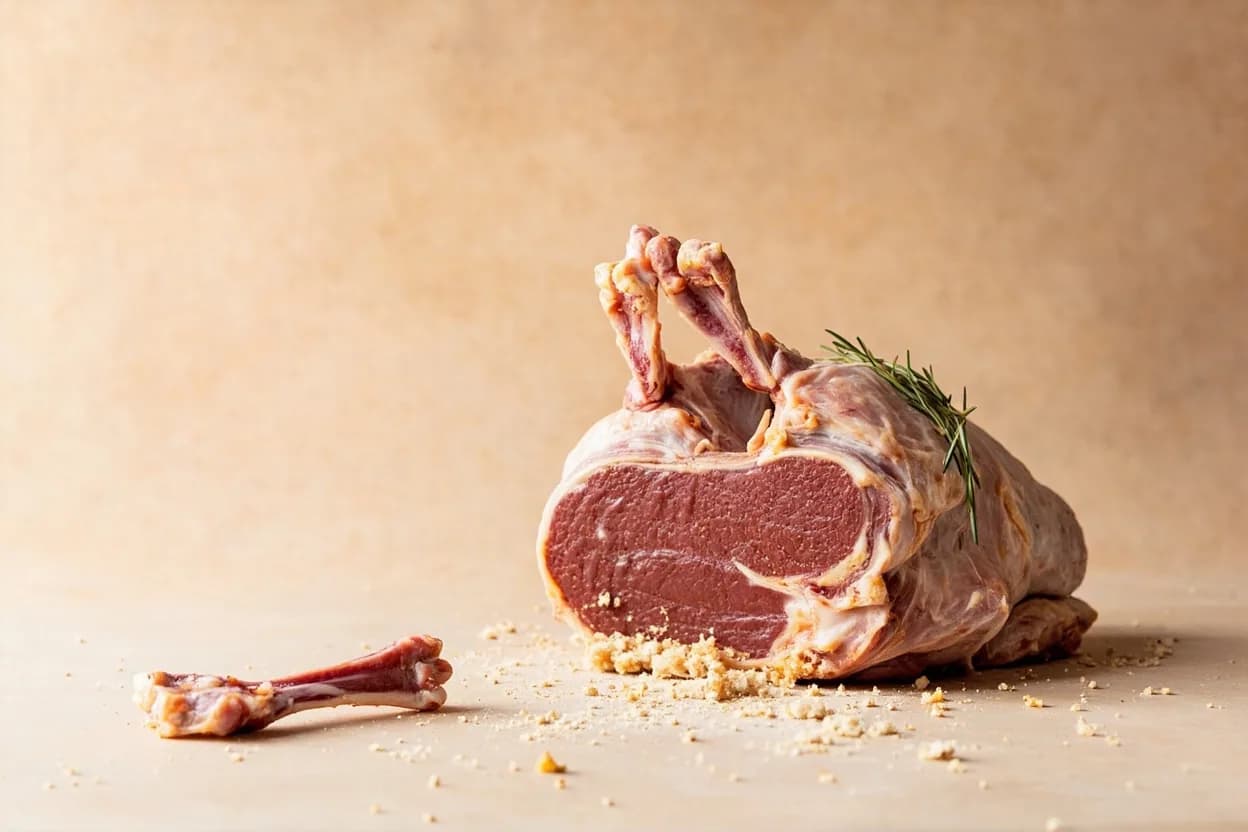

Where it comes from
A standard 1.5–2 kg (3.5–4.5 lb) whole broiler chicken. Breakdown removes all four limbs (two legs, two wings) and splits the torso. The backbone and keel bone remain with the breast halves in the 8-piece format; some butchers remove the backbone entirely first (spatchcock-style) before splitting the breast. The 10-piece format further crosscuts each breast half — the upper portion retains the wing joint area, the lower portion is a boneless-adjacent block.
Best for
How to cook it
- 1STEP 1 — Remove legs: lay bird breast-side up, pull leg away from body, slice through the skin between thigh and breast. Flex the thigh back until the hip joint pops, then cut through the joint. Repeat on other side.
- 2STEP 2 — Separate thigh and drumstick: locate the fat line on the inner thigh that runs directly over the knee joint. Cut through the joint following that line — no sawing required if you hit the cartilage.
- 3STEP 3 — Remove wings: fold wing away from breast, cut down through the shoulder socket. The joint is just inside the breast edge.
- 4STEP 4 — Split the carcass: use kitchen shears to cut along both sides of the backbone (reserve for stock). Open the carcass flat. Score along the sternum (keel bone) with a knife, then press firmly to split, or cut with shears.
- 5STEP 5 (for 10-piece): crosscut each breast half in two approximately at the midpoint of the breast, keeping a portion of rib on each section.
- 6Dry-brine the pieces uncovered in the refrigerator 4–24 hours for superior seasoning penetration and crisper skin.
Prep & butchery
- Pat bird thoroughly dry with paper towels before breaking down — wet skin is slippery and risky
- Use a sharp boning knife for joints and kitchen shears for the backbone; a chef's knife is too wide for precise joint work
- Flex each joint to identify the gap before cutting — poultry joints cut through cartilage not bone
- Keep a clean damp cloth nearby; frequent wiping of the knife keeps cuts precise and safe
Substitutes
- Pre-cut mixed chicken pieces (supermarket)
Convenient but often unevenly sized; breasts are frequently too large relative to thighs
- Bone-in chicken thighs (4-pack)
If only dark meat is needed; more cost-effective than a whole bird for dark-meat dishes
- Spatchcocked whole chicken
Alternative to piece breakdown when roasting whole — achieves faster, more even cooking without separating into pieces
Related cuts
Skin-on airline breast with drumette attached — the premium version of the breast half
- Chicken Thigh (bone-in, skin-on)
The dark-meat yield from the same breakdown
- Spatchcock / Butterfly
Alternative whole-bird technique using the same backbone removal as step one of the 8-piece breakdown
Appears in
References
- 1.Thomas Keller — The French Laundry Cookbook
- 2.Jacques Pépin — La Technique
- 3.James Peterson — Glorious French Food
- 4.USDA Institutional Meat Purchase Specifications (IMPS) for Poultry, Series 1000
Confidence: high
Notes
The oyster
The oyster (sot-l'y-laisse — French for 'a fool leaves it there') is a small, rounded muscle nestled in the hollow of the ilium on either side of the backbone. It is the most tender, flavor-concentrated piece on the bird. When breaking down a chicken at the table, the cook who knows to excavate the oyster with a spoon before presenting the legs is making a quiet statement of competence.
8 vs. 10 piece — the cook's choice
The 10-piece format exists to solve an engineering problem: a 200 g (7 oz) breast half cooks more evenly than a 400 g (14 oz) whole breast half when all pieces go into the same pan or fryer simultaneously. American fried chicken chains standardized the 10-piece for this reason. For home roasting where pieces can be staggered or moved, the 8-piece is simpler.