Poultry — Breakdown & Cuts
Whole Chicken Chop (Bone-In Cantonese Style)
Also: 白切雞斬法, Cantonese chopped chicken, bai qie ji cuts, bone-in chicken chop, cleaver-chopped chicken
The Cantonese cleaver technique for hacking a poached or roasted whole chicken through the bone into precise, bite-sized pieces — a ceremony of geometry and knife control that shapes the entire dining experience.
In Cantonese cuisine, a whole cooked chicken (typically poached as bai qie ji, or roasted) is portioned by the cook using a heavy Chinese cleaver (choi dou or kwen dou) in a specific sequence of strokes that produces bone-in pieces of uniform size suitable for chopstick service. The technique is not random hacking — it follows a deliberate anatomical logic: detaching the legs and wings at their joints, then bisecting the breast cavity, and finally cross-cutting each section through the bone into pieces roughly 3–4 cm wide. Bone-in presentation is non-negotiable in the Cantonese idiom because the marrow, joint gelatin, and bone surface contribute flavor and the visual integrity of the bird signals freshness and respect.
In photos
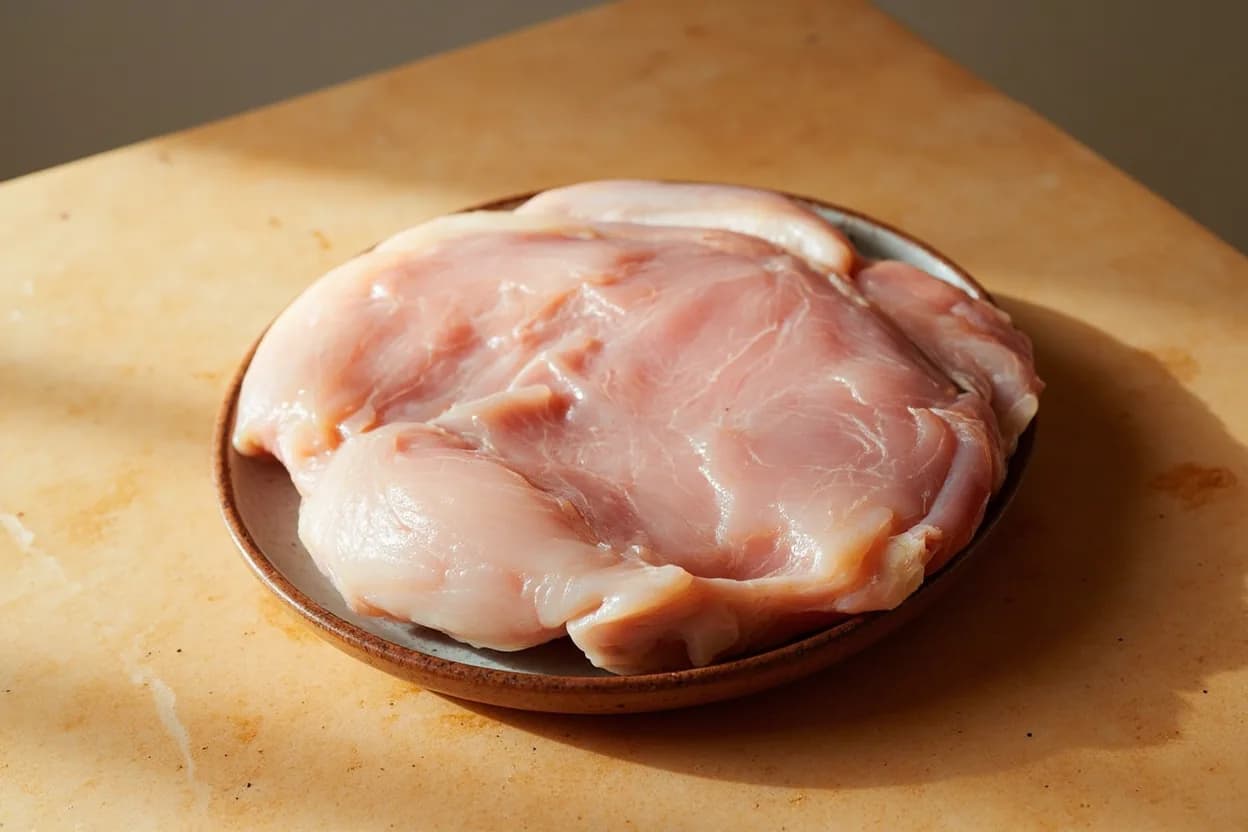
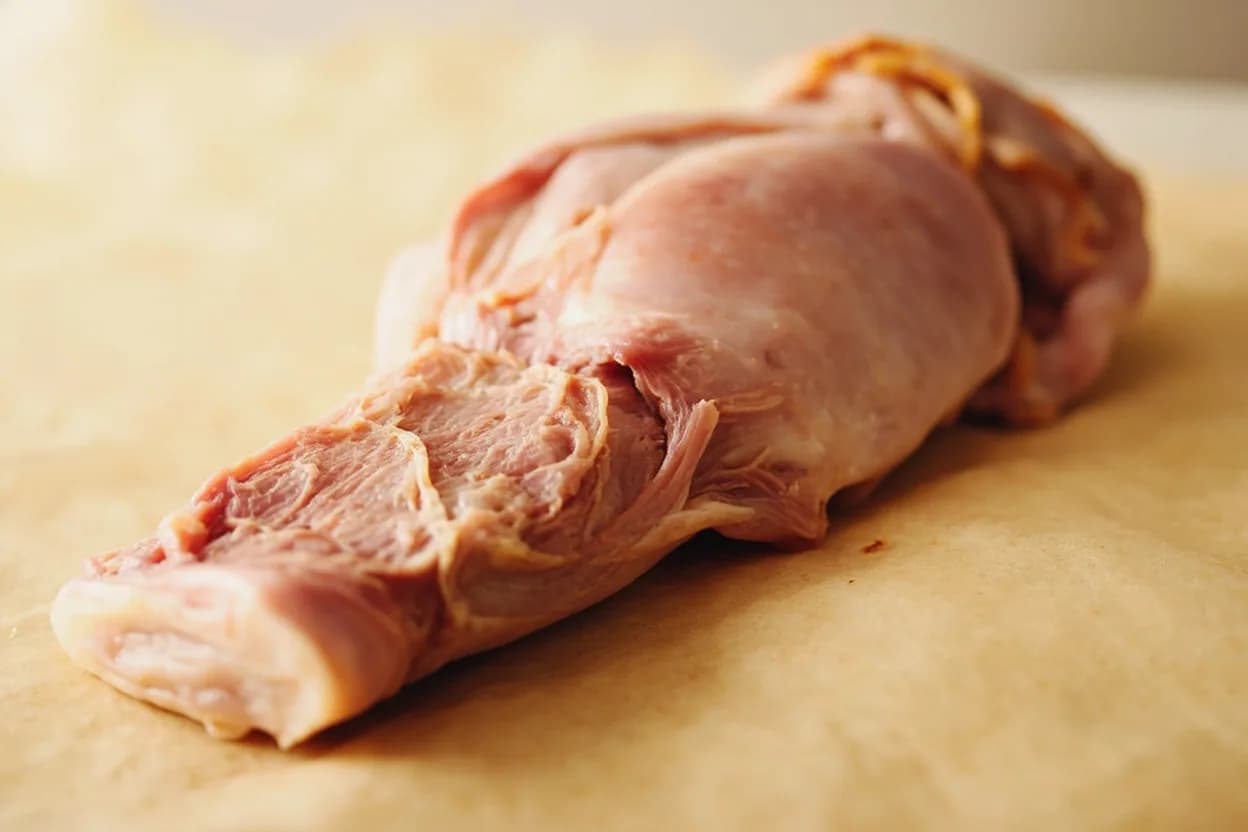
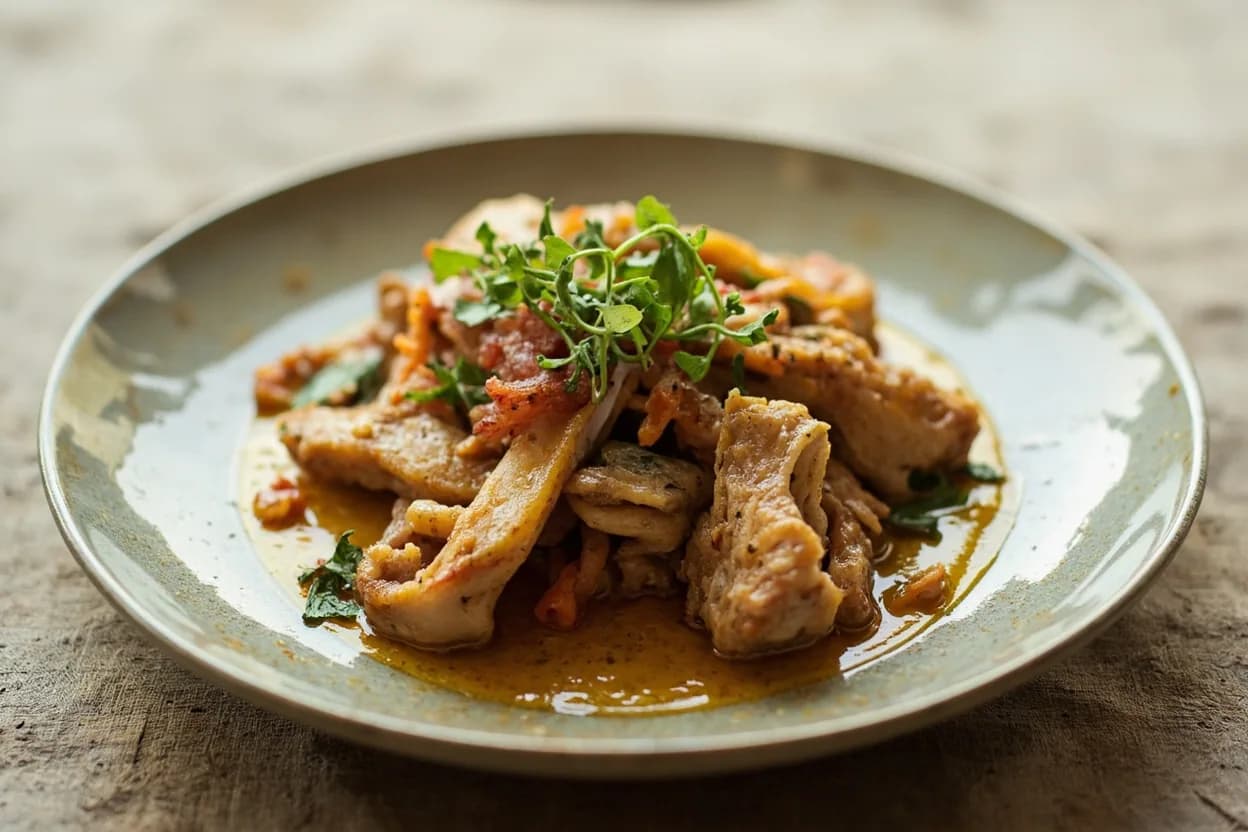
Where it comes from
The entire cooked whole chicken — breast, wings, thighs, drumsticks, back, and neck — chopped through all bones. Unlike Western carving which separates at joints and discards the back, Cantonese chopping retains and presents every part, including the oysters, parson's nose, and neck.
Best for
How to cook it
- 1Let the whole cooked chicken rest 5–10 minutes after cooking to allow juices to redistribute and the bird to firm slightly — a very hot, floppy bird is harder to control under the cleaver.
- 2Detach each leg by pressing outward and severing at the hip socket with one stroke; do the same for both wings at the shoulder joint.
- 3Place the wingless, legless carcass on its back and split it down the center of the breast with 2–3 decisive downward strokes along the sternum.
- 4Chop each breast half transversely into 3–4 cm pieces straight through the rib bones.
- 5Chop each thigh through the femur into 2–3 pieces; chop each drumstick into 2 pieces just below the knuckle and at mid-shaft.
- 6Split each wing at the elbow joint; chop the drumette in half.
- 7Chop the back section (backbone + oyster) into bite-sized pieces — these go in the center of the platter.
- 8Reassemble pieces on the platter to approximate the bird's silhouette; pour ginger-scallion oil over the top and serve immediately with the dipping sauce alongside.
Prep & butchery
- Use a heavy Chinese cleaver (kwen dou or choi dou) — a thin chef's knife will bind in bone. The blade should be 200–230 mm and substantial enough to power through without wobbling.
- A thick hardwood or end-grain chopping block is essential — a thin plastic board will slide and absorb blade shock poorly.
- The stroke is a controlled drop: raise the cleaver 15–20 cm, align, and let its weight do the work — do not saw or apply sideways force.
- Cold chicken chops more cleanly than hot; if the bird has rested to near room temperature the pieces are neater.
- Wipe the blade between passes if skin and fat are building up — a sticky blade deflects and causes ragged cuts.
- Position fingers in a 'bear-claw' curl when stabilizing the piece; the knuckles act as a depth stop for the blade.
Substitutes
- Western Jointing (Carving)
Separates at joints, removes bones — produces larger boneless pieces but destroys the Cantonese presentation logic and loses gelatin and marrow contribution.
- Half-Chicken Split
Splitting bird in two then cross-chopping is an acceptable shortcut that maintains bone-in character while halving the number of required strokes.
Related cuts
Both techniques begin with the leg-quarter separation at the hip joint; Cantonese chop then cross-cuts further.
- Whole Chicken Butchery (Western)
Western jointing uses the same joint-first logic but results in larger, bone-free pieces unsuited to chopstick service.
- Peking Duck Carving
Also a whole-bird presentation technique; differs in that the skin is separated from the meat and bones are not served.
Appears in
References
- 1.The Food of China — E.N. Anderson
- 2.Land of Plenty: A Treasury of Authentic Sichuan Cooking — Fuchsia Dunlop
- 3.Mastering the Art of Chinese Cooking — Eileen Yin-Fei Lo
- 4.The Wok: Recipes and Techniques — J. Kenji López-Alt
Confidence: high
Notes
Bone-In Is Not Compromise — It Is the Dish
Western cooks encountering bone-in chopstick portions sometimes mistake this for a rustic shortcut, but the opposite is true. The bone-in Cantonese chop is the considered standard. Serving boneless pieces would be seen as a cost-cutting measure (removing the back, neck, and oysters) that disrespects the bird and the guest. In a traditional bai qie ji platter, the number of pieces, their width, and the arrangement on the plate all signal the kitchen's skill and intention.
The Cleaver as Precision Instrument
The Chinese cleaver (dou) is not a blunt instrument — a well-maintained kwen dou has an edge sharp enough to slice paper and heavy enough to pass through bone cleanly without shattering it. Shattered bone (producing sharp splinters rather than clean-cut surfaces) is the hallmark of a dull blade or poor technique, and is a textural hazard for diners. Keeping the cleaver razor-sharp is the first prerequisite of good Cantonese chopping.