Beef Doneness
Chuck Roast & Short Rib Collagen Conversion
Also: collagen to gelatin conversion, braising temperature window, chuck roast done temperature, short rib braise temperature
Collagen in chuck and short ribs converts to gelatin between 85–95°C (185–203°F), yielding the silky, fork-tender texture that defines a great braise.
Chuck roast and bone-in short ribs are among the most collagen-rich beef cuts available. Their connective tissue — primarily Type I and Type III collagen — must be hydrolyzed into gelatin before the meat becomes fork-tender. This conversion occurs in a temperature window of approximately 85–95°C (185–203°F), but it is not instantaneous: the rate of conversion depends on both temperature and time. A braise held at a gentle simmer (around 85–88°C / 185–190°F) for 3–4 hours yields the most luscious, intact texture. Aggressive boiling at 100°C cooks the muscle fibers dry before collagen has fully converted, producing stringy, cottony meat despite being 'done.' The sweet spot — and the goal of classic braising technique — is sustained temperature in this window long enough for gelatin to saturate every fiber bundle.
In photos

What happens
Collagen is a triple-helix protein that begins to denature and dissolve around 70°C, but meaningful hydrolysis into soluble gelatin accelerates significantly above 80°C. In the 85–95°C window, collagen fibers shrink, unwind, and break into shorter peptide chains that dissolve into the braising liquid. This gelatin thickens the sauce, adds body and sheen, and — crucially — saturates the desiccated muscle fibers that have contracted during cooking. The result is meat that appears 'moist' despite having lost substantial water, because each fiber is coated in dissolved gelatin. Fat from the marbling and bone marrow also renders fully in this range, adding richness. Above 95°C (a rolling boil), the collagen converts faster but muscle fibers fray and separate, producing a pulled, shredded texture rather than sliceable, fork-tender chunks.
What to look for
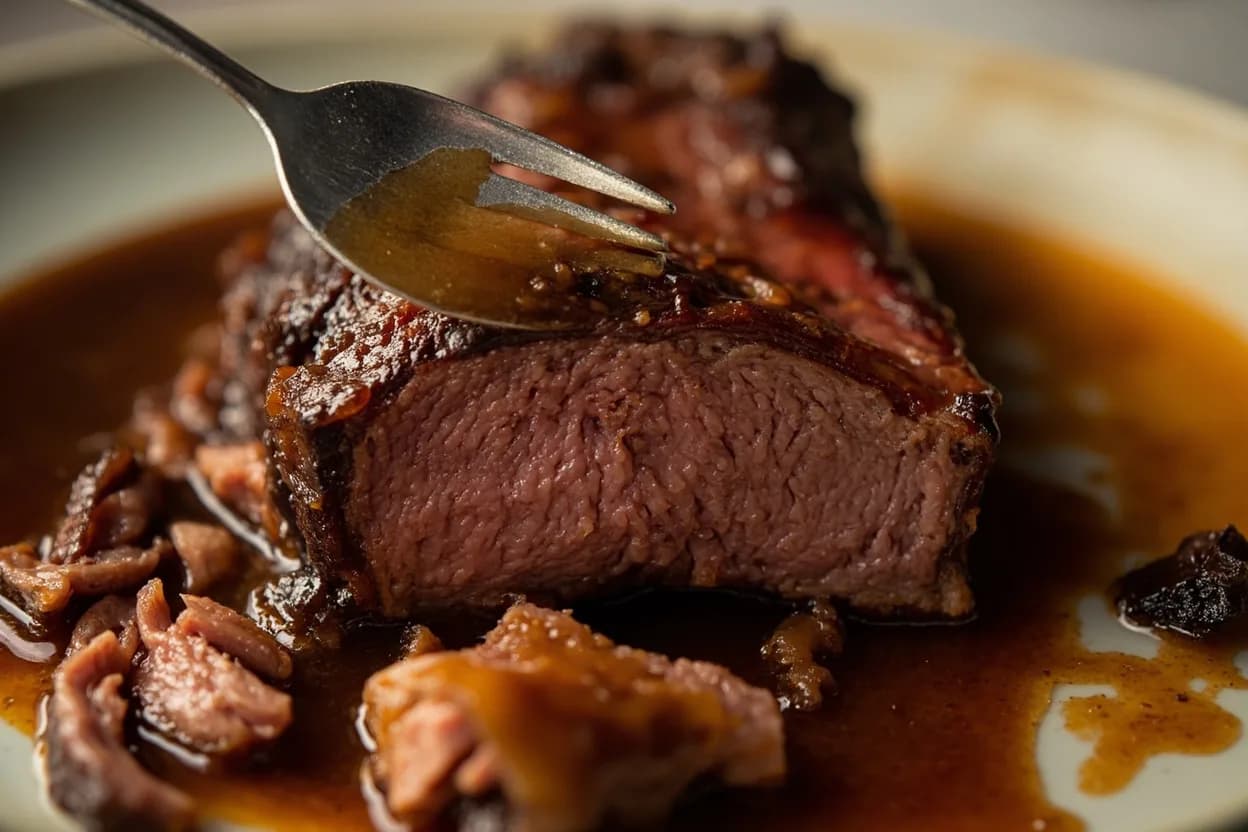
- A fork or spoon pressed gently into the meat meets almost no resistance — it collapses without tearing
- The braising liquid has thickened and coats a spoon — a sign that gelatin has dissolved into the sauce
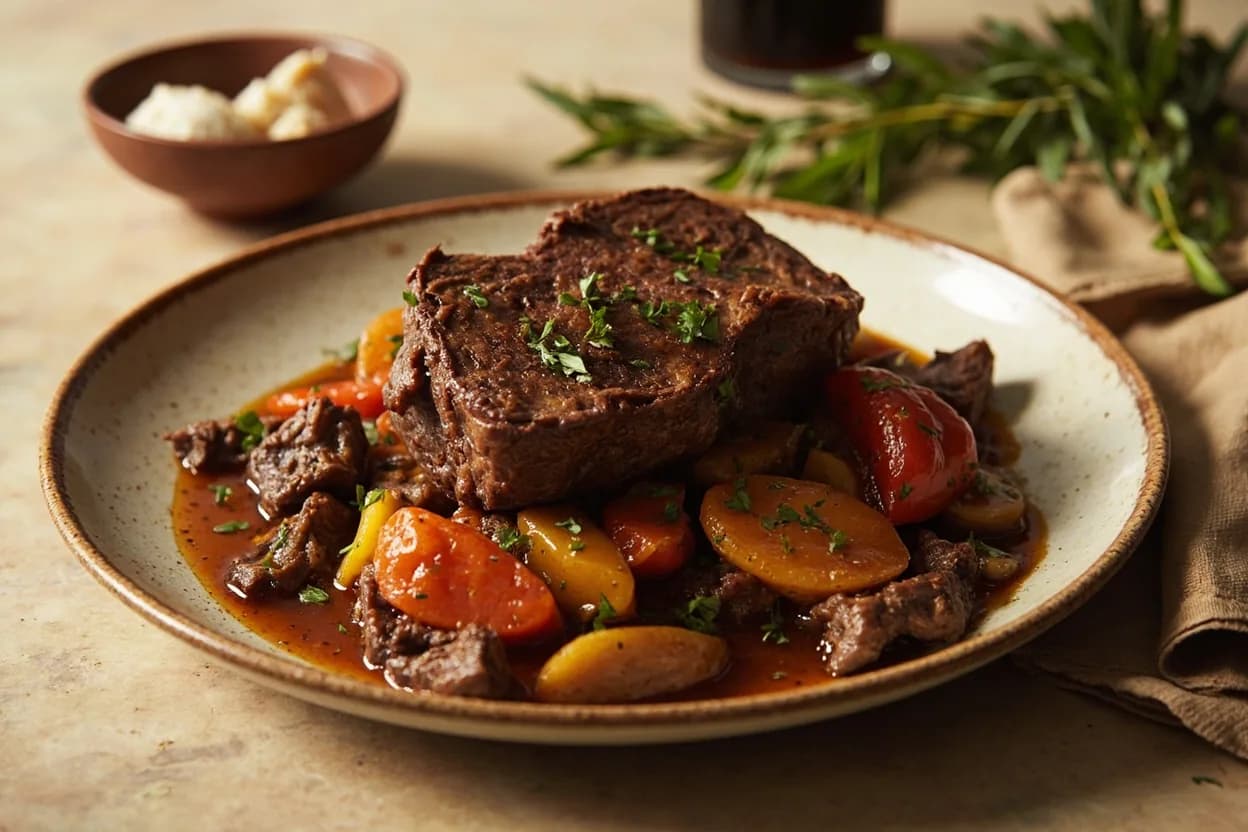
- Meat surface has a glossy, yielding sheen rather than a dry, fibrous look
- Bone-in short ribs: meat pulls cleanly from the bone without force
- Chuck roast: individual muscle seams separate easily when probed, but large pieces hold shape rather than shredding
How to check
- Insert a cake skewer or thin probe into the center of the thickest piece — it should slide in with zero resistance
- Verify internal temperature is 88–95°C (190–203°F); lower readings indicate more time is needed
- Lift a piece slightly with tongs — it should begin to yield at its own weight but not disintegrate
- For short ribs: grasp the exposed bone and gently twist; it should rotate or pull free cleanly
Food safety
Carryover & resting
Braised cuts in their liquid see minimal carryover because the surrounding liquid acts as a thermal buffer. However, resting short ribs or chuck roast in the braising liquid (off heat, covered) for 20–30 minutes allows the gelatin to re-set slightly, firming the texture and making slicing cleaner. Overnight refrigeration in the liquid is the professional standard: the fat cap solidifies and can be lifted, and the re-heated meat is often better than fresh.
The science behind it
Browning the meat before braising (searing) generates flavor compounds via Maillard; the braise itself does not create new browning on the interior
- Braising Liquid Reduction
The gelatin released by collagen conversion thickens the braising liquid into a sauce as it reduces after cooking
Short ribs braised to this window share the same collagen-conversion science as smoked beef ribs; the cooking medium (liquid vs. smoke) differs, the biochemistry does not
- Osso Buco Technique
Veal shank braising relies on the same collagen-to-gelatin conversion; the marrow contributes additional gelatin
- Pot Roast Stall
Chuck roast in an oven braise can stall around 160–165°F as moisture evaporates from the exposed surface — keeping the lid tight or submerging the cut avoids this
Appears in
References
- 1.On Food and Cooking: The Science and Lore of the Kitchen — Harold McGee
- 2.The Food Lab — J. Kenji López-Alt
- 3.Modernist Cuisine: The Art and Science of Cooking — Nathan Myhrvold et al.
- 4.Ratio: The Simple Codes Behind the Craft of Everyday Cooking — Michael Ruhlman
Confidence: high
Notes
Gentle vs. Aggressive Braise
The difference between a braised short rib that slices cleanly and one that shreds to strings is temperature control. A 325°F oven typically produces a liquid temperature of 88–93°C — right in the conversion window. A 375°F oven boils the liquid and toughens the meat before the collagen fully converts. Many professionals finish short ribs at 275°F for 4–5 hours, or even lower (250°F, 6–8 hours), for the most refined texture.
Sous Vide and Collagen Conversion
Sous vide allows precise control of the collagen conversion window. Short ribs at 74°C (165°F) for 48–72 hours achieve full collagen conversion while keeping the muscle fibers more intact than a conventional braise — the result is a different, more uniform texture. At 85°C for 12–24 hours, sous vide short ribs approach conventional braise texture with a tighter, more consistent result.