Bread & Dough Doneness
Croissant Internal Temperature
Also: croissant doneness, viennoiserie doneness temperature, laminated dough bake temperature
Croissants are fully baked at an internal temperature of 88–93°C (190–200°F), when the laminated layers have set, the butter has been absorbed into the crumb, and the exterior is deep mahogany gold.
Croissants occupy a precise baking window determined by the behavior of laminated butter doughs. Unlike lean breads, the butter content, egg wash, and delicate layered structure of a croissant require lower internal temperatures than lean artisan bread — typically 88–93°C (190–200°F). At this range, the enriched dough proteins have coagulated, the starch layers have gelatinized, and the steam generated from the butter's water content has finished creating the characteristic honeycomb of paper-thin laminated layers. Underbaking below 82°C (180°F) leaves the interior gummy and raw-tasting; overbaking above 96°C (205°F) dries out the crumb and destroys the honeycomb structure.
In photos

What happens
As the croissant bakes, butter between the dough layers melts and the water in the butter flash-vaporizes into steam, forcing the thin dough sheets apart to create hundreds of distinct flaky layers. Starch granules gelatinize from the outside inward; egg proteins in the dough and egg wash coagulate; Maillard reactions on the surface drive the amber-to-mahogany color change. At the target range of 88–93°C, all these transformations are complete and the structure has set into the airy, shatteringly crisp exterior with a soft, honeycombed interior that defines a well-made croissant.
What to look for
- Deep, even mahogany-amber color from base to crown — pale gold indicates underbaking, dark brown with cracked layers indicates overbaking
- The exterior shell shatters audibly when pressed lightly — a hollow, glassy crunch
- When held to the ear and pressed gently, a well-baked croissant crackles and crunches
- The base is evenly golden, not pale or greasy — pale base means underbaked; excess butter pooling on the pan is a sign of under-lamination or underbaking
- The croissant feels significantly lighter than it did before baking — butter water has evaporated as steam
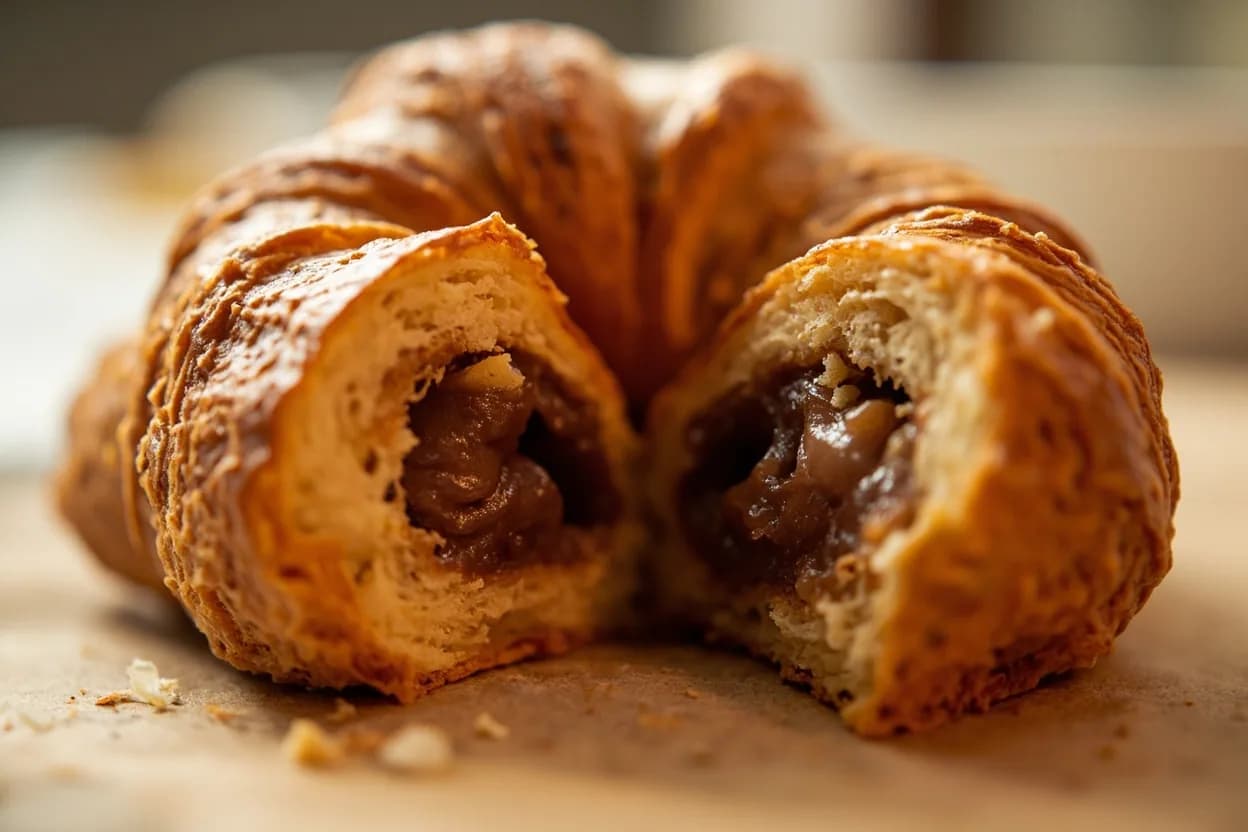
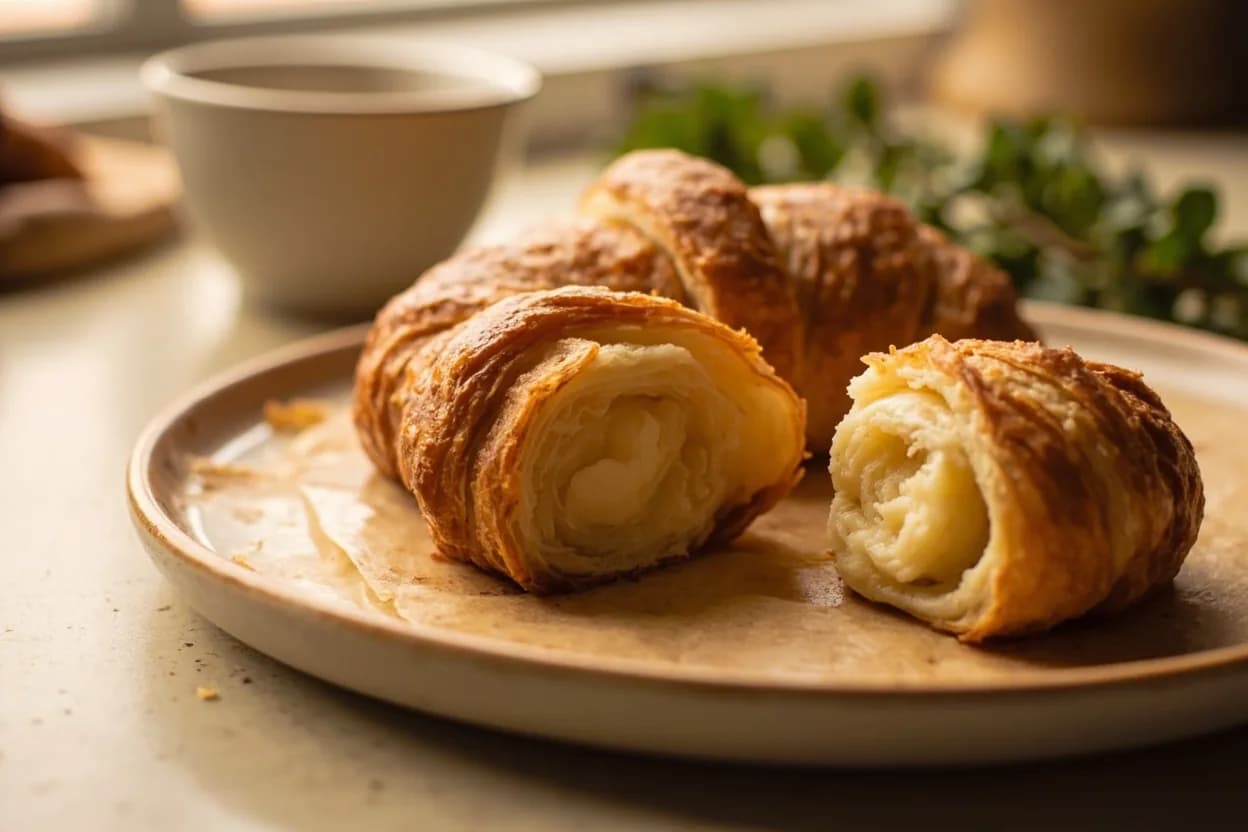
- Cross-section when sliced reveals a fine, open honeycomb of distinct, paper-thin layers separated by air
How to check
- Insert an instant-read thermometer into the thickest part of the croissant from the end or bottom to avoid marring the top surface; target 88–93°C (190–200°F)
- Visual color check: the surface should be a deep, even amber-mahogany, not pale gold or unevenly browned
- Lift test: a done croissant feels noticeably light for its size; a heavy croissant is still retaining steam and butter water
- Tap the base: should sound hollow and feel crisp, not dense or soft
- For high-volume bakery production, verify a test croissant from each batch at 75% of bake time to calibrate timing to oven deck temperature and pan type
Carryover & resting
Croissants experience minimal carryover cooking compared to meat proteins, but they continue to crisp and set for 3–5 minutes after leaving the oven as steam escapes the interior. Allow to cool on a wire rack — not on a solid surface — to prevent steam from softening the base.
The science behind it
- Lamination
The process of folding butter into dough in repeated turns to create hundreds of alternating layers; the steam from butter's water content drives oven spring and layer separation
The initial dough layer in laminated pastry, into which the butter block (beurrage) is encased; its gluten development determines how cleanly the layers hold
The butter block encased in the détrempe; high-fat, low-water European-style butters (82–84% fat) produce cleaner, more distinct layers than standard butters
The color and flavor development on the crust surface, driven by egg wash proteins and milk sugars reacting with heat above 130°C (265°F)
- Egg wash
Applied before baking to promote browning and sheen; the proteins in egg wash caramelize to create the characteristically glossy mahogany surface
- Pain au chocolat
Shares the same laminated dough and baking temperature target as croissants
- Danish pastry
Similar laminated enriched dough with comparable internal temperature target (82–88°C / 180–190°F), adjusted for fruit or cream fillings
Appears in
References
- 1.Modernist Bread — Myhrvold & Migoya (The Cooking Lab, 2017)
- 2.Advanced Bread and Pastry — Michel Suas (Delmar Cengage, 2009)
- 3.The Art of French Pastry — Jacquy Pfeiffer (Knopf, 2013)
- 4.Bouchon Bakery — Thomas Keller & Sebastien Rouxel (Artisan, 2012)
Confidence: high
Notes
Lower target than lean bread — and why
Most lean artisan breads need to reach 95–99°C (203–210°F) to fully drive off excess moisture and set the crumb. Croissants target a lower range (88–93°C / 190–200°F) because the fat content substantially changes the thermodynamics: butter's fat coats the starch granules, reducing the free water that must be evaporated, and egg proteins coagulate at lower temperatures than lean dough proteins. Baking a croissant to bread temperature dries it out and destroys the soft, yielding honeycomb interior.
The honeycomb diagnostic
Cutting a croissant in cross-section is the most authoritative quality check. A properly baked croissant should reveal a fine, irregular honeycomb of air cells separated by gossamer-thin, golden-brown layers. A gummy or closed crumb indicates underbaking. A dry, compressed crumb with few visible layers indicates overbaking or under-lamination. Bakers evaluate cross-sections routinely during production to calibrate oven temperature, bake time, and lamination quality together.