Pork Doneness
Pork: Safe Whole-Muscle Internal Temperature
Also: pork loin done temp, pork chop internal temp, 145°F pork, USDA 2011 pork update
Whole-muscle pork reaches food-safe doneness at 63°C (145°F) with a 3-minute rest — a landmark 2011 USDA revision that permits a slight pink blush in the center.
In May 2011 the USDA Food Safety and Inspection Service revised its safe minimum internal temperature recommendation for whole-muscle pork cuts (loins, chops, tenderloin, roasts) from 71°C (160°F) to 63°C (145°F) followed by a mandatory 3-minute rest. This brought pork in line with the established standard for whole beef, veal, and lamb roasts. The revision was based on updated time-temperature lethality data showing that 63°C held for 3 minutes achieves an equivalent log-reduction of Salmonella and Trichinella spiralis as the old instant 71°C target. The result is pork that may show a faint blush of pink at the center — previously alarming to American consumers but now recognized as safe and desirable for texture.
In photos

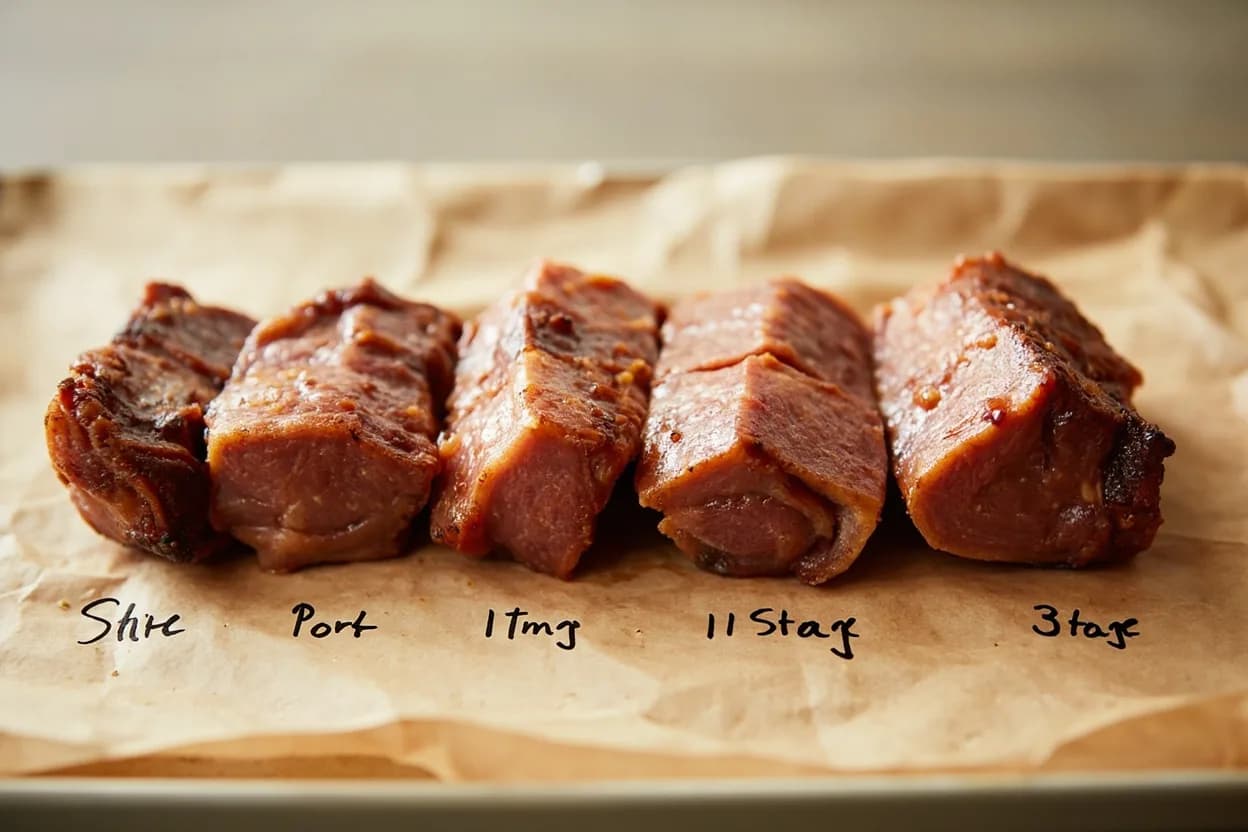

What happens
At 63°C, the primary structural proteins — myosin (denatures fully around 50–55°C) and actin (denatures around 65–70°C) — are in a transitional state: myosin has set the structure while actin retains partial functionality, preserving more moisture and tenderness than the old 71°C standard allowed. Collagen in the connective tissue begins to solubilize slowly but has not fully converted to gelatin at this temperature. The pink color remaining at 63°C is due to myoglobin that has not fully oxidized — it is not an indicator of unsafe meat. The 3-minute rest allows the surface-to-center temperature gradient to equalize and carryover heat to complete the lethality calculation.
What to look for
- Center of loin or chop shows a faint blush of pale pink — not deep red or translucent
- Juices run clear to very faintly rosy when pierced at the thickest point
- Meat offers firm but yielding resistance when pressed — springs back without feeling rubbery or hard
- Cut surface appears glossy and moist, not dry or chalky
- No raw, gelatinous texture at the center
How to check
- Insert instant-read thermometer into the geometric center of the thickest portion, avoiding bone (bone conducts heat faster and will give a false high reading)
- For pork chops, insert the probe horizontally from the side of the chop into the very center
- For a roast, probe from the end toward the center along the long axis
- Rest 3 full minutes tented with foil before cutting — the temperature will typically rise 2–4°C during this period (carryover)
- Pull from heat at 60–61°C if resting on a warm surface to account for carryover
Food safety
Carryover & resting
Whole-muscle pork roasts carry over 3–8°C depending on size and surface temperature; chops and tenderloins carry over 2–4°C. Pull from the oven or grill 2–4°C below target and rest 3–5 minutes for chops, 5–10 minutes for roasts, tented loosely with foil. For a bone-in pork rib roast, target a pull temperature of 59–60°C for a final rested temperature of 63°C.
The science behind it
Ground pork requires 71°C with no rest — the 63°C standard applies only to intact whole-muscle cuts
- Trichinella
The parasite historically driving overcooked pork; destroyed at 55°C, well below the 63°C standard
- Myoglobin
Pink-colored protein responsible for the residual blush at 63°C; not an indicator of undercooking
- Blade Tenderization
Mechanically tenderized pork must be cooked to 71°C; the process carries surface pathogens inward
Appears in
References
- 1.USDA FSIS News Release: USDA Revises Recommended Cooking Temperature for All Whole Cuts of Meat, Including Pork, May 2011
- 2.On Food and Cooking — Harold McGee
- 3.The Food Lab — J. Kenji López-Alt
Confidence: high
Notes
The pink blush is not a defect
For decades, American pork was cooked to 71°C or beyond because consumer habit equated any pink with unsafe pork. The science never supported that: myoglobin color and pathogen lethality are independent. A 63°C center chop with a rosy blush is safer and far more palatable than dry, chalk-white 77°C pork — and is now the professional and regulatory standard.
European context
Many European and Japanese pork preparations (buta no shōgayaki, escalope de porc) have traditionally been cooked to doneness by texture and color rather than strict temperature, often landing near 63–68°C. The 2011 USDA revision aligned US guidance with longstanding international practice and modern food-science understanding.