Offal & Specialty Cuts
Tripe & Tendon Collagen Melt Temperature
Also: collagen dissolution temperature, tripe braising endpoint, tendon gelatinisation point
Extended cooking above 90°C dissolves the dense collagen in tripe and tendon into silky gelatin, transforming rubbery connective tissue into tender, unctuous texture.
Tripe (bovine rumen wall) and tendon (dense bands of type I collagen connecting muscle to bone) are almost entirely collagenous protein. Unlike skeletal muscle, which softens as myofibrillar proteins denature at 65–70°C, tripe and tendon require sustained heat above 85–90°C to hydrolyse the triple-helix collagen molecule into soluble gelatin. The process is time-dependent: temperature opens the helix, but only prolonged exposure dissolves enough cross-links to yield the characteristic slip-through, yielding bite. A pressure cooker shortens this considerably by raising the boiling point, achieving the same effect in a fraction of the stovetop time.
In photos

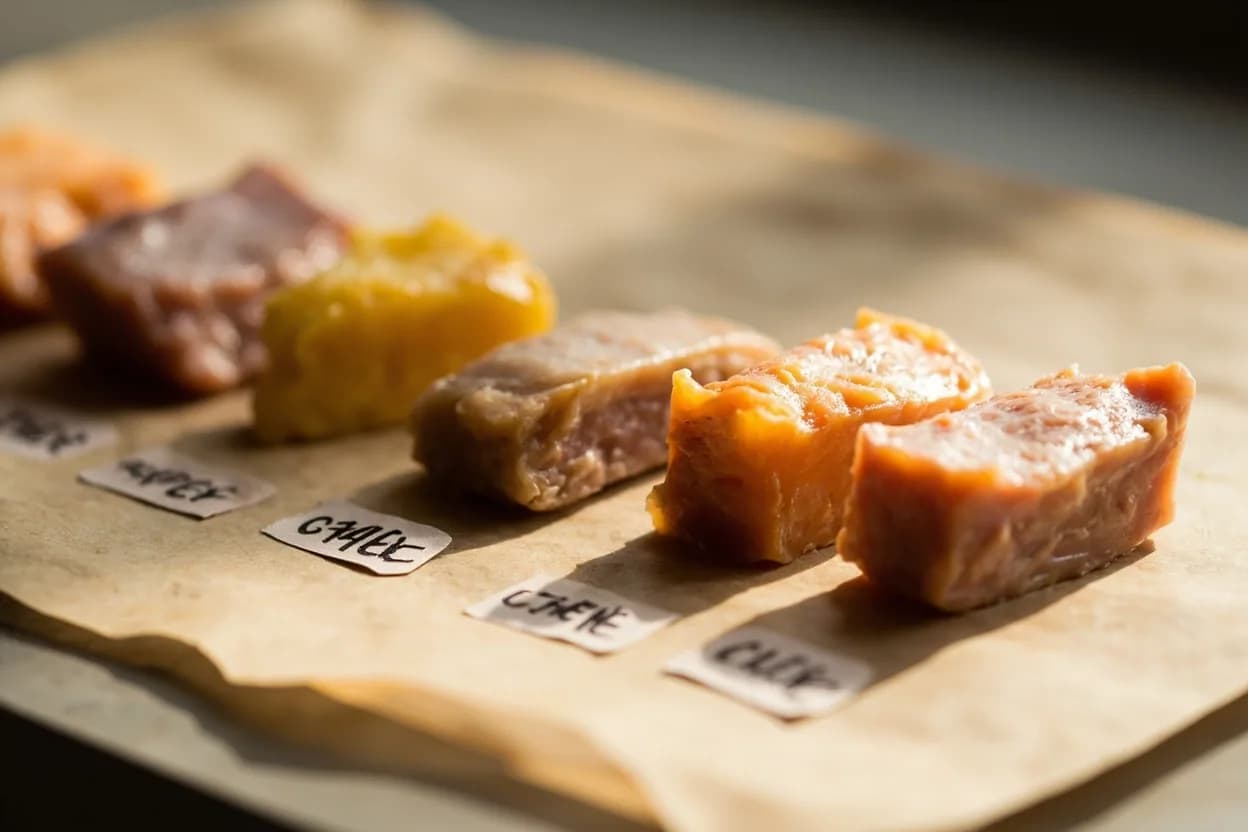

What happens
Collagen consists of three polypeptide chains wound into a right-handed triple helix stabilised by hydrogen bonds and covalent cross-links. Above 70°C, hydrogen bonds begin to break; above 85–90°C, the triple helix unwinds and the chains hydrolyse into shorter peptides (gelatin). Cross-link density is higher in older animals and in tendons vs. tripe, demanding longer cooking. As gelatin leaches into the braising liquid, it forms the thick, self-saucing quality prized in dishes like pho bo gân, coda alla vaccinara, and Cantonese braised beef tendons. The tissue itself, now drained of structural protein, becomes translucent, yielding, and almost frictionless on the palate — colloquially described as 'melting.'
What to look for
- Tripe: transforms from opaque white and rubbery to translucent ivory or pale gold; slides apart when pulled with two spoons
- Tendon: shifts from pearlescent-white and firm to amber-translucent and gelatinous; a probe passes through with no resistance
- Braising liquid thickens noticeably as gelatin dissolves out — a spoon dragged across the surface leaves a slow-filling path
- Aroma deepens from bland-fatty to rich, savory, slightly sweet (Maillard products from gelatin decomposition)
- A piece of tripe cut in cross-section should show no white, fibrous, unhydrolysed core
How to check
- Pinch test: grip a small piece between thumb and forefinger — it should offer almost no resistance and tear cleanly without springing back
- Spoon drag: press a spoon gently on the surface of a piece; fully done tendon will dimple and not recover
- Probe thermometer: ensure the braising liquid is held at 90–95°C (a bare simmer with occasional large bubbles, not a hard boil); time is the variable, not temperature alone
- Chopstick test (Cantonese): a bamboo chopstick should pierce tendon with light pressure and slide through without catching on fibrous strands
- Visual (tripe): hold a piece up to light — fully dissolved collagen yields a semi-translucent, honeycomb-textured piece
Food safety
Carryover & resting
Collagen dissolution is irreversible — there is no 'overcooked' risk from brief carryover the way there is with skeletal muscle. However, tripe left in its braising liquid off-heat will continue to gelatinise as the liquid cools and the surface gelatin recongeals around the pieces, which can cause them to fuse. Spread pieces on a tray or keep submerged and refrigerate promptly if not serving immediately.
The science behind it
The central biochemical transformation: triple-helix hydrolysis requires both sufficient temperature and time
- Pressure Cooking
At 110–121°C (15 psi), the same dissolution occurs in 45–75 minutes rather than 3–4 hours
- Braising Temperature
Maintaining a gentle 90–95°C simmer (not a rolling boil) prevents tripe from disintegrating into shreds while still hydrolysing collagen
- Gelatin Set Point
The gelatin released by tendon sets firm at below 25°C — allowing the braising liquid to be used as a natural aspic
Safety minimum (71–74°C) is distinct from and lower than the texture/collagen target (90°C+)
Appears in
References
- 1.On Food and Cooking — Harold McGee (Scribner, 2004)
- 2.Modernist Cuisine Vol. 3: Animals and Plants — Nathan Myhrvold et al. (The Cooking Lab, 2011)
- 3.The Science of Good Cooking — America's Test Kitchen (2012)
- 4.Food Chemistry — H.-D. Belitz, W. Grosch, P. Schieberle (Springer, 4th ed., 2009)
Confidence: high
Notes
Why Boiling Hurts, Not Helps
A hard boil (100°C) does not speed collagen dissolution meaningfully compared to a 90–95°C simmer — it only agitates the liquid, causing tripe to tear, releasing proteins that cloud the broth, and toughening the outer surface faster than the interior can soften. The ideal is a persistent, lazy simmer: surface broken every few seconds, steam rising, liquid darkening slowly. Vietnamese pho masters maintain the stock at 85–90°C for this reason, ensuring clear, sweet broth and yielding tendon.
Animal Age and Cross-Link Density
Collagen in older animals (cow vs. veal) has more pyridinoline cross-links — covalent bonds that require more energy to break. Veal tripe softens in 1.5–2 hours; mature beef tripe needs 3–4 hours; ox tendon from a working leg may need 4–5 hours at a full simmer. Pressure cooking normalises this variability by raising the temperature to 110–121°C, hydrolysing even heavily cross-linked collagen in under 90 minutes.