Seaweed & Sea Vegetables
Kombu
Also: konbu, dashima (Korean), haidai (Chinese), kelp, Saccharina japonica, Laminaria japonica
Japan's master umami key — thick dried kelp whose glutamates unlock savory depth in dashi, rice, and vegetarian broths.
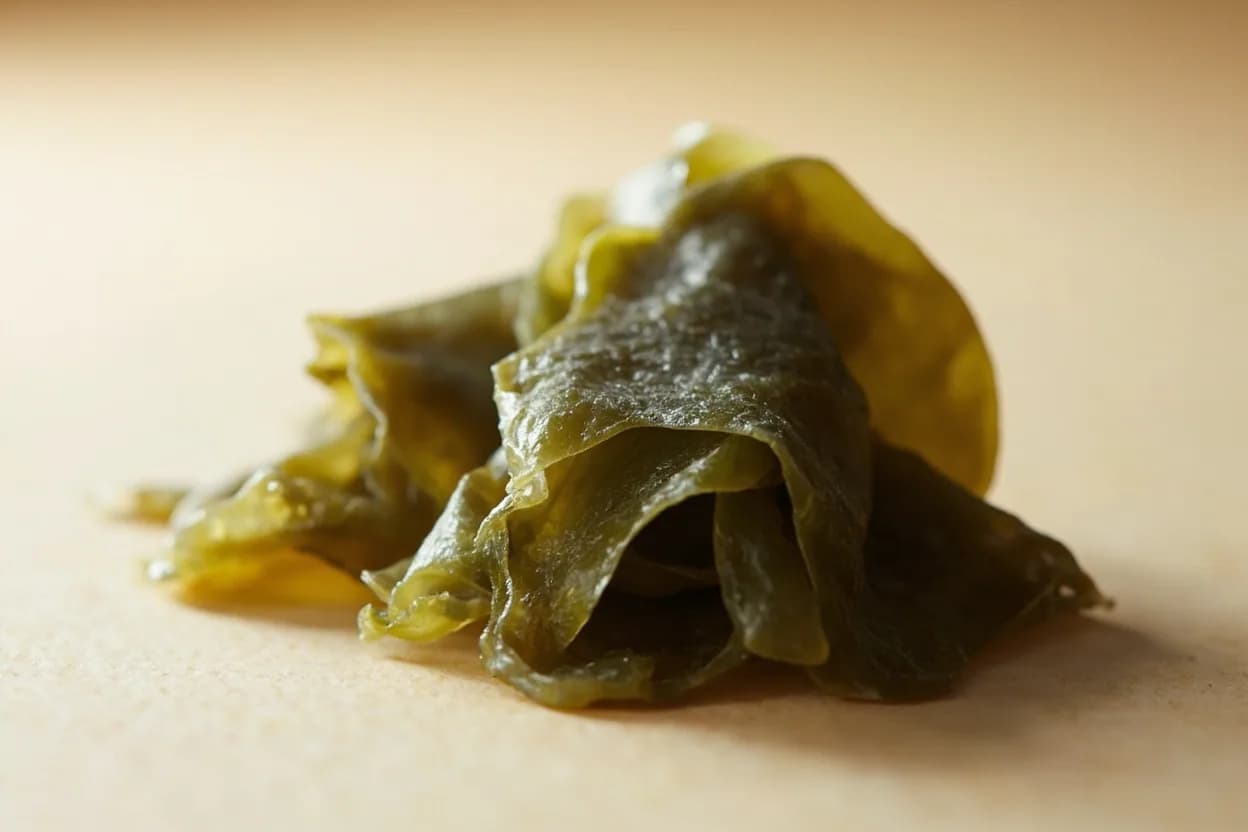
Kombu is large dried kelp, principally Saccharina japonica, harvested from cold-water coasts of Hokkaido, Japan, and the Korean peninsula. It is the single greatest natural source of free glutamic acid (the compound responsible for umami), containing up to 3,190 mg per 100g — several times more than Parmesan cheese. The white powder visible on dried kombu sheets is not mold but natural glutamate and mannitol crystals; it should not be washed off. When steeped in cold or warm water, kombu releases an almost transparent liquid with deep, oceanic, savory character — the foundation of ichiban dashi and the basis of Japanese cuisine. Kombu carries no discernible 'seaweed' brininess in dashi; it reads as a clean, almost mineral savouriness with a faint sweetness.
In photos
Flavour profile
Classic pairings
- Katsuobushi (bonito flakes)Japanese
Kombu and katsuobushi together create ichiban dashi — the glutamate-inosinate synergy amplifies umami to extraordinary levels. This is the foundational pairing of Japanese cooking.
- Shiro shoyu / usukuchi soy sauceJapanese
Light soy rounds out kombu dashi's minerality with gentle salt and sweetness, creating a complete seasoning for delicate dishes.
- TofuJapanese / Kyoto kaiseki
Simmered briefly in kombu dashi, tofu absorbs profound savoriness while staying visually and texturally pristine — kombu dashi is the canonical preparation for yudofu.
- Short-grain Japanese riceJapanese
A strip of kombu in the rice cooker adds quiet umami depth to every grain — a home technique used across Japan.
- Dried shiitake mushroomJapanese vegetarian / shojin ryori
Shiitake carries guanosine-5'-monophosphate (GMP), a third umami pathway that adds to kombu's glutamate for a triple-layered vegetarian dashi.
- Clams and shellfishJapanese
Clam broth and kombu share an oceanic mineral quality and complementary umami compounds — together they power clear Japanese soups of extraordinary depth.
- Daikon radishJapanese (oden, simmered dishes)
Kombu dashi is the braising liquid of choice for daikon — it lifts the radish's mild sweetness without overwhelming its delicacy.
Adventurous pairings
- Dry white wine
Adding a strip of kombu to a white wine reduction dramatically deepens its savory structure — a Western kitchen technique exploiting glutamate-acid balance.
- Butter and pasta
Kombu-infused butter for finishing pasta creates an oceanic umami creaminess that mimics but surpasses clam sauce without any seafood.
- Lentils
Cooking lentils with a strip of kombu (a technique also used with beans in Japanese cooking) softens them faster, adds umami, and reduces flatulence through kombu's enzymes.
- Cucumber (pickled)
Tsukemono (Japanese pickles) made with kombu brine acquire a savory dimension beyond simple acid — a model for any quick pickle recipe.
- Parmesan rind
Both are glutamate powerhouses; simmering kombu and a Parmesan rind together creates a pan-cultural super-broth of remarkable depth.
Tread carefully
- Boiling temperaturesavoid
Heating kombu above 60°C extracts bitter, slimy compounds (alginates) and destroys the clean glutamate extraction — always use cold or warm infusion, removing before the boil.
- Strongly acidic liquidsavoid
Kombu's alginates become bitter and gelatinous in highly acidic environments — avoid prolonged contact with vinegar or citrus before infusing.
- Pungent spices (star anise, clove)avoid
The clean minerality of kombu is erased by strong spice compounds — its subtlety requires a quiet aromatic context.
How to use it
- Cold-steep in water overnight (hiyashi dashi) for the cleanest, brightest glutamate extraction
- Warm-steep at 55–60°C for 30–60 minutes for ichiban dashi (remove before boiling)
- Kombu water: soak a strip in 1 litre of cold water for 30 minutes as an instant vegetarian base
- Score the surface with a knife before steeping to increase glutamate release
- After steeping for dashi, slice the spent kombu and use as tsukudani (simmered in soy and mirin) — nothing is wasted
- Add a strip to the rice cooker with short-grain rice for quiet, savory depth
Appears in
Related flavours
- Katsuobushi (bonito flakes)
The canonical partner for kombu in dashi — inosinate (katsuobushi) and glutamate (kombu) create the defining umami synergy of Japanese cooking.
- Dried shiitake mushroom
GMP-rich shiitake adds a third umami compound to kombu's glutamate for a deep vegetarian stock.
Both are glutamate-rich seaweeds; kombu is a broth ingredient while nori is a wrapper and garnish — they share the same oceanic-umami vocabulary.
References
- 1.Dashi and Umami: The Heart of Japanese Cuisine — Eat-Japan / Cross Media Ltd
- 2.Japanese Farm Food — Nancy Singleton Hachisu
- 3.On Food and Cooking — Harold McGee (Scribner)
- 4.The Flavor Bible — Karen Page & Andrew Dornenburg (Little, Brown)
Confidence: high
Notes
The glutamate ceiling
Kombu is the richest natural source of free glutamic acid on earth, with concentrations reaching 3,190 mg per 100g. For context, Parmesan — the next most cited natural glutamate source — contains around 1,200 mg per 100g. This is why a single strip of dried kombu can transform a litre of plain water into something that tastes complete: the glutamate signals 'savory food is present' to the palate before a single other ingredient is added. The biochemistry of dashi is, in a sense, the biochemistry of the umami discovery — Kikunae Ikeda first isolated glutamate from kombu in 1908.
Kombu-jime technique
Sandwiching raw fish fillets between sheets of dampened kombu (kombu-jime) for several hours draws moisture from the fish while depositing glutamate on the surface — effectively curing and seasoning simultaneously. The technique intensifies the fish's own umami and firms its texture. It is particularly effective with white fish such as sea bream (tai), flounder (hirame), and halibut.