Grains & Rice
Black (Forbidden) Rice
Whole-grain rice that cooks to deep purple with a nutty, slightly sweet chew; striking under fish or stir-fries and in coconut-milk puddings.
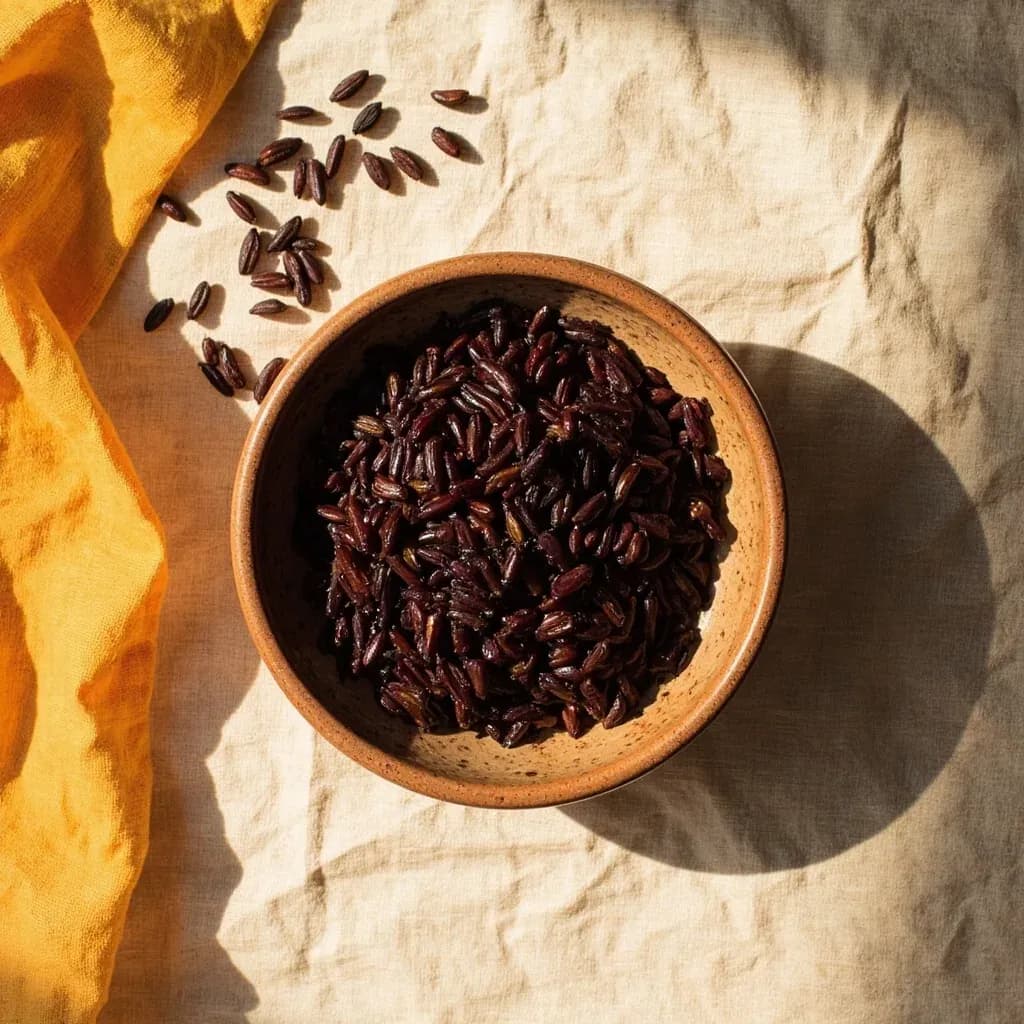
Black rice is a true whole grain whose deep purple-to-near-black color comes from anthocyanins — the same antioxidant pigments that stain blueberries and red cabbage — concentrated in its bran layer. Cultivated in China for at least four thousand years, it was long reserved as tribute food for emperors, which is the source of the "forbidden rice" name that still travels with it. Unlike rice that is colored by dye, every grain of black rice is naturally pigmented, and that pigment carries most of the grain's flavor and nutritional value.
When cooked, the grain behaves like a chewy, slightly sticky rice with a glossy, almost lacquered finish. The flavor is nutty and earthy with a faint roasted-vegetable sweetness that becomes more pronounced when the dry grains are toasted in fat before any liquid goes in. Because the bran stays intact, black rice holds its shape better than polished white rice and gives a satisfying bite that stands up to bold dressings, coconut milk, and rich braises. It also reacts to acid — a squeeze of lime or a splash of vinegar will visibly shift the color on the plate.
The key to cooking it well is choosing the right variety for the dish. Glutinous Chinese Hei Mi and Indonesian Beras Hitam go to sweet puddings where their sticky, dessert-rice texture is an asset. Italian Venere, a short, plump aromatic rice, is the choice for seafood risottos. Thai Hom Nil, a long-grain jasmine descendant, is the most versatile — clean enough for grain salads, sturdy enough for sushi, and aromatic enough to eat plain. Buying by country of origin rather than a generic "black rice" label makes a real difference at the stove.
- Measured in
- g
- Storage
- Pantry
Find it in
Suits
Types & varieties
Short- to medium-grain, cooks sticky and very dark; the classic Asian dessert rice
Long-grain jasmine descendant with floral aroma; turns purple-black when cooked; the most versatile everyday variety
Aromatic short-grain developed in the Po Valley in the late 1990s; the rice of choice for seafood risottos
Glutinous, deeply pigmented grain used in traditional sweets and rice cakes
Short, plump grain traditionally eaten on special occasions; turns deep purple when cooked
Choosing the right variety
Black rice is not a single product — the grain length, stickiness, and aroma differ enough between varieties to change the dish. Match the rice to the recipe rather than treating them as interchangeable.
- Glutinous Hei Mi and Beras Hitam for sweet puddings simmered in coconut milk — they go creamy and hold their shape in a thick liquid.
- Italian Venere for risotto and any dish where you want a short, plump, aromatic grain that drinks in stock.
- Thai Hom Nil for salads, sushi, poke bowls, and everyday sides — it stays the most separate and the most fragrant.
- Japanese Kuro Gome when you want a short, slightly sticky grain with deep color for onigiri or bento presentations.
- Mix 50/50 with white jasmine or short-grain rice to stretch the color, lighten the texture, and cut cost on everyday use.
Cooking for color and chew
The bran layer is where everything good lives, so the goal is to cook the rice gently enough to keep the pigment intact while still driving moisture into the center. A short soak, a tight lid, and a covered rest off the heat will give glossy, deeply colored grains that are tender at the core and still toothsome at the edge. Toasting the dry grains in a little butter or oil before adding liquid pulls out a roasted, almost popcorn-like note that pure boiled rice never has.
Common uses
Tips & pitfalls
- Rinse the rice under cold water until the water runs nearly clear, but don't scrub aggressively — you want to remove surface starch, not strip the anthocyanins that give the rice its color and flavor.
- Soak the grains for 30 minutes to 1 hour before cooking for more even texture and a shorter simmer; longer soaks work too but aren't necessary.
- Toast the dry rice in a teaspoon of butter or oil for 1–2 minutes over medium heat before adding liquid; the grains will smell nutty and the finished rice will taste deeper and less flat.
- Keep the lid on tight during simmering and resist the urge to stir; lifting the lid interrupts the steam that finishes the grain evenly.
- Use a 2:1 water-to-rice ratio with a pinch of salt for a tender result; drop to 1.75:1 and shorten the rest for a chewier, more separate grain.
- Rest the rice covered off the heat for 10 minutes after cooking, then fluff with a fork so each grain separates and the color brightens.
- A splash of rice vinegar or lime juice tossed through the cooked grains shifts the color visibly and balances the rice's natural sweetness — useful in both savory bowls and desserts.
- Cool cooked rice in a thin layer on a sheet pan before refrigerating; thick warm mounds develop off-flavors and dry out at the edges. Use within 4–6 days.
- Do not confuse black glutinous rice (sweet, sticky, deep purple) with black japonica (still firm and separate) when substituting in a recipe — they cook and behave very differently.
Nutrition
Energy
1536 kJ · per 100 g
Where the calories come from
Protein
7.5g
15% DV
Carbs
76.3g
28% DV
Fat
3.2g
4% DV
Fiber
3.6g
13% DV
Sugars
0.7g
of which
Sodium
5mg
0% DV
Source · USDA FoodData Central · approx. Rice, brown, long-grain, raw (Includes foods for USDA's Food Distribution Program)
View on FDC →In the shops
Matched grocery products
No matched grocery products for Black (Forbidden) Rice yet.
Good to know
- Origin
- China, cultivated for at least 4,000 years; reserved for emperors, hence "forbidden rice"
- Color source
- Anthocyanins in the bran layer, the same pigments that color blueberries and blackberries
- Primary producing regions
- Jiangsu, Zhejiang, and northern Fujian in China; also grown in Thailand, Indonesia, and Italy
- Typical cook ratio
- 1 cup rice to 1.75–2 cups water or liquid
- Cook time
- 30–45 minutes simmering after an optional 30-minute soak
- Texture when cooked
- Chewy, slightly sticky with a glossy deep-purple to nearly black hue
- Flavor profile
- Nutty, earthy, slightly sweet, with a subtle roasted-vegetable finish
- Nutritional note
- Whole grain; higher in protein, fiber, iron, and anthocyanin antioxidants than polished white rice
- Yield
- About 3 cups cooked from 1 cup dry
- Shelf life (dry)
- 6–12 months in an airtight container in a cool, dark pantry
- Shelf life (cooked)
- 4–6 days refrigerated in a sealed container
Substitutes
- Wild rice — Similar dark color and chewy texture; more robust, earthy flavor and a longer cook time
- Purple jasmine or sticky purple rice — Same anthocyanin family; lighter lavender hue and slightly less intense nuttiness
- Black quinoa — Gluten-free whole grain with comparable protein and a similarly dramatic dark presentation
- Arroz negro (Spanish squid-ink rice) — Not a true substitute — the color comes from ink, not bran — but it is used in the same savory seafood contexts
Pairs with
Also called
forbidden rice · purple rice · Chinese black rice