Proteins
Chicken Drumstick
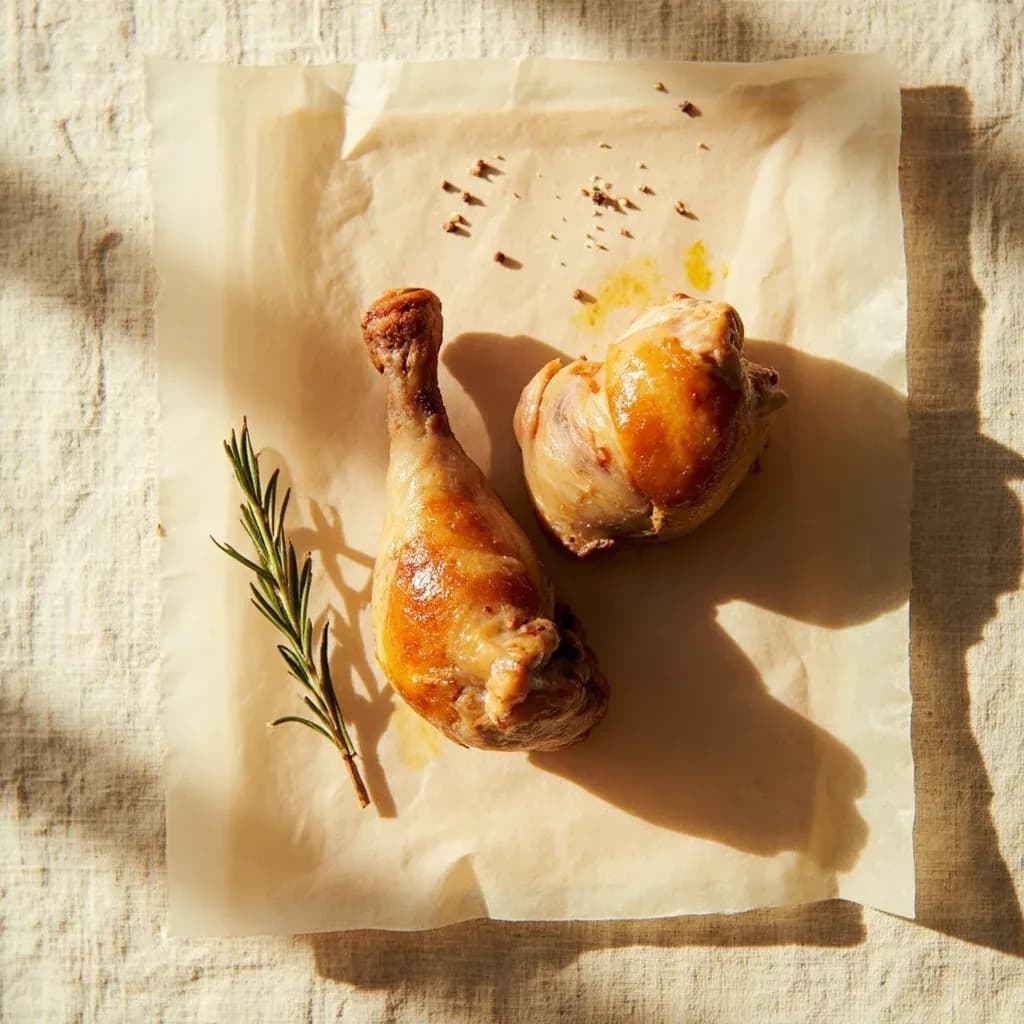
Dark, juicy lower leg on the bone; forgiving and rich-tasting, it holds up to roasting, frying and braising and stays moist where breast dries out.
The drumstick is the lower leg of the chicken — tibia and fibula wrapped in dark meat, capped by a generous layer of skin and subcutaneous fat. It is one of the most forgiving cuts in any kitchen: inexpensive, flavorful, and structurally built for both quick high-heat cooking and long, slow braises. Where a breast dries out the moment its proteins tighten past about 70°C, a drumstick's connective tissue only begins to break down around 75°C and turns properly silky between 80 and 85°C. That window of forgiveness is what allows a pan of drumsticks to rest under a tent while you finish a sauce, or to ride out an extra few minutes on a hot grill without becoming shoe-leather.
Three structural features drive nearly every cooking decision. First, the skin: when dried and salted, it renders into a brittle, golden crust and self-bastes the meat beneath. Second, the fat cap and intramuscular fat keep the meat moist through long cooks and give it a deeper, slightly mineral flavor than breast. Third, the bone: it slows heat transfer, so the muscle immediately around it is the last zone to cook and the best place to probe for doneness. Treating these features as assets rather than obstacles is what separates a serviceable drumstick from a great one.
Because the bone enriches any liquid it sits in, the drumstick also doubles as a flavor engine. A few pieces simmered in stock, tomato, wine, or coconut milk will thicken a thin sauce into something glossy without any added thickener. Almost every cuisine has at least one signature drumstick dish — coq au vin, tandoori, jerk, adobo, karaage, bulalo, jollof — which is itself evidence of how widely the cut travels.
- Measured in
- g
- Storage
- Refrigerate
Find it in
Types & varieties
Young bird ~6–8 weeks; the retail default. Mild flavor, tender texture, quick to cook.
Yellow-tinged skin and slightly sweeter, plumper flesh from a maize-heavy diet.
Birds raised on organic feed with no routine antibiotics; otherwise handled like standard.
Outdoor access; often firmer texture and more pronounced flavor from exercise and varied diet.
Older breeds such as Dorking, Wyandotte, Sussex or Plymouth Rock; deeper, gamier flavor, firmer muscle, smaller drumsticks.
Very young, small bird; drumsticks are petite and cook in roughly two-thirds the usual time.
Birds processed per religious requirements; often pre-rinsed or lightly brined, so season cautiously.
Skin-on is standard for roasting, grilling and frying to render fat and crisp the surface; skinless is used when a leaner finish or faster braise is wanted.
Reading the cut
Think of the drumstick as three concentric layers, each with its own job. The outer skin crisps and browns when dry and hot. The fat cap beneath the skin melts and bastes during long cooks, carrying flavor into the meat. The dark muscle itself is laced with collagen that converts to gelatin above roughly 75°C, which is what gives properly cooked drumstick meat that almost saucy, slippery quality. The bone sits in the middle like a heat sink: it cooks more slowly than the surrounding meat, so the muscle right against it is the last to finish. Probe there, not at the surface.
- Skin: dry → crisp; wet → steam.
- Fat cap: renders at high heat and protects the meat during long cooks.
- Muscle: improves as it climbs from 74°C to 85°C — do not pull it early.
- Bone: the trusted reference point for doneness.
Target temperatures
The USDA safe minimum is 74°C / 165°F, and at that temperature a drumstick is perfectly safe and reasonably tender. For a noticeably better texture, push to 80–85°C; the collagen around the bone melts into gelatin and the meat loosens from the bone just enough to eat cleanly. Past 90°C the fat renders out aggressively and the meat begins to feel stringy, so settle into that 80–85°C window and rest the piece for 5–10 minutes before serving.
- 74°C: safe, slightly chewy, holds shape.
- 80–85°C: optimum — silky, juicy, the meat pulls cleanly from the bone.
- 90°C and beyond: fat drains, fibers tighten, texture turns stringy.
Buying and storing
Look for plump, even-shaped pieces with unbroken skin and no dark spots or freezer burn. A pale, slightly waxy bloom on the skin is normal; a strong sulfurous or sour smell is not. Keep raw drumsticks on the lowest refrigerator shelf in a covered container so juices cannot drip onto produce, and use within 48 hours. For longer keeping, freeze in a single layer on a tray, then transfer to a sealed bag — flash-freezing prevents the pieces from gluing together. Thaw in the refrigerator overnight rather than on the counter; rapid thawing at room temperature invites bacterial growth on the surface before the center has thawed.
- Buy: even shape, unbroken skin, no off-odors.
- Refrigerate: ≤4°C, use within 1–2 days.
- Freeze: up to 9 months at –18°C; thaw in the fridge overnight.
Common uses
Tips & pitfalls
- Pat the skin completely dry, then salt generously at least 40 minutes ahead — or uncovered in the fridge overnight — for crispier skin and seasoning that penetrates to the bone.
- For fried chicken, dredge in seasoned flour, rest 10 minutes, then dredge again; the second coat survives splashes and stays audibly crunchy.
- Brine (about 30 g salt per litre water, 1–2 hours) if the bird is lean or very young — it seasons deeply and gives insurance against overcooking.
- Cook to 80–85°C internal, not the USDA minimum — dark meat's collagen only softens past about 75°C, and pulling early leaves it chewy.
- Score the skin in two or three shallow cuts across the thickest part of the drumstick so fat renders and marinades or rubs reach the meat underneath.
- For braises, sear first in a hot pan, then simmer partially covered; uncover for the last stretch so the sauce reduces and concentrates rather than stewing the skin to mush.
- Don't crowd the pan when searing or frying — a crowded pan drops the oil temperature and steams the skin instead of crisping it.
- Rest 5–10 minutes after roasting or grilling, tented loosely with foil, so the juices relax back into the meat instead of spilling onto the board.
- Probe near (but not touching) the bone — that zone cooks last and is the one to trust, not the surface reading.
Nutrition
Energy
268 kJ · per 100 g
Where the calories come from
Protein
9.4g
19% DV
Carbs
8.3g
3% DV
Fat
1.4g
2% DV
Fiber
2g
7% DV
Sodium
9mg
0% DV
Source · USDA FoodData Central · Drumstick leaves, raw
View on FDC →In the shops
Matched grocery products
No matched grocery products for Chicken Drumstick yet.
Good to know
- Also known as
- Chicken leg (lower leg), drumstick
- Cut from
- Lower leg of the chicken, between the knee and ankle joint
- Meat type
- Dark meat (myoglobin-rich), with higher intramuscular fat than breast
- Bone
- Bone-in (tibia and fibula); skin-on unless removed
- Average weight
- 110–170 g (4–6 oz) per piece at retail
- Edible yield
- Roughly 55–65% after bone removal
- Safe internal temperature
- 74°C / 165°F (USDA); 80–85°C gives a silkier, more succulent texture
- Storage, raw
- 1–2 days refrigerated at ≤4°C; up to 9 months frozen at –18°C
- Storage, cooked
- 3–4 days refrigerated; 2–3 months frozen
- Skin and fat
- Generous skin and subcutaneous fat cap; renders well and self-bastes during cooking
Substitutes
- Chicken thigh (bone-in) — Closest swap: same dark meat, similar fat and connective tissue; cook times nearly identical at the same weight.
- Chicken leg quarter — Drumstick attached to the thigh; substitute 1:1 by weight, allow slightly longer cooking time.
- Turkey drumstick — Larger but follows the same logic of bone-in dark meat; great for braising, reduce count by roughly a third.
- Cornish hen leg — Smaller, more delicate; works for refined presentations but cook time drops to roughly 20–25 min roasting.
Pairs with
Also called
drumstick · chicken leg · chicken drumsticks