Proteins
Chicken Tender
Small strip of muscle under the breast, very lean and quick-cooking. Bread and fry, skewer, or stir-fry; overcooks fast. Sold as the natural cut behind breaded tenders.
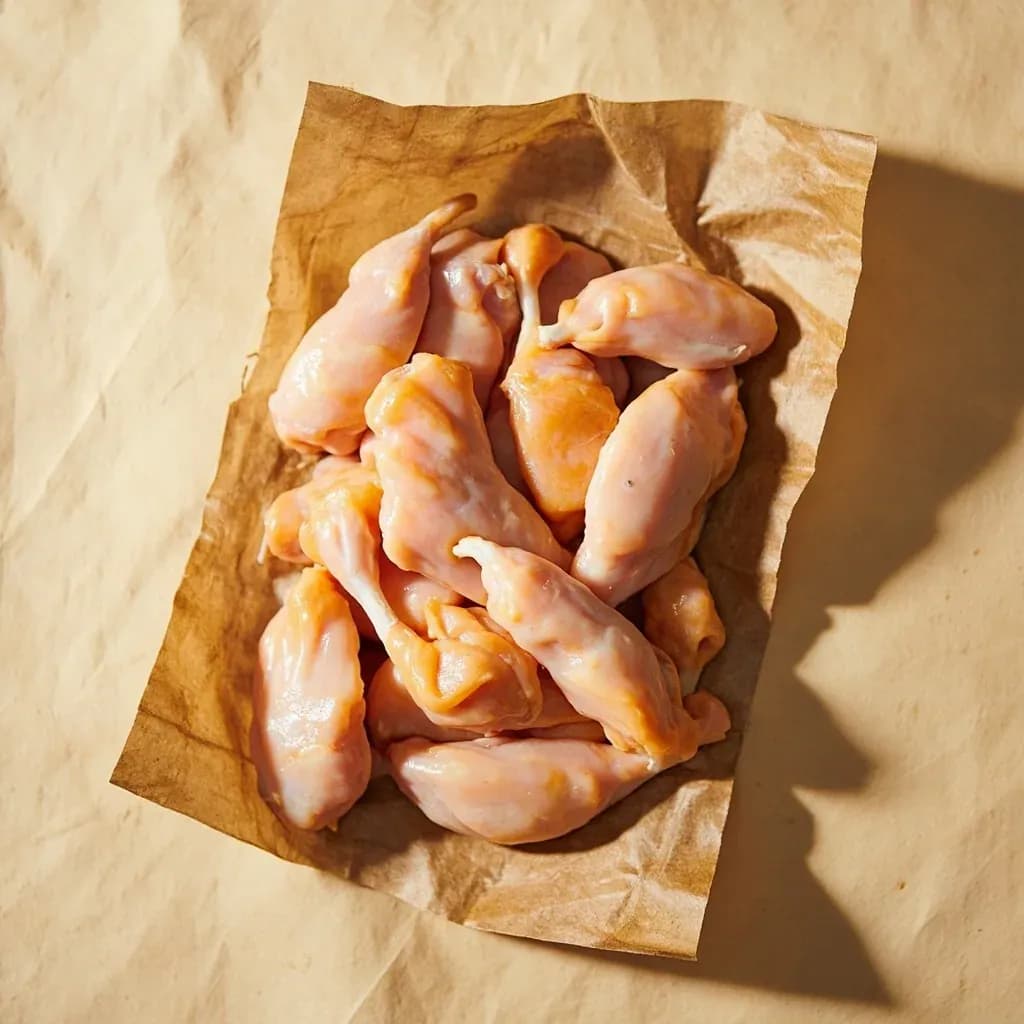
The chicken tender is the pectoralis minor, a thin, strap-shaped inner pectoral muscle that lies tucked against the underside of each breast half. Two come from every bird, and at roughly 3–4 inches long and about an ounce apiece, they are small but prized because the muscle fibers are fine, almost entirely free of connective tissue, and never do much work during the bird's life. That anatomy is why the cut is sometimes called the "filet mignon of the chicken": it is the most tender piece on the animal without any mechanical pounding, marination, or aging.
The trade-off is leanness. With barely a gram of fat per tender, this cut has almost no built-in insurance against overcooking, which is why the timing window for tenderloins is narrower than for any other chicken part. Pull at 160°F (71°C) and the carryover does the rest; push past 165°F (74°C) and you have essentially boiled the moisture out. Because the tender is small and uniformly shaped, it also cooks in a fraction of the time of a full breast — two to four minutes per side in a hot pan, roughly six to eight minutes over a hot grill — which makes it the natural choice for any preparation built around speed or single-bite serving, from yakitori skewers to wrapped hors d'oeuvres.
A note worth flagging at the outset: most of what is sold as "chicken tenders" in restaurants and freezer aisles is not this cut at all, but chopped-and-formed breast meat pressed into a tender-shaped piece. The actual tenderloin is hand-trimmed from beneath the breast and carries a telltale ridge along one side and a small white tendon at one end. When a recipe calls for the natural cut and you want the texture it is famous for, look for those whole-muscle indicators on the package.
- Measured in
- g
- Storage
- Refrigerate
Find it in
Types & varieties
The actual pectoralis minor, hand-trimmed from the breast. Two per bird. Considered the premium product and the only true chicken tender.
Made from breast trimmings that are ground, bound, and pressed into tender-shaped pieces. Common in foodservice and frozen brands; cheaper, more uniform shape, slightly springier bite.
Pre-soaked in brine or flavoring (buttermilk, lemon-pepper, teriyaki, buffalo) and sold ready to cook. Saves time and adds moisture insurance against overcooking.
The same cut from birds raised under those standards. Slightly firmer texture and more pronounced chicken flavor, especially from slower-growing heritage breeds.
Identifying the Real Tenderloin
Because the term "tender" is used loosely in the marketplace, knowing what to look for at the butcher counter or in the grocery case matters more here than with most cuts. The natural tenderloin has three giveaway features: a slightly asymmetric, teardrop shape that's fatter on one end and tapers to a point on the other; a faint longitudinal ridge running down one face (the seam where it attached to the breast); and a small, pearly white tendon at the thick end. That tendon must be trimmed before cooking — left on, it tightens and turns chewy as the meat heats.
Reformed tenders, by contrast, look almost too perfect: uniform thickness end to end, smooth on every side, no ridge, no tendon. The texture tells you too — they spring back firmly when pressed raw and feel more uniform when bitten, lacking the loose, layered fiber of a whole muscle. For breaded-and-fried applications where the cut is essentially a delivery vehicle for crust and sauce, reformed pieces perform fine. For pan-seared, grilled, or stir-fried work where the meat itself is meant to be tasted, the natural cut is worth seeking out and the small price premium it carries.
Common uses
Tips & pitfalls
- Brine or marinate in buttermilk for 20–30 minutes before cooking — the lean muscle dries out fast and benefits from added moisture plus a touch of salt and lactic acid.
- Pull from heat at 160°F (71°C); carryover will carry it to a safe 165°F (74°C) without overcooking. A tender is best when still noticeably juicy at the center.
- Pound lightly to an even thickness if you want uniformly quick cooking, especially for pan-fried breaded cutlets where a thick spot will finish late.
- Pat the surface thoroughly dry before searing or breading — wet tenders will steam instead of brown, and breading will not adhere to a damp surface.
- Season inside the breading (salt, pepper, garlic powder, sweet paprika) — the cut is mild and needs flavor built in, not just a salty crust.
- Don't crowd the pan; they cook so quickly that steam from a packed skillet will ruin the crust and leave the breading soggy.
- For grilling, use a two-zone fire and sear hot-and-fast over direct heat — the high surface-area-to-mass ratio means flare-ups will char the outside long before the inside is safely cooked.
- Trim the small white tendon off the thick end before cooking — it tightens during cooking and turns into a tough, rubbery strip that pulls the meat with it.
Nutrition
Energy
1100 kJ · per 100 g
Where the calories come from
Protein
14.7g
29% DV
Carbs
15g
5% DV
Fat
15.8g
20% DV
Fiber
1.1g
4% DV
Sugars
0.4g
of which
Sodium
536mg
23% DV
Source · USDA FoodData Central · Chicken breast tenders, breaded, uncooked
View on FDC →In the shops
Matched grocery products
No matched grocery products for Chicken Tender yet.
Good to know
- Anatomical name
- Pectoralis minor — the small inner pectoral muscle that runs along the underside of each breast half.
- Yield per bird
- Two tenders per chicken, one beneath each breast half.
- Typical size
- About 3–4 in (7–10 cm) long, 1–1.5 oz (28–45 g) each, roughly 1 in (2.5 cm) wide at the thickest point.
- Fat content
- Very lean — roughly 1 g fat per tender; essentially all protein (~22–25 g per 100 g).
- Doneness temperature
- USDA-safe at 165°F (74°C); best pulled at 160–163°F (71–73°C) so carryover finishes the cook without drying the muscle.
- Cook time
- 2–4 min per side pan-seared, 4–6 min deep-fried at 350°F (175°C), 8–12 min baked at 400°F (205°C), 6–8 min grilled over medium-high heat.
- Storage (raw)
- Refrigerate 1–2 days; freeze up to 9 months wrapped tightly to prevent freezer burn.
- Label watch-out
- Most commercial "chicken tenders" are chopped-and-formed breast meat, not the natural muscle. Look for "whole-muscle" or "natural cut" on the label; the real tender has a visible ridge and a small white tendon at one end.
Substitutes
- Boneless, skinless chicken breast, sliced into strips — Closely related muscle, widely available and cheaper. Slice against the grain about 1 in (2.5 cm) wide and pound to even thickness. Slightly less tender but cooks in roughly the same time.
- Chicken cutlet (pounded breast) — Use when a recipe calls for a butterflied, breaded tender; adjust thickness so the cutlet cooks through in the same short window.
- Boneless, skinless chicken thigh, trimmed and sliced — More forgiving thanks to extra fat, but richer flavor and a chewier texture. A good swap for grilled or saucy applications, less ideal for delicate breaded preparations.
- Turkey tenderloin — The same anatomical cut from a turkey; larger and slightly gamier, but works in any of the same preparations with a longer cook time.
- Firm white fish (cod, haddock) — For breaded-and-fried applications; cooks in similar time but flakier texture and a very different flavor.
Pairs with
Also called
chicken tender · chicken strip · chicken goujon · breast tenderloin
