Beverages
Oolong Tea
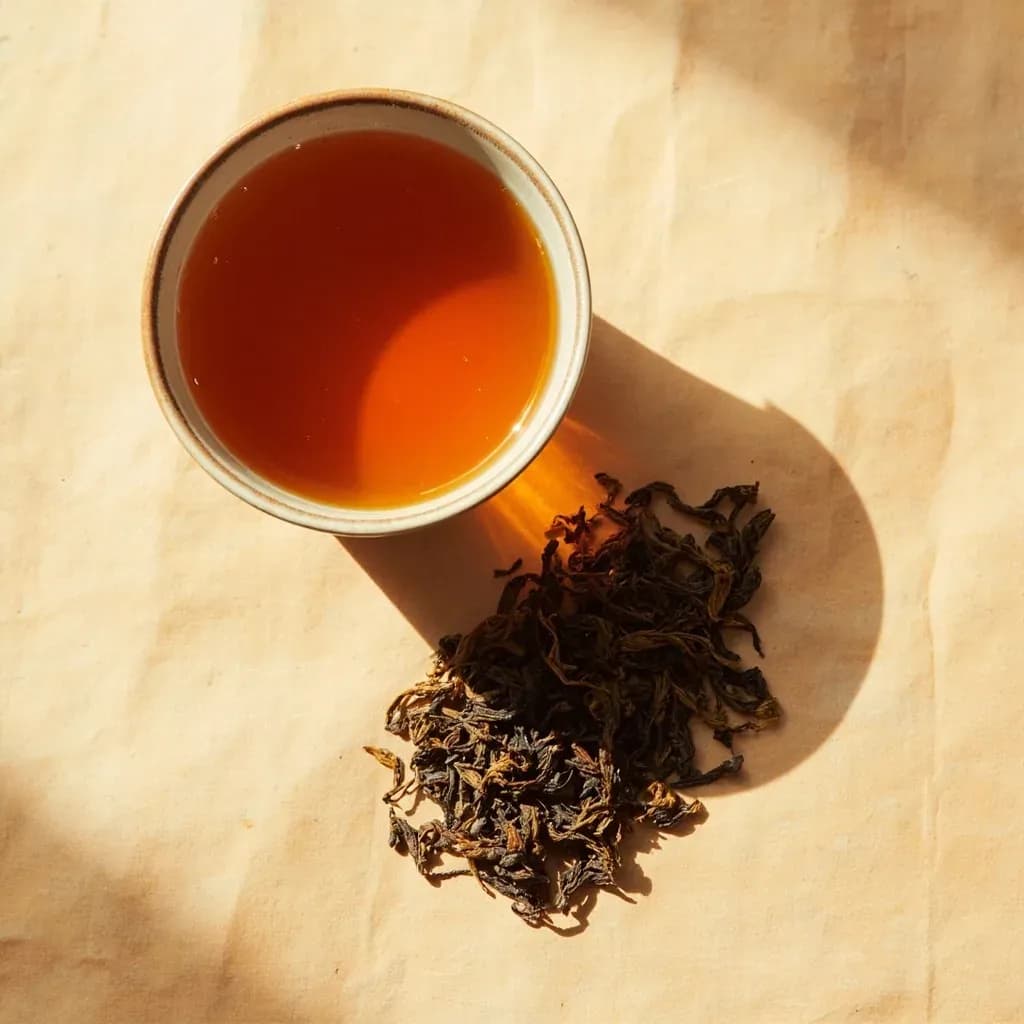
Partially oxidized tea between green and black, with toasty floral-orchid notes — brewed hot or iced, smoked into tea-smoked duck, and steeped into custards and braises.
Oolong occupies the broad middle of the tea spectrum — partially oxidized leaves that range from barely touched by air (almost green) to nearly black. That range is exactly what makes the ingredient useful in the kitchen: pick the right end of the spectrum and oolong can behave like a delicate green tea in a custard, a roasted, smoky black tea in a braise, or anything in between. Treat it as one flavor and it will surprise you; treat it as a spectrum and it becomes one of the most versatile teas to cook with.
The two poles are worth knowing. The Wuyi Mountains of northern Fujian produce yan cha, or 'rock teas' — heavily oxidized, charcoal-roasted leaves like Da Hong Pao and Rou Gui, with deep cocoa, mineral, and woodsmoke notes that stand up to red meat, chocolate, and smoking. Anxi in southern Fujian and the high mountains of Taiwan produce lighter, greener oolongs — Tieguanyin, Jin Xuan, the gao shan cha — that are floral, creamy, and closer in spirit to a fine green tea than to a breakfast Assam. Most cooking decisions hinge on which pole you are reaching for.
Because oxidation is variable, oolong misbehaves when handled like a single ingredient. Brewing water that is too hot extracts harsh tannin from light oolongs; too cool a steep and a roasted rock tea never opens up. The same is true in the pan — a spoonful of Da Hong Pao will dominate a delicate broth, while Tieguanyin will disappear into a heavy braise. Cook by category, not by the word on the tin.
- Measured in
- g
- Storage
- Pantry
Find it in
Suits
Types & varieties
Anxi, Fujian. Light to medium oxidation, tightly rolled balls; vivid orchid and creamy floral notes.
Wuyi Mountains, Fujian. Medium-heavy oxidation, charcoal-roasted; mineral, dark cocoa, roasted grain. The original 'mother bushes' are no longer harvested commercially.
Wuyi rock tea. Roasted, full-bodied, with stone-fruit and wood-smoke character.
Wuyi rock tea named for cassia; spicy, warming, deeply roasted.
Taiwan. Medium oxidation and roasting; balanced floral and toasty notes.
Taiwan, grown above 1,000 m. Light oxidation, creamy and milky-floral; often labeled by mountain (Li Shan, Ali Shan, Shan Lin Xi).
Taiwanese cultivar; creamy, buttery, soft floral — the 'milkiness' is a flavor impression, not actual dairy.
Taiwan. Heavily oxidized (≈60–70%); leaves bitten by leafhoppers produce honey, ripe fruit, and muscatel notes.
Phoenix Mountain, Guangdong. Medium oxidation with ripe-fruit and orchid aromatics.
Choosing Oolong for the Kitchen
Most kitchen mistakes come from treating oolong as a single ingredient. Decide first which end of the spectrum your dish needs, then pick a cultivar that fits.
- Light, green-leaning oolongs (Anxi Tieguanyin, Taiwanese Jin Xuan and high-mountain gao shan): floral, creamy, often milky. Best for infusing dairy, pairing with seafood and stone fruit, cold-brewing for iced tea, and delicate syrups for cocktails.
- Heavily oxidized, roasted oolongs (Wuyi yan cha — Da Hong Pao, Rou Gui, Shui Xian): cocoa, mineral, smoke, cassia. Best for tea-smoking, braising rich meats, ganache and truffles, and standing up to char siu and roast duck.
- Mid-oxidized Taiwanese teas (Dong Ding, Oriental Beauty) are the all-purpose middle — floral enough for desserts, deep enough for glaze reductions.
- Buy by harvest year for Taiwan; for Wuyi rock teas, ask whether the roast is fresh (sharp, slightly green) or rested (rounder, more cocoa), and plan a few months of rest if it tastes aggressive.
- Buy in 50–100 g tins. Once opened, aroma fades in weeks, not months — a large foil bag goes flat before you finish it.
Common uses
Tips & pitfalls
- Use cooler water (≈85 °C / 185 °F) for green-leaning oolongs like Tieguanyin; reserve near-boiling (≈95 °C / 205 °F) for roasted Wuyi styles to open them up. The single most common kitchen error is treating all oolong like black tea and pouring off the kettle.
- Rinse the leaves with a quick hot pour and discard that water before the first drinkable steep — it wakes the compressed leaf and noticeably improves clarity.
- For gongfu brewing, use a high leaf-to-water ratio and short steeps; flavor shifts noticeably from steep 1 to steep 4, so taste as you go rather than timing blindly.
- Do not let brewed oolong sit on the leaves. It turns bitter and woody within minutes once over-extracted — decant the whole pot into a pitcher, or pull the infuser.
- Store oolong in a dedicated airtight tin. Sitting next to coffee or spices will mute the floral top notes within a few weeks; glass jars on a sunny counter are the second-most common mistake.
- Cold-brew at roughly 1 g per 100 ml in the fridge for 8–12 hours for a smooth, low-bitterness concentrate that is excellent iced and a better base for cocktails than hot-brewed tea.
- A charcoal-roasted Wuyi oolong that tastes sharp or green is not defective — it is fresh from the roast. Give it 1–3 months in a sealed tin and the edges will round into cocoa and stone fruit.
- For tea-smoking, use a dry wok lined with foil, then a layer of rice and sugar, then a generous handful of dry oolong, then the meat on a rack with a tight lid. Smoke needs to be trapped to penetrate — a loose lid wastes the leaves.
Nutrition
Energy
4 kJ · per 100 g
Where the calories come from
Protein
0g
0% DV
Carbs
0.2g
0% DV
Fat
0g
0% DV
Fiber
0g
0% DV
Sugars
0g
of which
Sodium
3mg
0% DV
Source · USDA FoodData Central · approx. Beverages, tea, Oolong, brewed
View on FDC →In the shops
Matched grocery products
No matched grocery products for Oolong Tea yet.
Good to know
- Type
- Semi-oxidized tea (Camellia sinensis); oxidation ranges roughly 8–85%
- Origin
- China, Fujian Province; established by the early 18th century under the Qing dynasty
- Two main traditions
- Northern Fujian (Wuyi rock oolongs, heavily oxidized and roasted) and Southern Fujian / Guangdong (Anxi-style, lighter and more floral)
- Major growing regions
- Fujian and Guangdong (China); Nantou, Chiayi, Hualien, and Ali Shan (Taiwan)
- Caffeine
- Roughly 30–50 mg per 8 oz (240 ml) cup — between green and black tea
- Brewing temperature
- 85–95 °C / 185–205 °F; lighter oolongs at the low end, roasted rock teas at the high end
- Gongfu ratio
- 5–8 g leaf per 100 ml water, multiple short steeps of 20–45 seconds
- Western ratio
- 2–3 g per 240 ml cup, steeped 3–5 minutes
- Shelf life
- 1–2 years sealed; roasted Wuyi oolongs often improve over 6–12 months of rest
- Storage
- Airtight, opaque, cool, away from light, moisture, and strong odors; never refrigerate
Substitutes
- Black tea (Lapsang Souchong or Keemun) — Best stand-in for roasted Wuyi-style oolong in braises, smoking, and custards; gives similar depth and tannin. Note: Lapsang Souchong carries pine smoke, not charcoal roast, so the flavor skews different.
- Black tea (general) — Use at roughly 1:1 leaf weight in most recipes; expect a flatter, more malt-driven flavor.
- Green tea (Longjing or Sencha) — Substitute for light, floral Anxi-style oolong; lower the brewing temperature by 5–10 °C to avoid bitterness.
- White tea (Shou Mei or Bai Mu Dan) — Replaces high-mountain Taiwanese oolongs when you want a soft, honey-floral base for infusions and cocktails.
- Roasted barley tea (mugicha) — Caffeine-free option for toasty, grainy notes in chilled drinks, ice cream, and light broths.
Pairs with
Also called
wulong tea · wu long tea
