Spices
Pink Peppercorn
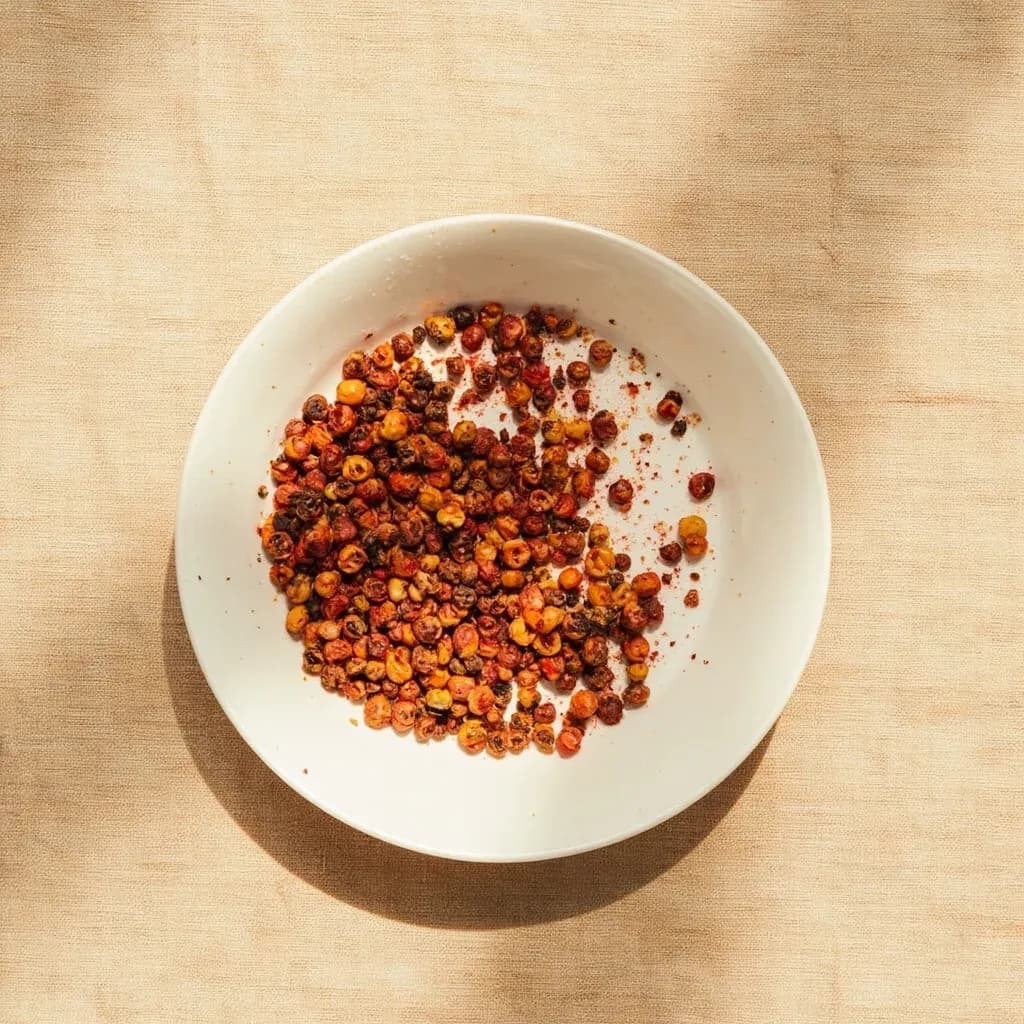
Not true pepper but a dried rose-red berry, fruity and faintly piney with mild heat. Crush over fish, salads and desserts for colour and perfume; brittle shells crumble easily underfoot of a spoon.
Pink peppercorns are the dried ripe fruits of two South American trees in the cashew family — Schinus molle, the Peruvian peppertree, and Schinus terebinthifolius, the Brazilian or Aroeira peppertree. Despite the name, they share no kinship with Piper nigrum; botanically they sit closer to cashews, pistachios, mangoes and, on the unfortunate end of the family, poison ivy. Madagascar and Réunion now dominate the export trade, but the berries only became a kitchen fixture from the 1980s on, when chefs like Jean-Georges Vongerichten helped push them from apothecary jars into restaurant pass drawers.
The flavor is the reason they earned that place. Where black peppercorns hit with sharp, biting heat, pink peppercorns offer a soft, fruity sweetness layered with resinous pine and only a trace of true pungency. The aroma is driven by volatile terpenes — chiefly limonene and the phellandrenes — the same family of compounds that gives juniper, cardamom and a ripe tangerine peel their lift. Those oils are fragile, which is why pink peppercorns behave as a finishing spice rather than a workhorse: add them at the end of cooking, crush them lightly so the brittle shells do not shatter into a sandy dust, and treat them as perfume and color, not as the primary seasoning.
One caution worth keeping in mind: because they belong to Anacardiaceae, sensitive eaters — particularly anyone with a cashew or pistachio allergy — can cross-react. Only the dried husks are used in cooking, in small quantities, and the seeds inside are typically discarded. Treated as a colorful, perfumed finishing touch, they earn their keep on everything from seared tuna to a chocolate tart.
- Measured in
- g
- Storage
- Pantry
Find it in
Suits
Types & varieties
The classic culinary pink; small, bright pink-to-coral berries, softer shell, more aromatic and distinctly piney. Default in most South American cookbooks.
Slightly larger, deeper red berries with a sharper, more resinous and sometimes pepper-bitter note; the workhorse of the Madagascar and Réunion trade.
Whole black, white, green and pink corns packed together for table grinders and steak au poivre; the pink is included for color and fruity lift, not heat.
Berries packed in vinegar or brine; soft, glossy, slightly tart. A classic French butcher's garnish for pâté, foie gras, soft cheese and chocolate desserts.
Dried vs. Brined: Two Different Garnishes
The form you buy dictates how you use them. They are not interchangeable in a recipe, and picking the wrong one is the most common pink-pepper mistake.
- Dried whole berries are the all-purpose form. Crush them lightly between fingertips, the back of a spoon, or with a brief pulse in a mortar, and scatter over fish, salads, roasted roots, chocolate or cocktails. They keep their color best in clear, cool conditions and add a clean pine-fruit perfume.
- Brined berries are softer, glossier and faintly tart from the vinegar. They are a garnish, not a seasoning — think pâté en croûte, a fresh chèvre log, a seared foie gras, or a chocolate tart just before slicing. Drain them well, or they will bleed liquid across the plate.
- Never grind brined berries in a peppermill; the moisture will clog it and the salt-vinegar balance will throw off a dish that was not built for it.
- If a recipe simply says "pink peppercorns" without specifying, it almost always means the dried form. Brined berries are usually labeled "in brine" or "preserved."
Common uses
Tips & pitfalls
- Buy whole, not pre-ground. The volatile oils — especially limonene — dissipate within weeks of grinding, and a jar of dusty pink powder is a jar of lost perfume.
- Crush between your fingertips or with the back of a spoon rather than driving a heavy pestle. The shells are very brittle and a vigorous grind turns them to sand, which reads gritty on the palate.
- Add crushed pink peppercorns at the end of cooking. Heat dulls the floral aroma within minutes and turns the vivid pink a muddy brown, defeating the point of using them.
- Avoid lots that look dull, dusty or uniformly tan; good berries are plump, vividly pink and smell of pine resin and dried fruit the moment you open the jar.
- Toast briefly — 20 to 30 seconds in a dry pan over medium heat — to amplify the pine-resin aroma, but step away. They scorch fast and once burnt there is no rescuing them.
- If you have a cashew or pistachio allergy, taste a single berry before committing to a dish, or skip them. Cross-reactivity within Anacardiaceae is documented and even a small amount can trigger a reaction in sensitive individuals.
- For desserts, always pair pink pepper with acid — citrus zest, raspberry, passion fruit. The fruitiness needs brightness to lift it past simple sweetness, or it flattens into jam.
- Save the aromatic dust that settles at the bottom of the jar. It is essentially a ready-made finishing spice; fold it into soft butter for a steak or melt it over roasted squash.
Nutrition
Energy
121 kJ · per 100 g
Where the calories come from
Protein
0.9g
2% DV
Carbs
6.5g
2% DV
Fat
0.4g
0% DV
Fiber
2.8g
10% DV
Sugars
4.1g
of which
Sodium
3mg
0% DV
Source · USDA FoodData Central · approx. Peppers, jalapeno, raw
View on FDC →In the shops
Matched grocery products
No matched grocery products for Pink Peppercorn yet.
Good to know
- Botanical source
- Dried ripe berries of Schinus molle (Peruvian peppertree) or Schinus terebinthifolius (Brazilian/Aroeira peppertree), both in the family Anacardiaceae. Not related to true pepper (Piper nigrum).
- Flavor
- Fruity and slightly sweet, with a resinous pine top note; pungency is mild, far less than black pepper.
- Color
- Rose-pink to coral when fresh and properly stored; turns dull brown as the volatile oils oxidize.
- Aroma compounds
- Limonene and alpha- and beta-phellandrene drive the citrus-pine character; small amounts of piperonyl-related alkaloids are also present.
- Major producers
- Madagascar and Réunion dominate the export trade; smaller volumes come from Peru, Brazil and South Africa.
- Allergen note
- Anacardiaceae family members share allergens with cashew, pistachio, mango and poison ivy; sensitive individuals may react.
- Shelf life
- Best within 6–12 months; store airtight, away from light and heat, and freeze for longer keeping.
- Typical cost
- A premium 50 g jar of Malagasy berries usually runs 2–4× the price of standard black peppercorns.
Substitutes
- Sichuan peppercorns — Do not match the flavor, but they bring a similar tingling-fruity quality. Use at about half the volume, as they numb more than they perfume.
- Tellicherry-style black peppercorns plus a pinch of dried crushed rose petals — Recreates the mild heat plus a floral-aromatic top note for savory work. Not a visual match, but the flavor balance reads similarly.
- Crushed dried juniper berries — The closest match in piney-resinous character; the gin/evergreen note rhymes with pink pepper, though juniper is sharper and lacks the sweetness.
- Mixed-peppercorn jar (black + white + green + pink) — If you cannot find pure pink peppercorns, a mixed-peppercorn blend gives the same color speckle and a truer pepper heat.
- Dried rose hips, lightly cracked — A visual stand-in only. Fruity and tart, useful for plating color and a similar rose tone, but not a flavor substitute.
Pairs with
Also called
pink pepper · baies roses · rose pepper · schinus berries
