Dairy & Eggs
Single / Light Cream
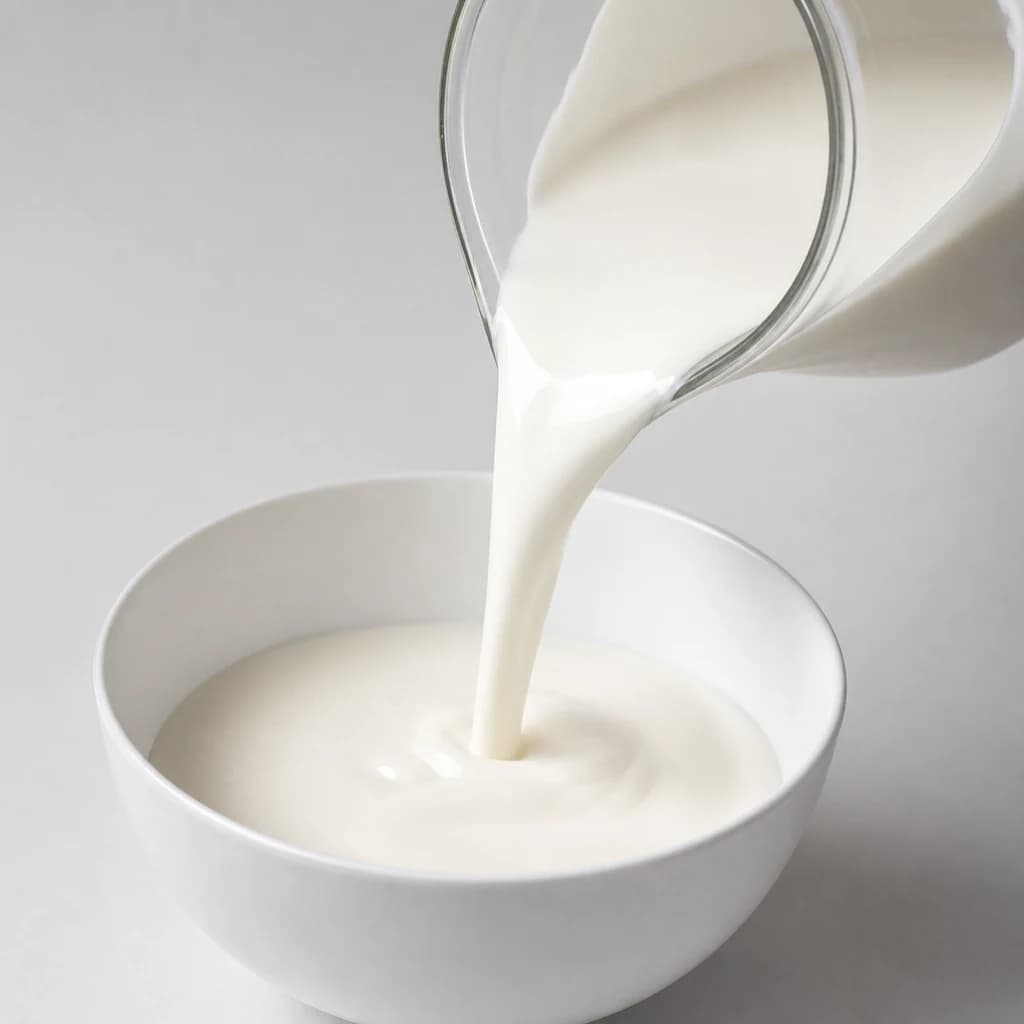
Pourable cream around 18-20% fat for enriching coffee, soups and sauces. Will not whip and curdles if boiled hard, so stir in off the heat where heavy cream would hold.
Single cream — called light cream in the United States — is the pourable everyday cream that sits in the middle of the dairy-fat spectrum, defined by a legal floor of 18% milkfat in the UK and a range of 18–30% in the US, though supermarket cartons almost always land at the lower end, around 18–20%. That fat level is its defining characteristic: high enough to enrich a soup, sauce, coffee or pudding with body and dairy sweetness, yet low enough that the cream pours like thick milk at room temperature and will not hold air when whisked. In British cookery it is the default 'pouring cream,' the lighter partner to double cream, and the workhorse of finishing touches where richness is wanted but heaviness is not.
Its behavior in the pan is just as important as its fat content. Single cream curdles if boiled hard, if added to a strongly acidic liquid while hot, or if reduced for too long, because there is not enough fat to protect the milk proteins from coagulating. This makes it a finishing ingredient — stirred in at the last moment, off the heat, or tempered in slowly — rather than a cooking one. Used correctly, it lends a glossy, silken quality to pan sauces, puréed soups and custards; used carelessly, it splits into watery whey and rubbery curds. Knowing where and when to add it is the single most important skill in cooking with it.
In the wider dairy family, single cream occupies a useful middle ground: richer and more rounded than whole milk or half-and-half, much lighter and more pourable than double, whipping or heavy cream. It is the cream to reach for when you want dairy flavor and body without the weight, the structure or the calorie load of its richer cousins.
- Measured in
- ml
- Storage
- Refrigerate
Allergens
Find it in
Suits
Types & varieties
18–20% fat; the everyday British pouring cream, lighter of the classic single/double pairing
18–30% fat per FDA; the closest American equivalent to British single cream
Same 18% minimum; 'pouring' is descriptive rather than a separate legal grade
10.5–18% fat; milk-and-cream blend; thinner and less rich, useful as a thinning substitute
Single cream lightly cultured with lactic bacteria; tangier and looser than crème fraîche
Why single cream splits — and how to prevent it
The curdling that frustrates so many cooks is fundamentally a protein issue. Cream is an emulsion of milkfat globules suspended in water that contains milk proteins (mainly casein) and the milk sugar lactose. The fat globules act as physical buffers that keep the proteins from clumping together. Single cream has just enough fat to enrich flavor and add viscosity, but not enough to fully shield the casein when conditions turn harsh.
Three things reliably cause single cream to split: a hard boil (proteins denature and aggregate above roughly 85°C/185°F), a strong acid added while the cream is hot (tomato, lemon juice, wine or vinegar lower the pH and the proteins precipitate), and prolonged reduction (water evaporates, concentrating both proteins and acid). The fix in every case is the same: add the cream at the end of cooking, off the heat, and bring the dish up to no more than a gentle simmer to finish.
- Temper cold cream into a hot liquid by whisking a ladle of the hot liquid into the cream first, then returning the warmed mixture to the pan
- In acidic sauces (tomato, lemon, wine reductions), add the cream after the acid has been balanced or reduced and the pan is off the burner
- Stabilise with cornflour — about 1 teaspoon per 200 ml — when a recipe genuinely requires boiling, as in many Indian and Southeast Asian curries
Single vs double vs half-and-half: a quick orientation
The single/double terminology is British and refers to the relative density of the cream; the richer the cream, the heavier it feels. Double cream (48% fat minimum) is thick enough to spoon and whip to stiff peaks; single cream pours. American labeling is less consistent: 'heavy cream' or 'whipping cream' is roughly 36–40% fat, while 'light cream' is the closest US match to British single. American half-and-half, a blend of milk and cream at 10.5–18% fat, is the next step down again and is noticeably thinner — useful in coffee but too watery to enrich a sauce in equal measure.
Common uses
Tips & pitfalls
- Never boil: add to hot liquids off the heat, or at the very last moment, to avoid curdling
- Temper cold cream into hot mixtures by adding a ladle of the hot liquid to the cream first, then returning the warmed cream to the pan
- Do not try to substitute it for double or whipping cream in desserts that require structure — it will not hold peaks
- In acidic dishes (tomato, lemon, wine reductions) add the cream at the end and keep the temperature below a simmer
- If a recipe calls for single and only double is on hand, lighten double with a little milk rather than the other way round — single plus extra cream does not behave the same
- For a slightly thicker pour, gently reduce single cream by about a quarter over low heat — it stays pourable but coats a spoon better
- Stir in about 1 teaspoon of cornflour per 200 ml if the cream must be boiled, as in some curries — it stabilises against splitting
- Single cream is not interchangeable with UHT long-life cream in cold desserts — the fresh version has a cleaner, sweeter flavor
- Keep the lid on the carton; cream readily absorbs fridge odors
- If it smells cheesy or yeasty, it has turned — discard it
Nutrition
Energy
816 kJ · per 100 g
Where the calories come from
Protein
3g
6% DV
Carbs
3.7g
1% DV
Fat
19.1g
24% DV
Fiber
0g
0% DV
Sugars
3.7g
of which
Sodium
72mg
3% DV
Source · USDA FoodData Central · Cream, fluid, light (coffee cream or table cream)
View on FDC →In the shops
Matched grocery products
No matched grocery products for Single / Light Cream yet.
Good to know
- Milkfat content
- 18–20% typical; UK single cream legally 18–23%; US light cream 18–30% per FDA
- Texture
- Pourable and fluid at room temperature; will not hold whipped peaks
- Whipping behavior
- Whips only to a loose, fleeting froth; not suitable for piped toppings or stiff peaks
- Heat behavior
- Curdles if boiled, reduced hard, or combined with strong acid while hot
- Flavor
- Mild, fresh, slightly sweet dairy
- Storage
- Refrigerate at 1–4°C; use opened cartons within 3–5 days
- Freezing
- Can be frozen but separates on thawing; best used in cooked dishes afterward
- Approximate nutrition
- ~195 kcal, 20 g fat, 4 g carbohydrate, 3 g protein per 100 ml
Substitutes
- Half-and-half (US) — Works in coffee and for gentle enrichment; thinner and slightly less rich, so reduce other liquids accordingly
- Whole milk + butter — About 80 ml milk whisked with 20 g melted butter approximates 100 ml single cream; for cooking only, not for pouring cold
- Evaporated milk — Useful in cooked sauces and soups; carries a slightly caramelised flavor, so avoid in delicate sweet dishes
- Crème fraîche (thinned if needed) — Tangier and markedly more stable to heat; good in cooked sauces, less suitable for sweet pouring
- Mascarpone loosened with milk — Whisk 2 parts mascarpone with 1 part milk; richer and thicker, good for pasta sauces
- Coconut cream (light) — Non-dairy option; imparts coconut flavor, so choose for curries, soups or tropical desserts only
Pairs with
Also called
light cream · coffee cream · table cream · pouring cream