Tying & Fastening
Trussing Needle
A long, stout needle with a large eye for threading kitchen twine through poultry and roasts, sewing cavities shut and cinching legs so a bird holds its shape and cooks evenly.
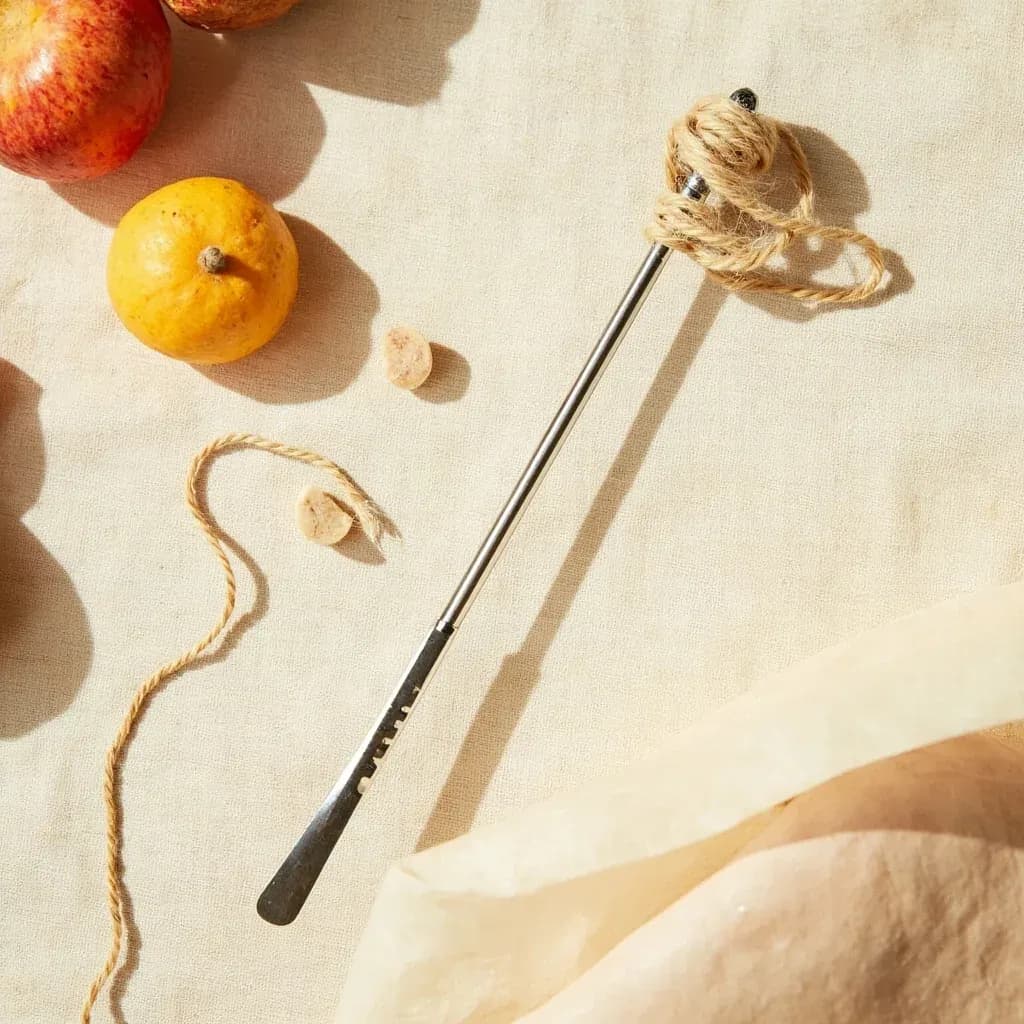
A trussing needle is the bridge between butcher's twine and the meat you want to bind. It is a long, rigid shaft of stainless steel — typically 15 to 25 cm — with a sharply ground point at one end and a generously oversized eye at the other. The eye is sized to thread cotton kitchen twine without fraying it, and the point is hard enough to pierce poultry skin, fat, and muscle in a single clean pass. It is one of the simplest tools in a cook's kit, but it solves a problem that hands alone cannot: pulling twine through the interior of a turkey, around a pork loin, or across a stuffed pocket without tearing the meat or shredding the string.
Trussing matters because shape dictates cooking. A bird whose legs and wings sit close to the body presents a compact target to the oven's heat, allowing the breast and thighs to finish in step with each other and the skin to render evenly. A rolled roast that has been sewn tight keeps its cylinder and slices into neat rounds rather than collapsing into a loose mound. The needle is what makes these trusses possible: it carries twine through cavities and joints that fingers can't reach, and it does so without enlarging the hole the way a paring knife would. Used correctly, it leaves a path narrow enough that the meat closes around the stitch as it cooks.
The modern trussing needle is essentially unchanged from the iron examples that appear in 18th- and 19th-century kitchen inventories, though stainless steel has replaced iron almost entirely because it tolerates repeated washing and won't react with salt brines or acidic marinades. The main choice a cook faces is between straight and curved shafts — straight for predictable, long passes through a rolled roast; curved for sewing around hip joints or into cavities where you can't see all the way through. A well-made needle will outlast decades of holiday birds if it is simply washed, dried, and stored where it won't get knocked blunt by other utensils.
Alternatives
Types & varieties
The classic, long straight shaft — easiest for predictable passes through thick cuts like a whole turkey or rolled pork loin.
Bent shaft that lets you sew around bones and through awkward cavities where a straight needle won't reach.
A slightly arched middle ground — better visibility than a fully curved needle while still navigating tight spots.
A related, sometimes larger tool with a hollow or slotted tip for threading strips of fat (lardo, bacon) through lean meat.
Has an open slot instead of a closed eye; you can snap twine into it without fully threading — useful for quick work.
Straight vs. Curved: When to Reach for Each
Both do the same job; the difference is geometry. The straight needle is the workhorse for any job where you can see straight through the meat — a rolled and tied pork loin, a boned and stuffed breast of veal, a ballotine sewn along its length. It pushes through cleanly, holds its line, and leaves a tidy, predictable hole. The curved needle earns its place when you are working around a corner: closing the neck cavity of a turkey where the needle has to arc past the wishbone, passing twine around the hip joint of a duck, or stitching shut a pocket you can only see into from one side. If you regularly roast whole birds, a curved needle is the one you will actually reach for; if you mostly tie roasts, a straight one will see more use.
- Straight: long roasts, boned and rolled meats, any pass where the entry and exit points are visible from the same angle.
- Curved: whole poultry cavities, sewing around wing or leg joints, any stitch where the needle must change direction inside the meat.
- Half-curved: a versatile compromise for cooks who want one needle rather than two.
Trussing Technique in Brief
Trussing is a practiced motion rather than a recipe, but a few habits make it cleaner and more secure. Damp twine, a meaty bite, and a snug (not strangling) finish are the three things that separate a professional truss from a loose bundle.
- Soak your twine in warm water for 10–15 minutes before starting. Damp twine chars less in the oven and grips the meat better as it shrinks.
- Thread the twine and leave a 15 cm tail so you can pull it through after the needle exits, rather than trying to wrestle the needle off mid-stitch.
- Pierce through muscle and connective tissue, not just skin. A stitch through skin alone tears out the moment the meat contracts.
- Work the needle along the natural curve of the bone when going around a joint; forcing a straight path risks splintering bone or snapping the shaft.
- Tie with a surgeon's knot or a simple double knot pulled snug. The bird should be compact, not compressed — you want air to reach the thighs, not to be locked out.
Care and Storage
A trussing needle asks for almost nothing in return. Stainless steel tolerates hot water, dishwashers, and the occasional boil for sanitizing between raw poultry and other proteins. Dry it before putting it away — a damp needle stored in a drawer will spot with rust, especially if it is a lower-quality plated model. The point is the part that matters most: keep it from knocking against other metal tools, and the needle will stay sharp enough to pierce skin without tearing for years.
- Hand wash in hot soapy water and towel dry; dishwasher sanitize cycles are fine for solid stainless steel.
- Store in a dedicated slot, a rolled canvas pouch, or a knife block — anywhere the point won't be dulled by contact with other utensils.
- If the point goes blunt, a few strokes on a fine diamond or ceramic rod will restore it; replace rather than resharpen once the tip is badly hooked.
- Sanitize in boiling water or a sanitizing solution when moving between raw poultry and ready-to-eat preparations.
Common uses
Tips & pitfalls
- Use only food-safe twine — 100% cotton butcher's twine or untreated kitchen string. Never jute, sisal, or dyed craft twine, which can ignite, shed fibers, or leach color into the meat.
- Soak the twine in water for 10–15 minutes before trussing; damp twine chars less, grips better, and tightens as the meat shrinks in the oven.
- Pierce through the meatiest parts of the cut, not just skin. A stitch through only skin tears out the moment the muscle contracts.
- Don't truss so tightly that air can't circulate. The bird should be snug, not strangled — otherwise the thighs cook unevenly and the skin steams rather than crisps.
- Curve the needle along the path of least resistance around bones; forcing a straight needle through a joint can snap the shaft or splinter bone.
- Sanitize before and after use, especially when moving between raw poultry and other proteins. Stainless steel tolerates boiling or a dishwasher sanitize cycle.
- Keep a dedicated kitchen needle — household sewing needles have eyes too small for butcher's twine and points too fine for skin and fat.
- Remove all twine before serving. Diners don't expect string on the plate, and forgotten twine is a choking hazard.
Good to know
- Material
- Stainless steel (most common); also nickel-plated steel and, traditionally, iron.
- Typical length
- 15–25 cm (6–10 in) for straight needles; curved versions 12–20 cm (5–8 in) along the curve.
- Eye
- Large, often 3–5 mm opening, sized to thread butcher's or kitchen twine without shredding it.
- Point
- Sharp, triangular or round-ground tip designed to pierce skin, fat, and muscle cleanly.
- Reusable
- Yes; wash in hot soapy water, sanitize, and dry to prevent rust.
- Dishwasher safe
- Most stainless-steel models are; lower-quality plated needles may pit or rust.
- Also called
- Larding needle (when used for binding), sewing needle, kitchen needle, spit needle.
- Used with
- Butcher's twine, kitchen twine, cotton string, silicone truss ties.
Also called
larding needle · poultry needle · roast needle
