Appliances & Heat
Anti-Griddle
A countertop plate chilled far below freezing to flash-freeze sauces and purées on contact.
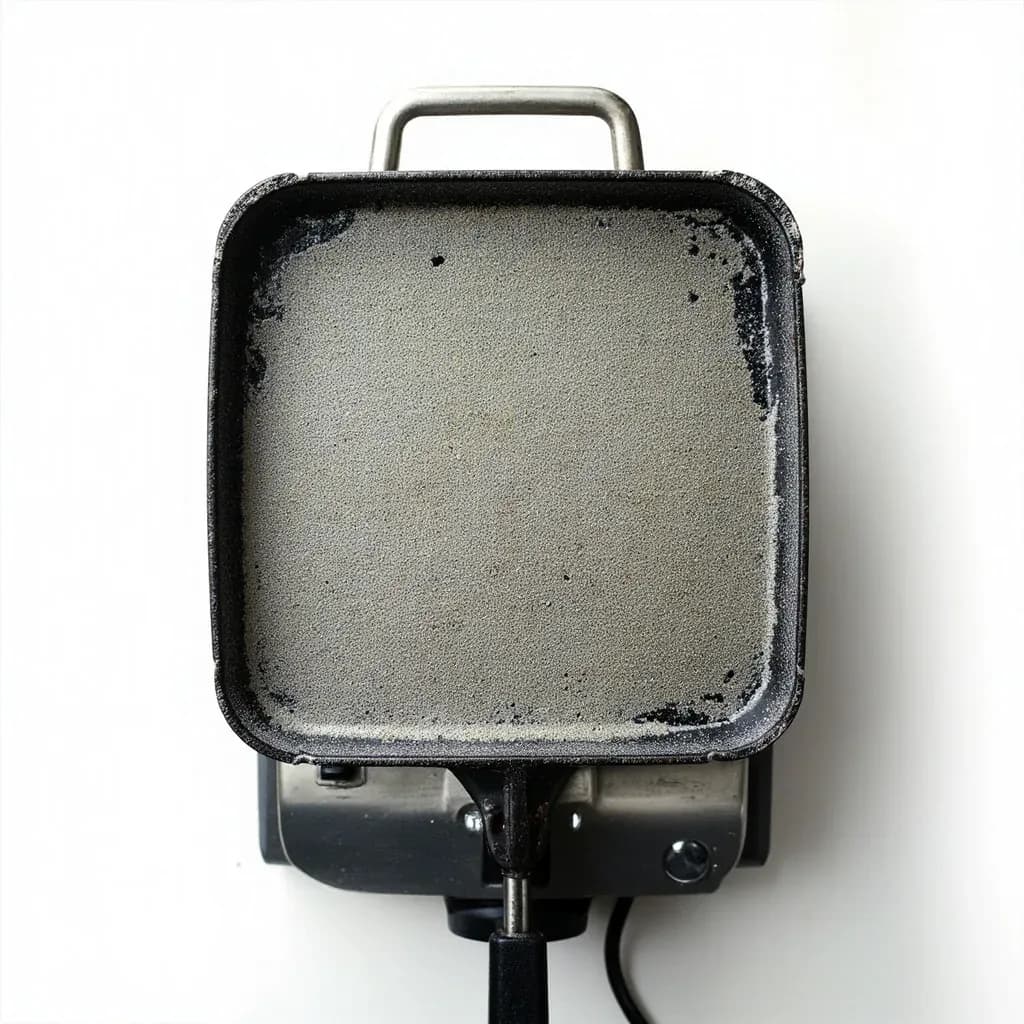
An anti-griddle is a flat-top appliance whose surface is cooled to roughly minus 30 degrees Celsius, the cold opposite of a hot griddle. Chefs spread or pipe purées, ganaches, and sauces onto it to freeze the bottom solid in seconds while the top stays soft, creating frozen lollipops, crisp shells, and other plated textures. It is a modern fine-dining tool for instant cold-setting without an ice bath or freezer wait.
The Anti-Griddle is a countertop appliance built around a polished metal plate refrigerated to roughly -30°F to -40°F (-34°C to -40°C). Where a hot griddle sears and browns, the Anti-Griddle flash-freezes anything spread across its surface, setting a thin, brittle layer in seconds. It was developed in the early 2000s by chef Wylie Dufresne in collaboration with PolyScience, the same company that helped bring sous vide circulators into restaurant kitchens, and it became one of the signature tools of mid-2000s molecular gastronomy.
What makes the tool genuinely useful is not cold itself but the speed of the chill. A blast freezer pulls a product down evenly from the outside in, but the Anti-Griddle freezes only the side in contact with the plate while the top remains soft and pliable. That asymmetry lets a cook lift a flexible sheet off the surface, drape it, or shatter it into shards and 'gravel' for plating. The frozen layer is, in effect, a textural garnish that melts on the tongue and returns to a sauce or purée as the diner eats.
In practice, it behaves less like a freezer and more like a high-precision tempering tool. The plate has a small working area and a single fixed operating temperature; if it has not fully chilled down, the product slushes and never sets, so the unit needs 20–30 minutes from a cold start and a moment to recover between heavy batches. The technique is also time-sensitive: spread the product too thick or leave it on the plate too long, and the purée freezes all the way through, losing the pliable top that makes the tool useful. It is a finishing instrument for plating, not a place to store food.
Alternatives
Types & varieties
The original commercial unit: a circular chilled plate with an integrated compressor, the model most often seen in restaurant kitchens.
A smaller countertop version aimed at lower-volume kitchens, R&D labs, and pastry programs.
Ad-hoc rigs built by chefs and food labs using dry-ice-cooled plates or laboratory cold stages; not standardized products, and rarely as stable as a purpose-built unit.
How the Freeze Behaves
The plate is engineered to extract heat faster than conduction can replace it, so the bottom 2–4 mm of any product solidifies almost instantly while the upper surface stays loose. That gradient is the whole point. A purée lifted off with a spatula will be a flexible disc on top and a glassy frozen underside, and it can be folded, draped, or broken into shards. Heavier items like a slab of foie gras or compound butter take a thin frozen skin and remain sliceable, which is why the tool is also useful for clean, unwarped cuts of high-fat foods that turn floppy at room temperature.
Because the chill is one-sided, the Anti-Griddle is not a substitute for a blast freezer or a standard freezer. It will not bring a quart of ice cream to serving hardness, and purées left on it for more than a few seconds begin to freeze all the way through, losing the pliable top that makes them useful. Treat the plate as a fast, shallow, contact-only freezer.
Hydrocolloids and What Makes a Recipe Work
Most successful Anti-Griddle recipes lean on a thickener of some kind. Pure thin liquids freeze into fragile, weeping ice that collapses as soon as it warms. A purée that has the body of soft yogurt, or a sauce bound with a small amount of gelatin, low-acyl gellan, or methylcellulose, holds its shape as a brittle sheet and shatters cleanly when broken. Acid and salt both depress the freezing point, so very acidic purées (citrus, vinegars) and very salty reductions tend to stay slushy rather than firming up, which can be useful for a frozen granita-style texture but not for a clean shard. Fat also slows the freeze; a ganache or a beurre blanc sets into a pliable disc rather than a glassy one, which is often exactly what is wanted.
Service and Timing
Anything that comes off the Anti-Griddle is on a clock. Frozen sheets start to soften and become tacky within 10–20 seconds at room temperature, and a finished component that looked brittle in the kitchen can pool on the plate by the time it reaches the dining room. Plate in small batches, keep finished pieces on a chilled sheet pan or in a holding freezer at the pass, and garnish last. The tool is for the final two minutes of a dish, not for prep.
Common uses
Tips & pitfalls
- Bring the unit to full working temperature before plating; a drop of water should freeze solid in under two seconds. Pulling purées onto a plate that is still warming up produces a slushy, weeping mess.
- Use purées thick enough to mound, roughly the viscosity of soft yogurt. Very watery liquids freeze into fragile ice and collapse on thaw.
- Spread product in a thin, even layer of about 1/8 inch (3 mm). Thicker layers freeze only on the bottom; thinner layers snap cleanly but can shatter before you can move them.
- Lift with a thin metal offset spatula or a bench scraper. Silicone and plastic tools stick to the cold plate and tear the frozen sheet.
- Work fast once a piece is off the plate. Frozen sheets begin to soften and become sticky within 10–20 seconds at room temperature, so keep finished pieces on a chilled tray or hold them in a freezer at the pass.
- Do not overcrowd the plate. Warm product dumped next to a frozen piece raises the local plate temperature and softens its neighbor. Leave gaps and work in small batches.
- Avoid heavy seasoning on the plate. Salt and acid both lower the freezing point, so a strongly acidic or salty purée stays slushy instead of firming up. Adjust seasoning after the freeze, on the plate.
- Clean the plate only after it has warmed to room temperature. Scraping frozen-on residue off a chilled plate will scratch or gouge the polished surface.
Good to know
- Inventor
- Wylie Dufresne, chef-owner of wd~50, New York
- Commercialized by
- PolyScience, around 2005
- Surface temperature
- Approximately -30°F to -40°F (-34°C to -40°C)
- Cooling method
- Closed-loop refrigeration, glycol-cooled in commercial units
- Plate shape
- Flat, polished circular metal plate (aluminum or stainless)
- Typical footprint
- Roughly 16–20 inches wide on commercial versions; smaller compact models exist
- Power
- Electric, 110V in North America, standard outlet
- Recovery time
- Allow 20–30 minutes from a cold start to reach working temperature
Also called
Anti Griddle · Cold Plate
Related

Stovetop
The everyday burners where most cooking actually happens

Oven
Enclosed dry heat for roasting, baking, and braising

Grill
Live-fire or gas grates for char, smoke, and high heat

Smoker
Low, slow heat and wood smoke for barbecue and brisket

Air Fryer
Countertop convection that crisps with little or no oil

Slow Cooker
Set-and-forget low heat for stews, beans, and braises

Pressure Cooker
Sealed steam pressure that cooks tough food in a fraction of the time

Rice Cooker
Foolproof, perfectly steamed rice every single time