Appliances & Heat
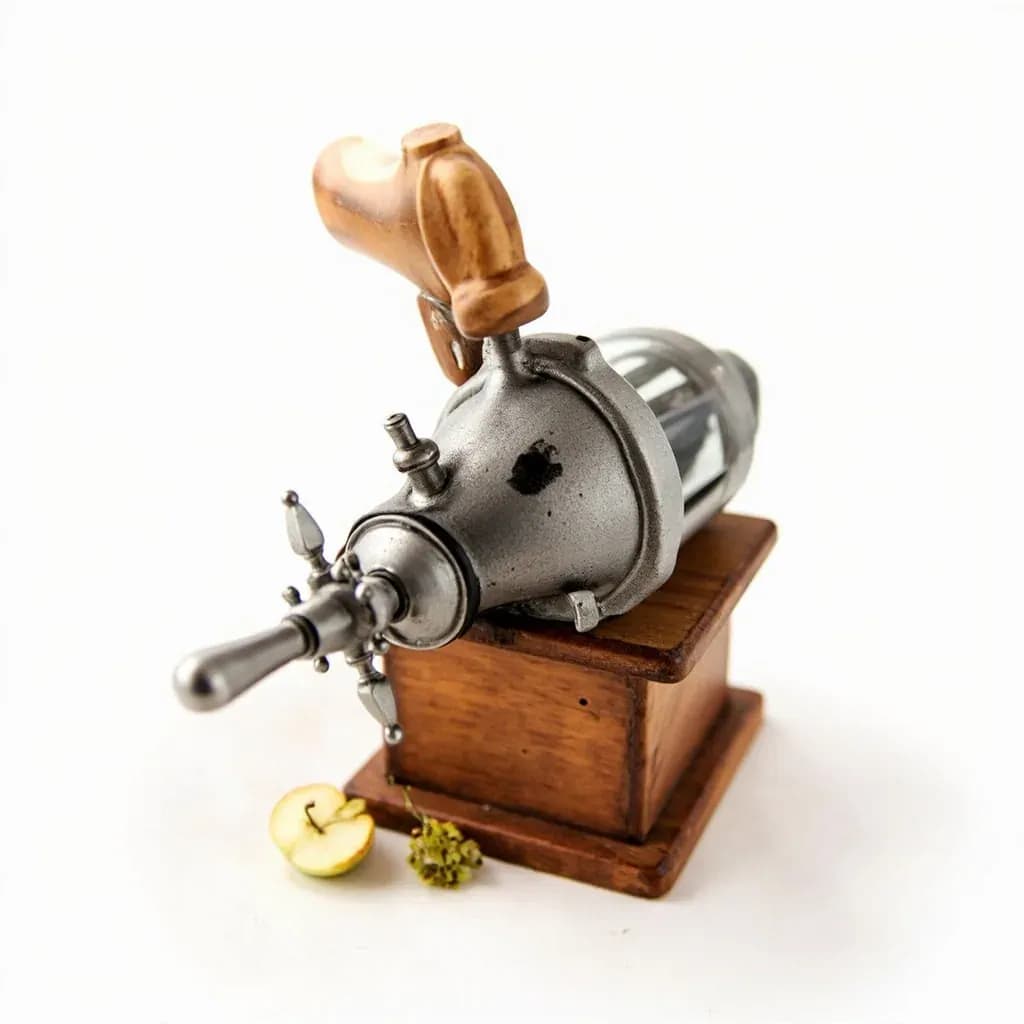
Apple Mill (Scratter)
A crusher that grinds whole apples into pulp to ready them for pressing into juice or cider.
An apple mill, or scratter, shreds whole apples into a coarse pulp (pomace) so the juice can later be extracted in a press. It is the first step in making cider, apple juice, or vinegar, breaking the fruit's cell walls to maximize yield. Versions range from hand-cranked toothed drums to electric motorized hoppers used by orchards and home cider makers.
An apple mill, also called a scratter, is the first stage of any traditional cider operation. Where a press does the work of squeezing liquid from fruit, the mill simply ruptures the apples' cell walls, reducing whole fruit to a coarse, fibrous pulp called pomace. That pulp is what the press then works on; the mill itself yields almost no juice. Understanding this distinction matters because every choice in milling — roller speed, tooth profile, how fine you push it — directly shapes how cleanly and completely the press can extract liquid downstream, and how the finished cider will taste and clarify.
The tool's signature is a hopper that funnels whole apples into a crushing mechanism: classically a pair of interlocking, toothed cast-iron rollers, though hammer-blade and rotary-drum designs exist. The output is intentionally coarse, almost like grated apple, never a smooth purée. Roller mills are prized by heritage cider makers because they break the flesh without pulverizing the seeds — which are loaded with bitter tannins — and without emulsifying the juice, which would cloud the finished cider and complicate pressing. Hand-cranked wooden units remain the iconic small-batch tool; electric benchtop mills with stainless or food-safe plastic hoppers dominate modern home setups; PTO-driven commercial mills process whole orchard drops in an afternoon.
Used well, a scratter turns hours of chopping into a steady feed of pulp and lets a small grower press bruised windfalls that would be too soft to slice cleanly. Used poorly — overfed, under-tensioned, run too long, or swapped for a blender — it jams, fines the pulp, and leaves you with a press job that is slower, cloudier, and harder to clear.
Alternatives
Types & varieties
Traditional two-roller design with a hardwood frame and cast-iron toothed rollers, mounted over a bucket or directly above the press; the classic home-ciderist tool.
Benchtop or free-standing mill with a stainless or food-safe plastic hopper, a rotating toothed cylinder, and a discharge chute; the modern home and small-orchard standard.
Two-stage countertop unit that scrats and presses in one frame; convenient for small batches but harder to disassemble and clean than separate units.
High-speed rotating blades that shatter the apple; produces a very fine pulp but introduces more oxidation and sediment than a roller mill, so it is less favored for traditional cider.
Large stainless drum with internal paddles or knives; used by commercial cideries for its high throughput and easy wash-down sanitation.
Tractor-powered unit for orchard-scale operations, fed by a bin or conveyor and paired with a rack-and-cloth or bladder press.
19th- and early-20th-century English and American units (often branded Whitcomb, Hardy, or local makers); prized by collectors and still functional after a roller and bearing refurbishment.
Mill, press, and juicer: how they differ
Cider-making equipment is often described loosely, and the three tools that show up in a cider kitchen do very different jobs. A scratter breaks fruit open. A press squeezes the broken fruit to extract liquid. A centrifugal or masticating juicer does both in one pass, but at the cost of shredding seeds, emulsifying juice, and aerating the pulp — all of which traditional cider makers try to avoid. The classic two-stage setup (mill, then rack-and-cloth press) exists because each stage works better when the other is kept simple: the mill only has to rupture cells, and the press only has to apply even pressure to a coarse, fibrous pulp that releases juice freely.
- Mill output is a damp, crumbly pulp with visible skin and flesh fragments, not free liquid.
- Press output is cloudy, sediment-rich juice that needs to settle, be racked, or be filtered before fermentation or drinking.
- A centrifugal juicer is a poor substitute for a mill-plus-press when the goal is traditional cider: it fines the pulp, liberates seed tannins, and oxidizes the must within minutes.
Running the mill well
Good milling is mostly about restraint. Feed apples at a steady pace, not faster than the rollers can take them, and let the rollers do the work; forcing fruit through just produces heat, fines, and jammed gears on a hand-cranked unit. On a motorized mill, the gap between rollers or the tension on the cylinder is adjustable — if recognizable slices come through, the setting is too loose; if the pulp looks more like applesauce than grated apple, it is too tight. Aim for a texture you could pick up in a handful and let fall apart loosely. That is what the press is built to handle.
- Sort before you mill: pull leaves, stems, and any soft or rotten fruit, because a single bad apple will taint a whole batch.
- Bring cold-stored apples to room temperature overnight; very hard, cold fruit is harder on hand-crank gears and crushes unevenly.
- Press within an hour of milling, or cover the pulp with a damp cloth; exposed pulp browns and oxidizes quickly, dulling the cider's aroma.
- Match mill throughput to press capacity; a scratter that outpaces the press leaves you managing a growing pile of oxidizing pulp.
Common uses
Tips & pitfalls
- Always remove stems, leaves, and any rotten spots before scratting — one moldy apple can spoil an entire press's worth of cider.
- Aim for a coarse, crumbly pulp, not a smooth purée; over-grinding releases excess pectin and produces cloudy juice that is hard to press and slow to clear.
- Press within an hour of scratting, or cover the pulp with a damp cloth; exposed pulp browns and oxidizes within minutes.
- Feed apples steadily rather than overloading the hopper — jamming forces you to reverse the crank and produces uneven fragments.
- Tighten roller or cylinder tension on motorized units if recognizable slices come through; loose settings leave half-crushed fruit that the press cannot handle.
- Rinse, then thoroughly dry wooden hoppers and cast-iron rollers right after use; trapped moisture swells wood and rusts iron teeth. A light food-grade oil rub before long storage protects wooden parts.
- Do not substitute a garbage disposal, blender, or meat grinder for a scratter — they pulverize pips into bitter tannins and emulsify the juice, which clarifies poorly and tastes harsh.
- For clearer juice, run the pulp through the mill twice only if your press cloth can handle the extra fines; a single pass is cleaner for most setups.
Good to know
- Also known as
- Scratter, apple grinder, apple crusher, cider mill
- Primary function
- Crushes whole apples into a coarse pulp (pomace) prior to pressing; does not extract juice on its own
- Typical capacity (home)
- 2 to 20 bushels per hour, depending on hand-crank or motorized model
- Typical capacity (commercial)
- 50 to 500+ bushels per hour for rotary drum and PTO units
- Drive
- Hand-crank, electric motor (1/2 to 5 HP typical), or tractor PTO on farm-scale units
- Crushing mechanism
- Rotating-toothed cylinder, dual toothed rollers, or high-speed hammer blades
- Hopper material
- Traditionally hardwood (oak, maple, beech); modern units often food-grade stainless steel or food-safe plastic
- Origin of name
- From 'scratting,' an old English and dialectal word meaning to scratch or scrape
Also called
Fruit Crusher · Scratter · Apple Scratter
Related

Stovetop
The everyday burners where most cooking actually happens

Oven
Enclosed dry heat for roasting, baking, and braising

Grill
Live-fire or gas grates for char, smoke, and high heat

Smoker
Low, slow heat and wood smoke for barbecue and brisket

Air Fryer
Countertop convection that crisps with little or no oil

Slow Cooker
Set-and-forget low heat for stews, beans, and braises

Pressure Cooker
Sealed steam pressure that cooks tough food in a fraction of the time

Rice Cooker
Foolproof, perfectly steamed rice every single time