Appliances & Heat
Asador Wood-Fire Grill
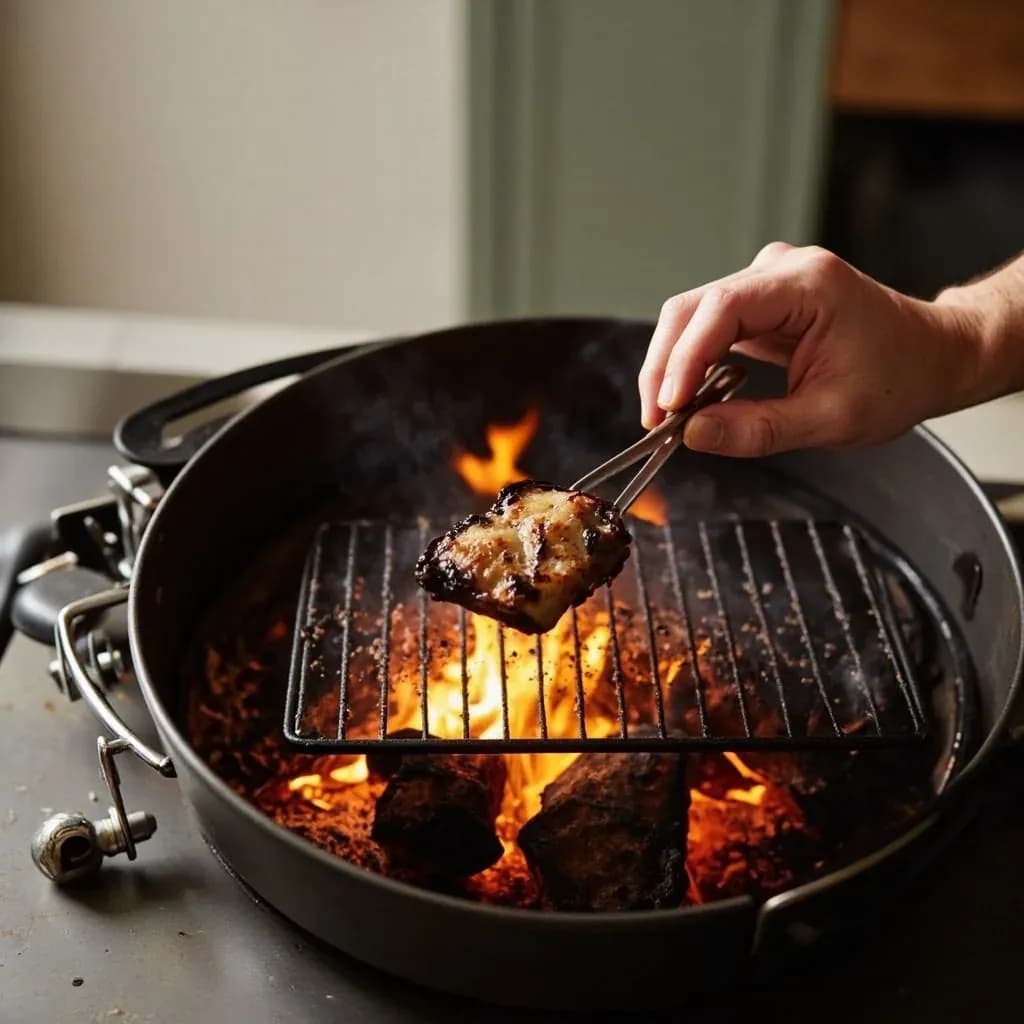
An adjustable wood-fire grill that raises and lowers the grate over coals for precise heat control.
An asador is a wood- or charcoal-fired grill, central to South American asado cooking, with a crank-adjustable grill grate that moves up and down over the fire. Lowering the grate sears, raising it gives gentle, slow heat for large cuts. The Santa Maria style works the same way, letting the cook dial heat by height rather than by smothering the fire.
An asador is a wood-fire grill built around a single, deceptively simple idea: keep the fire fixed and move the food. The name is Spanish for "roaster" or "griller," and the design ranges from a portable steel-frame unit with a notched bracket to a permanent brick hearth with a swinging grate. What unites every variant is a heat source of hardwood reduced to glowing embers, a sturdy rod or plate grate above it, and a mechanism — a hand-cranked wheel, a lever arm, or a chain-and-pulley — that raises and lowers that grate through a wide range of heights over a constant fire bed.
The payoff is control. By cranking the grate closer to the coals a cook can drive surface temperatures past 350 °C / 660 °F for a hard sear on a thick ribeye, then winch it back toward 150 °C / 300 °F for a gentler finish on the same cut without overcooking the interior. Because the heat is purely radiant from below — no flame licking the food — the result is the even, deeply browned, lightly smoky crust that defines asado-style cooking in Argentina, Uruguay, southern Brazil, and the Basque Country. Compared with a kettle grill or gas burner, an asador trades convenience for thermal range and the unmistakable flavor of hardwood embers.
Alternatives
Types & varieties
Brazilian and Argentine design with a hand-cranked wheel that raises and lowers a V-channel grate over an ember bed; the most direct realization of the height-adjustment concept.
Frame-mounted lever pivots the grate up and down over a fixed fire bed; common in mid-priced portable units and many Basque models.
Freestanding frame with a motorized or hand-cranked spit that rotates a whole animal beside (not over) the fire; used for cordero al palo, cochinillo, and other large roasts.
Permanent brick or stone hearth, often with a swinging or chain-suspended grate, found in Basque, Argentine, and Uruguayan courtyards and restaurants.
Compact steel unit with manual height adjustment via notched brackets, suited to balconies, small patios, and camping.
Managing the Ember Bed
The grate only does half the work; the fire underneath has to be ready. Most cooks light the wood 45–60 minutes before they want to cook, and they only put food over the fire once the logs have collapsed into a deep, even bed of glowing coals with no active flames. Ash should be a fine grey powder; chunks of black, unburned wood mean it is too early. From that point on, temperature is controlled almost entirely by raising or lowering the grate, not by adding fuel or poking the fire.
- Stack the embers thicker on one side and rake them thin on the other to create a two-zone fire: a hot zone for searing and a cooler zone for finishing thicker cuts or holding food warm.
- Use the hand test: hold your palm 10–12 cm above the grate at cooking height and count seconds. Three to four seconds is a hard sear; five to six is medium heat; longer holds mean a gentler roast.
- Keep a spray bottle of water or a small ash shovel within reach to tame flare-ups from dripping fat — never soak the coals, which will smother the radiant heat and douse the embers.
- Add new logs well before the existing bed burns through, and let them catch up before serving; chasing temperature with last-minute fuel produces flame and acrid smoke right when the food goes on.
Choosing and Seasoning the Grate
Carbon steel and cast iron develop the best sear and the most nonstick surface, but both need care. A new grate should be washed, dried over the fire, and then rubbed with a thin coat of high-smoke-point oil (grapeseed, sunflower, or canola) while still warm. That first seasoning layer darkens the metal and builds the base for a patina that will improve with every cook.
- Oil the grate, not the food: a cloth dipped in oil and wiped across hot bars seasons the steel and prevents sticking far more effectively than brushing oil onto steaks.
- Re-oil lightly after each cleaning while the metal is still warm to keep rust at bay on carbon steel.
- Scrub the grate with a stiff wire brush while it is hot, then let it sit over the dying fire for a few minutes to burn off residue before storing.
Common uses
Tips & pitfalls
- Use only well-seasoned hardwood; softwoods, treated lumber, and pallet wood throw acrid, resinous smoke and can deposit toxic residues on the food.
- Wait for the wood to burn down to a bed of glowing embers before cooking — grilling over active flames causes flare-ups and a sooty, bitter crust.
- Control heat by cranking the grate up or down rather than by moving the food around or by adding water to the fire, which smothers the coals.
- Build a two-zone fire by raking embers to one side, giving a hot zone for searing and a gentler zone for finishing or holding.
- Keep a spray bottle of water or a small ash shovel handy to tame flare-ups from fat drippings, but never douse the coals.
- Allow at least 45–60 minutes from lighting to a stable cooking bed of coals; rushing produces uneven heat and a heavy smoke profile.
- Clean the grate while still hot with a stiff wire brush, then oil it lightly before storing to prevent rust on carbon steel.
Good to know
- Origin
- Spanish (Basque Country, Castile) and Río de la Plata grilling traditions; the adjustable-grate form is iconic in the Santa Maria style of Rio Grande do Sul, Brazil, and the Argentine parrilla.
- Fuel
- Seasoned hardwoods such as oak, almond, quebracho, mesquite, hickory, and fruitwoods; lump charcoal is acceptable in some models.
- Heat source
- Wood reduced to glowing embers; cooking is by radiant heat from below, not by open flame.
- Adjustment mechanism
- Hand-cranked wheel (Santa Maria), pivoting lever arm, chain-and-pulley, or notched bracket that raises or lowers the grate over a fixed fire bed.
- Grate material
- Carbon steel or stainless steel rod grates; cast iron on some models; V-shaped channel grates (canaletas) are characteristic of Santa Maria-style units.
- Cooking temperature
- Roughly 150 °C / 300 °F with the grate at its highest to about 350 °C / 660 °F lowered close to the coals.
- Typical grate area
- 60–100 cm wide on portable and standalone units; built-in masonry asadors can exceed 150 cm.
- Also called
- Asador, parrilla, Santa Maria grill, churrasqueira, Basque grill.
Also called
Santa Maria Adjustable Grill · Asado Grill · Parrilla
Related

Stovetop
The everyday burners where most cooking actually happens

Oven
Enclosed dry heat for roasting, baking, and braising

Grill
Live-fire or gas grates for char, smoke, and high heat

Smoker
Low, slow heat and wood smoke for barbecue and brisket

Air Fryer
Countertop convection that crisps with little or no oil

Slow Cooker
Set-and-forget low heat for stews, beans, and braises

Pressure Cooker
Sealed steam pressure that cooks tough food in a fraction of the time

Rice Cooker
Foolproof, perfectly steamed rice every single time