Appliances & Heat
Backpacking Canister Stove
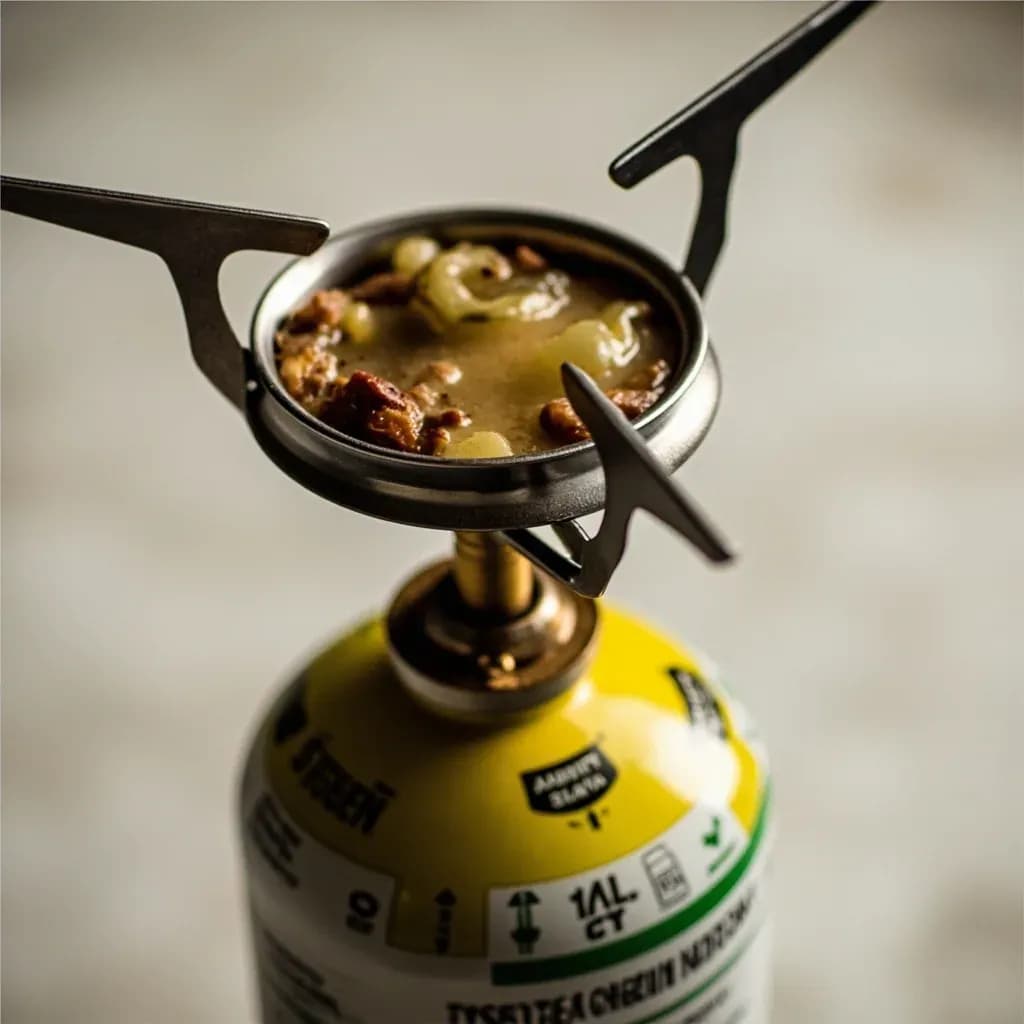
A tiny screw-on burner that threads onto a fuel canister to boil and cook in the backcountry.
A backpacking canister stove is an ultralight burner that screws directly onto a pressurized isobutane-propane canister, giving hikers a packable cooking source. It lights quickly and boils water fast for dehydrated meals and hot drinks, with a valve for simmer control. Its compactness and low weight make it the standard for solo and lightweight camp cooking.
The backpacking canister stove is the workhorse of modern three-season backcountry cooking: a compact burner that screws directly onto a pressurized fuel canister of isobutane/propane blend, ignites easily from a lighter or built-in sparker, and brings a liter of water to a rolling boil in roughly 3–5 minutes. Its dominance on the trail comes from a clean trade-off — it is dramatically lighter, faster, and easier to operate than a liquid-fuel stove, at the cost of poor cold-weather performance and limited simmer control. For most backpackers, that trade is exactly right: the stove's job is to boil water for rehydrating freeze-dried meals, brewing coffee, and melting snow, and it does all three with near-zero setup.
Under the hood, the system is straightforward. The canister is a sealed metal cylinder holding fuel under pressure; turning the valve releases vapor that mixes with air at the burner head and ignites. Flame is controlled by throttling the valve, though most small upright burners lack a true low simmer and tend to surge between off and a hot jet. Output typically runs 7,000–12,000 BTU/h, which sounds modest but is plenty for a 0.5–1 L pot. The same physics that make these stoves brilliant in summer becomes a liability below freezing, because the fuel blend loses vapor pressure and the flame sputters or dies altogether.
The practical upshot is that a canister stove is a specialist tool with a narrow but well-defined job. Pair it with a pot of matching diameter, a spark source, and a small windscreen, and it will quietly produce hot water and hot food for years of trips. Push it into conditions it wasn't designed for — deep cold, a long steady simmer of a sauce, or the sustained output demand of group cooking — and you will be shopping for a different stove.
Alternatives
Types & varieties
The classic small burner that threads directly onto the canister; the lightest, simplest, and cheapest option. Examples: MSR PocketRocket, Soto WindMaster, Snow Peak LiteMax, BRS-3000T.
Burner sits on a low stand connected to the canister by a fuel hose; better wind stability, easier simmering, and the canister can be kept warm in a jacket pocket for cold-weather use. Examples: Primus OmniFuel, Optimus Vega, MSR WindPro.
Burner and pot engineered as a single high-efficiency unit, usually with a finned heat exchanger on the pot base. Maximizes speed and fuel economy at the cost of versatility and simmer control. Examples: Jetboil Flash, Jetboil MiniMo, MSR WindBurner, MSR Reactor.
Canister flipped upside-down with a remote hose so liquid fuel feeds the burner instead of vapor, restoring pressure and output in cold weather. Examples: MSR WindPro, Optimus Crux with separate stand, or DIY inversion of a standard upright stove.
Cold-Weather Operation
Below about 0 °C (32 °F) a standard upright canister stove is the wrong tool for the job. The isobutane/propane mix loses vapor pressure in the cold, the flame shrinks and sputters, and the stove can extinguish itself entirely. Several techniques restore usable performance without abandoning canister fuel.
- Sleep with the canister in your sleeping bag or an inner jacket pocket so it stays warm overnight and is ready to light at breakfast.
- Pre-warm a chilled canister in your hands or against your body for a few minutes before lighting — this alone can noticeably improve cold-weather output.
- Switch to a remote-hose stove and keep the canister inside your jacket while the burner sits outside, decoupling the two temperatures.
- Invert the canister (with a remote hose or purpose-built inverted stove) so liquid fuel feeds the burner; pressure is no longer dependent on ambient temperature.
- For true winter or expedition conditions — sustained sub-zero temperatures, heavy snow melt, group cooking — a white-gas stove such as the MSR WhisperLite or MSR XGK is the more reliable tool.
Choosing the Right Variant
Pick the stove category that matches your trip profile rather than buying the lightest option on the shelf. The differences matter more than the weight savings.
- Three-season fair-weather backpacking, mostly boiling water for freeze-dried meals: a top-mounted burner is the right pick — light, cheap, fast to deploy.
- Cooking that involves any real simmering (sauces, risotto, pan-fried items): a remote canister stove gives stable low flame control.
- Group cooking, high winds, or fuel-efficiency priority: an integrated system like the Jetboil Flash or MSR Reactor boils faster and burns less gas per liter.
- Winter, alpine climbing, or high-latitude trips: an inverted canister stove or a white-gas stove is the safer, more reliable choice.
Common uses
Tips & pitfalls
- Never use a canister stove inside a tent, vestibule, cave, or snow cave — carbon monoxide builds to lethal concentrations quickly and without warning.
- In cold weather, pre-warm the canister in your hands or against your body for a few minutes before lighting; a warm canister delivers dramatically better output.
- Use a windscreen around the burner, but check the manufacturer's guidance first — integrated systems with heat-exchanger pots can overheat and damage the canister if wrapped in an aftermarket screen.
- Match pot diameter to burner flame spread: oversized pans waste heat, undersized ones produce soot and flare.
- Set the stove on a flat, stable surface — loose rocks, tilted cookware, or a soft footprint can spill boiling water on legs and gear.
- For real simmering, use a remote-canister stove or add a flame-spreading ring/diffuser; upright screw-on burners tend to surge between off and full flame.
- Carry a spare canister on any multi-day trip — a 100 g (3.9 oz) canister typically boils 10–12 L of water, which disappears faster than expected.
- Store canisters away from direct sun and never above ~50 °C (120 °F); never leave a canister in a hot car, and take partials to an outfitter for proper disposal rather than tossing them in the trash.
Good to know
- Fuel type
- Pressurized liquefied petroleum gas, typically an isobutane/propane blend
- Canister connection
- Screw-on to a standard 7/16" UNEF Lindal valve (most common); some models use a remote hose
- Typical power output
- Roughly 7,000–12,000 BTU/h (2,000–3,500 W), depending on model
- Boil time
- Approximately 3–5 minutes to boil 1 L of water in fair conditions
- Burner weight
- 45–110 g (1.6–3.9 oz) for the burner alone; integrated systems run 300–500 g total
- Operating temperature
- Best above ~4 °C (40 °F); performance drops sharply below freezing without cold-weather technique
- Flame control
- Adjusted by throttling the valve; many upright burners lack true simmer and tend to cycle
- Indoor use
- Outdoor or well-ventilated use only — produces carbon monoxide
- Approximate cost
- Burners $30–$70; integrated systems $80–$170; fuel canisters $4–$10 each
Also called
Portable Camp Stove · Canister Stove
Related

Stovetop
The everyday burners where most cooking actually happens

Oven
Enclosed dry heat for roasting, baking, and braising

Grill
Live-fire or gas grates for char, smoke, and high heat

Smoker
Low, slow heat and wood smoke for barbecue and brisket

Air Fryer
Countertop convection that crisps with little or no oil

Slow Cooker
Set-and-forget low heat for stews, beans, and braises

Pressure Cooker
Sealed steam pressure that cooks tough food in a fraction of the time

Rice Cooker
Foolproof, perfectly steamed rice every single time