Appliances & Heat
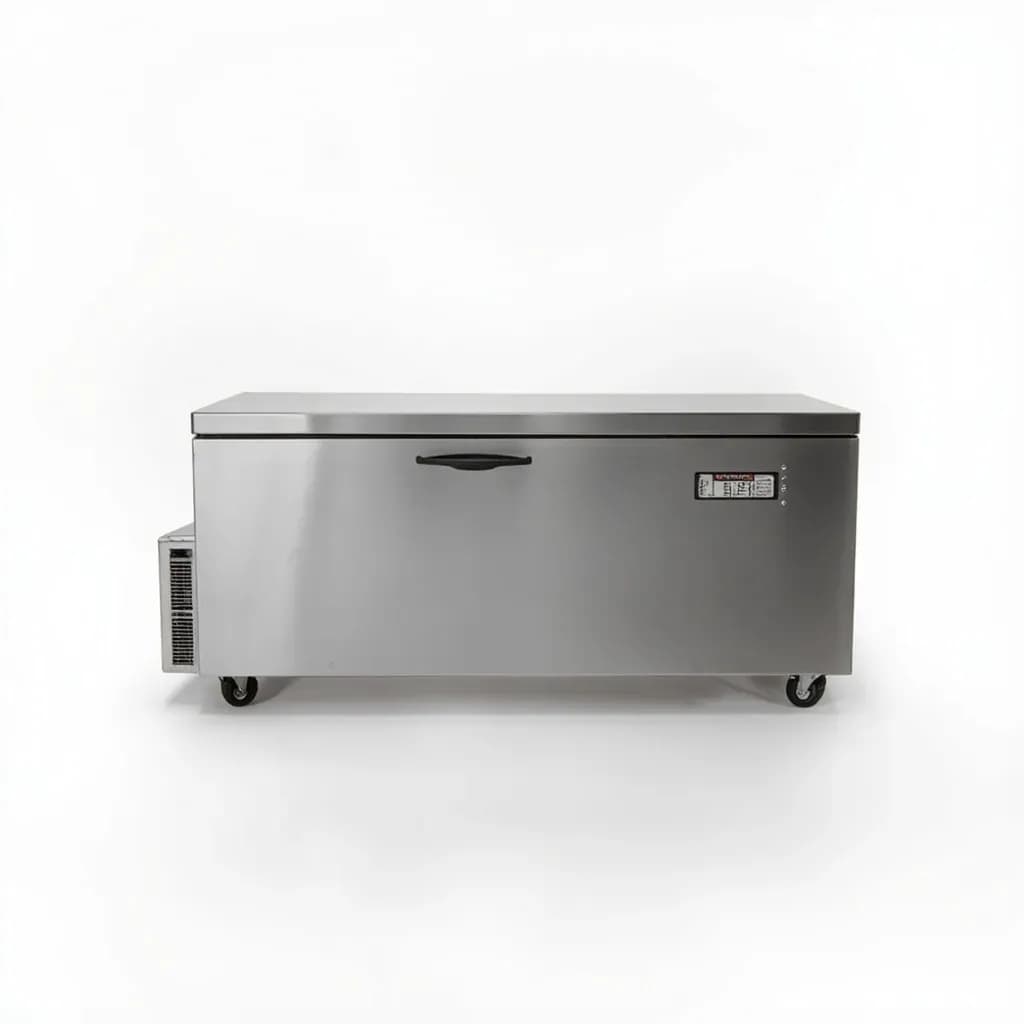
Blast Chiller
A high-power refrigeration unit that rapidly cools hot food through the danger zone for safe storage.
A blast chiller blows very cold air at high velocity to drop the temperature of just-cooked food in minutes rather than hours. Professional kitchens use it to move dishes quickly past the bacterial danger zone before refrigeration or freezing, locking in texture and reducing large ice crystals. It is standard equipment for batch cooking, pastry, and any operation cooking ahead of service.
A blast chiller is a high-output commercial refrigerator engineered for one job: dragging the core temperature of hot cooked food from roughly 90 °C down to about 3 °C in around 90 minutes. That speed matters because cooked food spends the bulk of its bacterial danger-zone time (5–60 °C) during slow cooling, and slow cooling is where kitchens lose control of both pathogens and quality. The unit is what lets a HACCP-driven brigade cool a hotel pan of braised short ribs, a stockpot of velouté, or a sheet of crème pâtissière into the safe cold-hold range in the time a domestic fridge would barely dent the surface.
Mechanically, a blast chiller is built very differently from the reach-in fridge next to it. It carries a much larger evaporator coil, a high-velocity fan that drives sub-zero air around the load, thick insulation so the cabinet walls do not sweat, and a heated door frame that keeps frost from building at the seal. Most cycles run in two phases: a soft chill that brings the product down toward 0 °C without flash-freezing the surface, then a hard chill that finishes the pull-down, before the unit switches to a holding mode at 1–3 °C.
For cooks the practical payoff shows up in texture as much as in safety. Pastry cream chilled this way sets without weeping, soups and stocks hold their gloss, and ice cream or gelato transferred straight from the batch freezer into a blast freezer keeps crystals small because the temperature passes through the -5 to -1 °C band quickly. The blast chiller is unglamorous equipment, but in a serious kitchen it sits beside the combi oven and the Pacojet as part of the cold-side backbone.
Alternatives
Types & varieties
Upright cabinet with shelves; the most common format in restaurant kitchens.
Tall cabinet sized to accept a sheet-pan trolley or GN racking cart, used in batch catering and central production.
Compact 3–10 kg capacity units for cafés, small bistros, and gelato shops.
Single unit with both chill and freeze cycles, often programmed separately for cooked food, pastry, and ice cream.
Large insulated room with high-capacity refrigeration used in central production kitchens, hospitals, and airline catering.
Specialised horizontal or vertical unit with very fast pull-down to -18 °C, designed to keep ice crystals small in gelato and sorbets.
How the cycle actually works
Most modern blast chillers run an automatic two-stage programme rather than a single cooling ramp. The first stage, often called soft chill, holds the cabinet air at a moderate sub-zero temperature while the fan pulls surface heat from the load. The aim is to avoid flash-freezing the outside of the product before the centre has given up its heat. Once the food probe reads in the low twenties at the core, the unit drops to hard chill, with the evaporator working at full output and air temperatures dropping well below 0 °C, finishing the pull-down to 3 °C. After that, the cabinet holds the load at serving-ready refrigeration until you pull it for service or transfer it to a standard refrigerator for storage.
- Soft chill: roughly 90 °C down to the low twenties °C in about 45 minutes for most products.
- Hard chill: from the low twenties °C down to 3 °C in another 30–45 minutes.
- Hold mode: cabinet settles at 1–3 °C and idles until the door is opened.
- The core probe, not the timer, should always be the trigger for ending the cycle.
Blast chilling in pastry and ice cream work
Pastry chefs reach for the blast chiller as readily as sauce cooks do, because hot dairy mixtures need to set cleanly. Crème pâtissière, crémeux, ganache, and mousse bases all benefit from a fast, even pull-down: the starch and protein network firms without syneresis, and butterfat sets in tiny, even crystals instead of weeping to the surface. The same logic governs ice cream and gelato, where the freshly churned base must race through the -5 to -1 °C band where large ice crystals form, ideally landing at -18 °C within four hours.
- Chilled pastry cream pipes and rolls cleanly without a long rest in the walk-in.
- Gelato moved from the batch freezer to a blast freezer at -18 °C stays scoopable straight from service.
- Tempered chocolate work, glazes, and enrobed pieces set cleanly in a blast chiller, holding their gloss without surface bloom.
- Batters and mousses portioned into moulds set their shape quickly, which speeds up dessert assembly.
Working without one
In a home kitchen or a small prep space, an ice bath does most of the work a blast chiller does, just messier and slower. A stainless bowl set over a larger bowl of ice and water, stirred often, will cool a litre of stock from simmering to room temperature in 10–15 minutes. The catch is that ice baths cool only the outside of dense products and cannot deliver the holding-temperature stability, or the auditable temperature record, of a dedicated unit.
- Ice bath with frequent stirring: best substitute for soups, stocks, and thin sauces.
- Spread food in shallow metal pans to maximise surface area, the same principle the blast chiller exploits.
- Do not seal hot food in plastic or glass containers until it has dropped below 40 °C, or steam will condense inside and dilute the product.
- For ice cream at home, place the freshly churned tub in the coldest part of a domestic freezer and resist opening the door for four hours.
Common uses
Tips & pitfalls
- Spread hot food in shallow gastronorm trays no deeper than 4–5 cm so the core cools within the rated cycle time.
- Always run a food probe into the thickest part of the product; trust the probe temperature, not the timer, before pulling the load.
- Do not seal hot food in airtight containers while it is still steaming — leave lids loose or use a steam-permeable cover to prevent condensation pooling.
- Avoid overloading. Most manufacturers cap effective capacity at roughly two-thirds of the listed weight to keep air circulation working.
- Label and date every load; once food is blast-chilled it should be moved promptly to a holding refrigerator and used within HACCP limits, typically 2–5 days.
- Keep the condenser coil and door gaskets clean — a clogged condenser is the single most common cause of failed chill cycles.
- For ice cream and gelato, chill the base to 3–4 °C first, then move it directly into the blast freezer at -18 °C; this gives the smoothest texture.
Good to know
- Primary function
- Pulls hot cooked food from roughly 90 °C to about 3 °C in around 90 minutes, far faster than a standard refrigerator.
- Food-safety rationale
- Designed to cross the bacterial danger zone (5–60 °C / 40–140 °F) as quickly as possible, helping kitchens meet HACCP cooling targets.
- Typical cycle capacity
- Countertop and reach-in models handle 12–40 kg per cycle; roll-in carts take 80–150 kg.
- Two-stage operation
- Most cycles run a soft chill above 0 °C, then a hard chill, before switching to holding mode at 1–3 °C.
- Construction
- Stainless interior and exterior, thick insulated walls, high-output evaporator fan, heated door frame to prevent condensation, and a food-probe socket for core-temperature monitoring.
- Refrigerant
- Modern commercial units use R452A, R448A, or R290; older units commonly ran R404A.
- Power
- Larger units require three-phase commercial power; small undercounter models can run on a 230 V single-phase supply.
- Origin
- Commercial blast chillers were developed in the UK and Northern Europe in the 1980s, partly in response to stricter food-safety legislation after high-profile catering outbreaks.
Also called
Blast Freezer · Shock Freezer
Related

Stovetop
The everyday burners where most cooking actually happens

Oven
Enclosed dry heat for roasting, baking, and braising

Grill
Live-fire or gas grates for char, smoke, and high heat

Smoker
Low, slow heat and wood smoke for barbecue and brisket

Air Fryer
Countertop convection that crisps with little or no oil

Slow Cooker
Set-and-forget low heat for stews, beans, and braises

Pressure Cooker
Sealed steam pressure that cooks tough food in a fraction of the time

Rice Cooker
Foolproof, perfectly steamed rice every single time