Appliances & Heat
Braai Grid
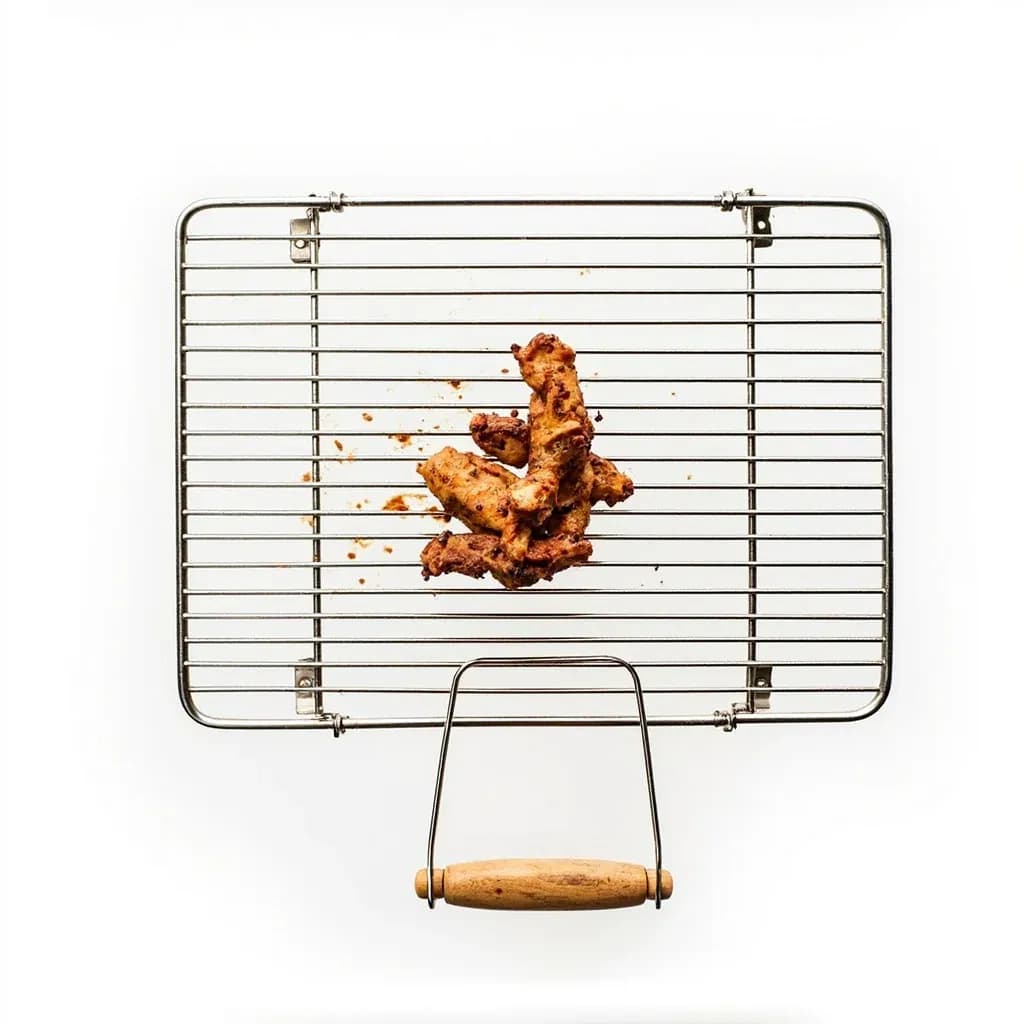
A hinged South African wire grill grate that clamps food for flipping over open coals.
A braai grid is a flat, hinged wire grate used in South African open-fire cooking to hold meat, fish, or vegetables securely while grilling over wood or charcoal coals. The two clamping halves let the cook flip everything at once and lift it off the fire by the handle. It is the centerpiece of a braai, the social grilling tradition, and is prized for cooking whole fish and boerewors without losing pieces to the flames.
The braai grid is the workhorse clamp-grate of the South African braai tradition — a pair of identical wire-mesh grates joined on one edge by a hinge, with a simple hook, eye, or sliding bar on the opposite side to lock them shut. Loaded with food and closed like a sandwich, the whole assembly flips in one motion, exposing both sides to the radiant heat of wood or charcoal coals without the cook ever having to spear a steak or pry a fragile fillet off an open grate. The mesh — roughly 10–15 mm square openings — is fine enough to cradle small whole fish and sliced vegetables that would otherwise drop between the wider bars of a standard braai rooster.
Its real genius is containment. Open-flame cooking punishes anything delicate: a butterflied snoek, a fillet of kabeljou, a tray of asparagus tips. The braai grid turns the fire into a kind of hinged plancha — the food cooks in contact with hot wire on both faces, picks up the smoke and char of the coals, and arrives at the table whole. Traditional chrome-plated mild steel is light enough to manage one-handed on a 400–600 mm handle, which keeps the cook's arm well back from the flare-ups that a fatty chop provokes over real wood.
In coastal Cape kitchens the braai grid is non-negotiable for whole fish; inland, it doubles as a sandwich press for braaibroodjies and a roasting cage for vegetables. It is a single-purpose tool that has survived almost unchanged because the problem it solves — turning food over an open fire without losing it — has not changed either.
Alternatives
Types & varieties
Large 330–350 mm hinged grid built to hold a whole butterflied snoek; the iconic Cape fish-braai tool.
280–300 mm chrome-plated version used for steaks, chops, sausages, fish fillets, and vegetables.
Modern shape that lays out sliced vegetables or butterflied chicken without overlap; useful for uniform presentation.
Upgrade for humid coastal kitchens; heavier, more expensive, and far more rust-resistant than chrome-plated steel.
Heavier and slower to maneuver, but retains heat strongly for deeper sear marks; needs seasoning like a skillet.
One straight handle opposite the hinge — the traditional Cape style, keeping the cook's hand well back from the fire.
Two handles that squeeze together to clamp the food; offers firmer pressure for delicate whole fish and thin fillets.
Loading and firing the grid
The technique is the point of the tool, and a few habits make the difference between a clean flip and a fish in the ashes. Open the grid flat, lay the food on one mesh, close the other over it, and clamp before going over the coals. This protects the food from direct flare-ups while the radiant heat from below does the work.
- Preheat the open grid on the coals for 2–3 minutes so the mesh sears the food on contact and stops it from sticking to the chrome.
- Brush or rub a thin film of neutral oil onto the inside of both meshes, or oil the food itself; bare chrome will lift fish skin and tear fillets.
- Lay the food on the lower mesh, close the upper mesh gently, and engage the hook or sliding bar — do not press hard, you want contact, not a vise.
- Flip the whole assembly once, when the underside releases cleanly; opening and re-closing repeatedly bleeds heat and dries out delicate flesh.
- When the fire is very fierce, rest the closed grid on a brick at the edge of the coals rather than directly over the flames to avoid scorching.
Care and longevity
Chrome-plated steel is the traditional and affordable choice, but the plating is the part that fails first. A few minutes of after-care after every cook will stretch a grid's life from a season to many years.
- Scrub with a stiff wire brush while the grid is still warm — cold chrome is harder to clean and cold fat sets like glue.
- Rinse, then dry on the coals or in a warm oven; trapped moisture is what kills chrome plating overnight.
- Rub a thin film of cooking oil over both meshes before storing; the oil displaces air and slows oxidation.
- Never put a chrome-plated grid in the dishwasher — the alkaline salts strip the plating in a handful of cycles.
- Replace the grid once the plating has worn through to bare steel in patches; rust will then leach into food and the wire will pit.
Common uses
Tips & pitfalls
- The long handle still gets hot over a sustained cook — grip it with a dry cloth or a leather braai glove, not bare skin.
- If the grid warps from extreme heat, press it back into shape while still warm — cold steel will crack or spring back crooked.
- For a whole snoek, soak the grid briefly in seawater before the cook (a traditional Cape method); the salt seasons the metal and adds a faint saline note to the fish.
- Do not press hard when closing the grid — you want contact, not a vise; pressing crushes delicate fish flesh between the wires.
- Score the skin of whole flatfish lightly before clamping; otherwise the skin balloons from steam and bursts between the meshes.
Good to know
- Origin
- South Africa; evolved alongside 20th-century Afrikaner domestic braai culture from hand-forged wire clamps into mass-produced chrome-plated grids.
- Also known as
- Braai rooster, klap-braai grid, hinged grill, fish grid, snoek grid (when sized for whole snoek).
- Primary material
- Chrome-plated mild steel (traditional); stainless steel and nickel-plated versions are common upgrades; cast-iron hinged grids exist but are heavier.
- Common diameters
- 280 mm (11 in), 300 mm (12 in), 330 mm (13 in), and 350 mm (14 in) for the large snoek size.
- Mesh size
- Approximately 10–15 mm square openings — fine enough to hold small whole fish and sliced vegetables.
- Construction
- Two identical wire-mesh grates joined along one edge by a spring or pivot hinge, with a hook-and-eye or sliding bar closure opposite.
- Heat source
- Open wood or charcoal coals; not designed for gas burners or stovetop use.
- Durability note
- Chrome plating gradually burns off over direct flame; stainless steel lasts considerably longer but costs roughly two to three times as much.
- Cleaning
- Brush while warm, soak in hot soapy water, dry immediately, and oil lightly to prevent flash rust on chrome plating.
Also called
braai grill · hinged grill basket
Related

Stovetop
The everyday burners where most cooking actually happens

Oven
Enclosed dry heat for roasting, baking, and braising

Grill
Live-fire or gas grates for char, smoke, and high heat

Smoker
Low, slow heat and wood smoke for barbecue and brisket

Air Fryer
Countertop convection that crisps with little or no oil

Slow Cooker
Set-and-forget low heat for stews, beans, and braises

Pressure Cooker
Sealed steam pressure that cooks tough food in a fraction of the time

Rice Cooker
Foolproof, perfectly steamed rice every single time