Appliances & Heat
Buffalo Chopper (Bowl Cutter)
A heavy-duty rotating-bowl machine that chops and emulsifies large batches of meat and produce.
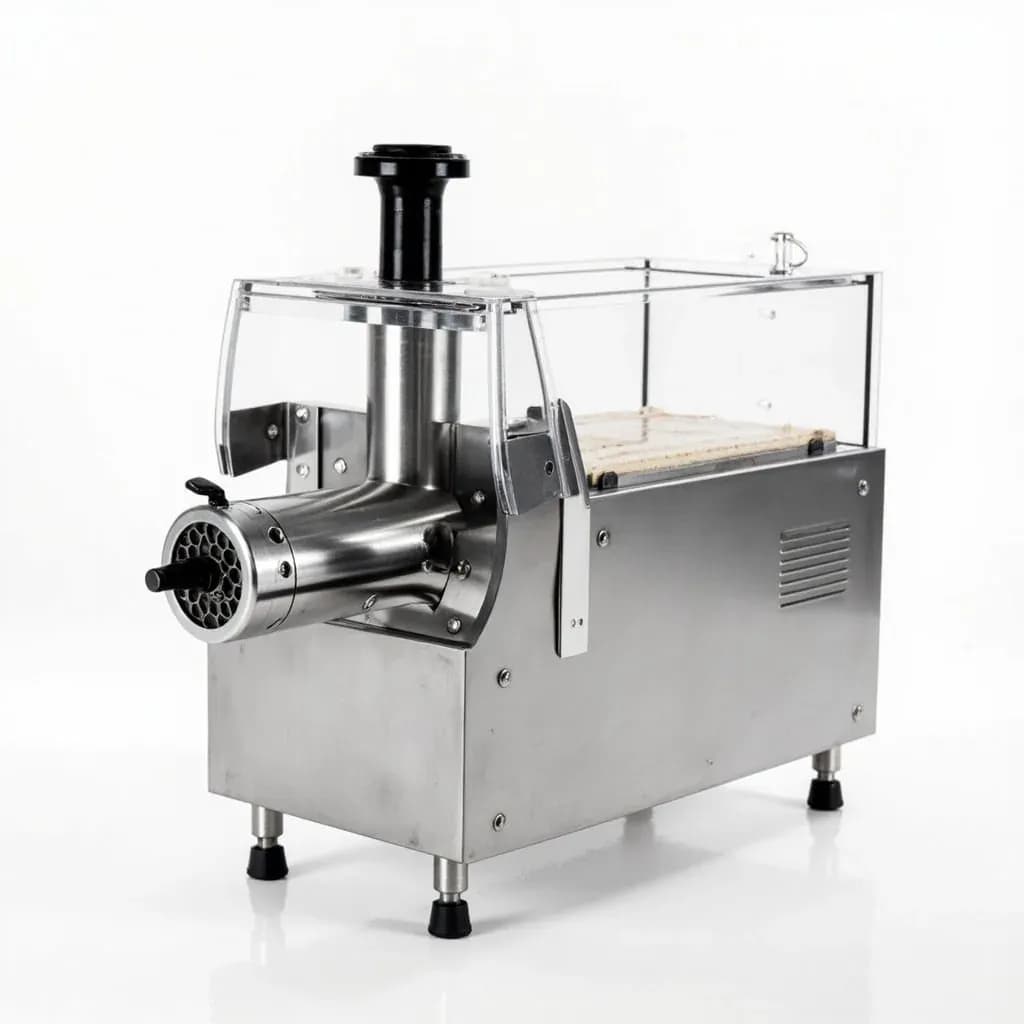
A buffalo chopper, or bowl cutter, is a commercial machine with a spinning bowl that carries food past a set of fast-turning curved blades, finely chopping or emulsifying in volume. Butchers and large kitchens use it to make sausage and pâté forcemeats, grind meat, and chop vegetables far faster than by hand. Its rugged build handles continuous heavy loads that would overwhelm a household food processor.
The bowl cutter — "Buffalo chopper" in American shops, Kutter in European ones — is the machine behind every smooth, sliceable sausage you've ever eaten. A heavy, lidded stainless bowl rotates slowly in one direction while a vertical head of curved knives spins fast in the other, producing a planetary cutting action that simultaneously chops, smears, and mixes whatever is inside. That counter-rotation is the whole point: a meat grinder extrudes product through a perforated plate and gives you a defined particle size, but a bowl cutter can reduce fat to a sub-millimeter dispersion coated in extracted meat proteins. The result is a true emulsion — the dense, bouncy, pink-white batter that holds fat and water together in frankfurters, hot dogs, bologna, and mortadella.
No other common kitchen machine does this at scale. Food processors chop, stand mixers whip, grinders comminute, but only a bowl cutter — by combining slow mixing, fast cutting, and the salt-driven extraction of muscle proteins — can build a stable meat batter. The same machine, fitted with a different knife head, also produces a coarse country-style sausage, a rough country pâté, or a pesto, which is why a 20–40 L variable-speed unit is the standard workhorse in butcher shops, charcuterie programs, and industrial sausage lines. Modern vacuum and heated-jacket variants extend the same logic into ready meals, plant-protein batters, and fish pastes.
Alternatives
Types & varieties
Freestanding 40–200 L units for industrial sausage lines, central butchery, and ready-meal plants.
Bench-mounted 5–20 L units common in butcher shops, R&D kitchens, and restaurant charcuterie programs.
Two-speed or inverter-driven units that allow slow combining (protein extraction) followed by high-speed chopping (emulsification).
Sealed lid pulled to roughly 0.5–0.8 bar to degas the batter; produces denser, paler, longer-keeping emulsions with no air pockets — standard for hot-dog and bologna production.
Bowl wall warmed by steam or electric jacket; used when rendering fat (foie gras, country pâté) is part of the process.
Hybrid with steam-heated bowl that chops and then cooks in the same vessel — used for liver pâté, ready meals, and baby food.
3–9 L machines used by product developers to scale down recipes before committing to a full production run.
The science of the emulsion
A frankfurter is essentially lean meat protein, water, salt, and a lot of fat locked into a single gel. The bowl cutter is the machine that builds that gel. Salt added at the very start dissolves salt-soluble muscle proteins — chiefly myosin — which unfold and become sticky. As the knives turn, the meat smears against the bowl wall and those exposed proteins coat every newly cut surface of fat. By the time the fat goes in, the bowl contains a thick, glossy batter with droplets well under a millimeter across, each wrapped in a protein film. Heat later sets that film and the emulsion holds its shape when sliced. Break the rules and the fat melts out, the proteins shrink, and you get the gray, greasy mush of a failed cook-out.
- Salt before fat. Always. Myosin extraction is what holds the emulsion together — without it, fat is just floating in meat paste.
- Keep the bowl below 12 °C (54 °F) for raw sausages and below 4 °C (39 °F) for cooked-emulsion products. A cutter can climb 10–15 °C in two minutes of running; heat smears the fat and denatures the proteins before they can do their job.
- Fat goes in last, slowly — a thin stream from a pitcher gives the knives time to disperse it. Dumping a slab of fat in at the start simply smears lard across the bowl wall.
- The smear test: pull a finger across the lid every 30 seconds. A true emulsion leaves a sticky, glossy, pale-pink streak; a broken one beads clear fat and runs watery.
- Listen to the load: a steady roar means the bowl is full and working; a dropping pitch means the batter is loosening (emulsion forming); a sudden high whine means the bowl is running dry or a knife has kissed the lid.
Common uses
Tips & pitfalls
- Pre-chill everything that goes into the bowl — meat, fat, water/ice, knives, and the empty bowl itself. A bowl-cutter batter can rise 10–15 °C in two minutes, and an emulsion that warms past 12 °C is already on its way to breaking.
- Add salt (and any curing salts) at the very start, before any fat. Salt dissolves the myosin proteins that actually lock the emulsion together; adding salt late produces a broken, greasy batter no matter how fine you chop.
- Sequence deliberately: lean meat in first, chop briefly, add ice or ice water, chop until tacky, then stream the fat in last. A thin stream beats a dump.
- Fill the bowl no more than 70–80% full. Overfilling prevents the planetary motion from circulating product through the knives and leaves unchopped pockets at the rim.
- Choose your knife head to match the texture you want. Curved three-blade heads emulsify; straight knives give a coarse chopped result; perforated knives mimic a coarse grind; specialty heads exist for cheese and vegetables.
- Treat knives as precision tools, not disposable ones. They are hardened stainless and should be honed lightly on a fine stone or sent back to the maker — aggressive regrinding changes the geometry and ruins the bowl clearance.
- Clean the bowl rim and lid gasket after every batch. Meat residue trapped in the seal is the number-one source of off-flavors and Listeria findings in butcher-shop audits.
- For vacuum-cutter work, pull the vacuum before adding any fat. Once fat is in, entrained air oxidizes the lipids and you'll taste it in the finished sausage.
Good to know
- Also known as
- Bowl cutter; Kutter; vertical cutter/mixer (VCM); silent cutter (Hobart trade name)
- Origin of name
- John E. Smith & Sons Co., Buffalo, New York — early 20th-century equipment maker whose machines became the generic American 'Buffalo' style
- Operating principle
- Counter-rotating bowl (slow) and vertical multi-blade knife head (fast) produce a planetary cutting and mixing action
- Knife clearance
- 0.2–0.5 mm gap between knife tips and bowl wall — the single most important mechanical variable, smaller gap = cleaner cut and better emulsion
- Knife head speed
- Roughly 1,500–4,500 rpm; variable-speed machines span 500–4,500 rpm
- Bowl rotation speed
- Typically 6–30 rpm, often reversible
- Standard configuration
- 3-blade 'spider' curved-knife head; 2-, 4-, and 6-blade heads are common options
- Typical bowl capacities
- 9 L, 20 L, 40 L, 60 L, 80 L, 100 L, 120 L, 200 L; lab/pilot models as small as 3–5 L
- Construction
- Stainless-steel bowl, knives, and lid; cast-iron or stainless frame; food-grade seals
- Lid features
- Hinged safety lid with feed chute; many modern units have interlock switches and some accept a vacuum dome
Also called
Bowl Cutter · Buffalo Bowl Chopper · Silent Cutter
Related

Stovetop
The everyday burners where most cooking actually happens

Oven
Enclosed dry heat for roasting, baking, and braising

Grill
Live-fire or gas grates for char, smoke, and high heat

Smoker
Low, slow heat and wood smoke for barbecue and brisket

Air Fryer
Countertop convection that crisps with little or no oil

Slow Cooker
Set-and-forget low heat for stews, beans, and braises

Pressure Cooker
Sealed steam pressure that cooks tough food in a fraction of the time

Rice Cooker
Foolproof, perfectly steamed rice every single time