Knives & Cutting
Butcher Knife
A sturdy broad-bladed knife for cutting, trimming, and portioning large cuts of meat.
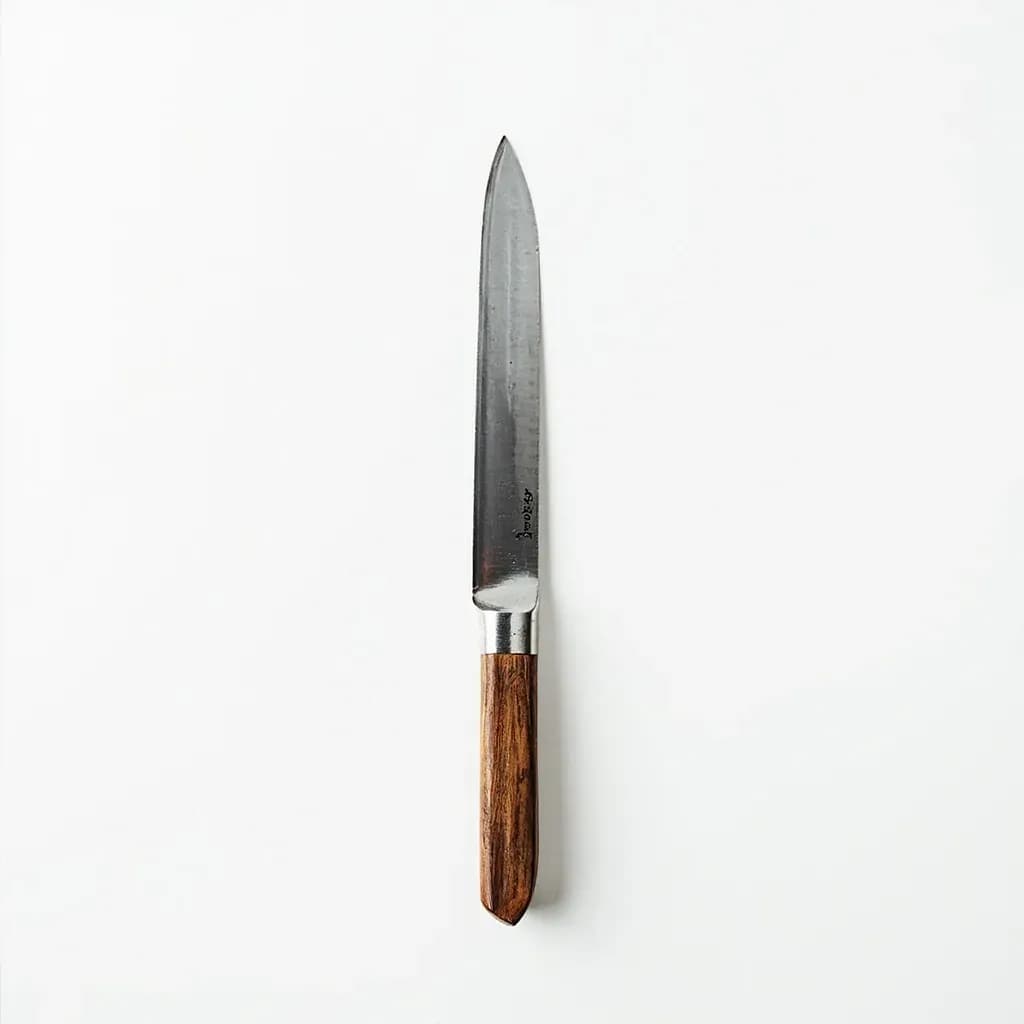
A butcher knife is a heavy, broad-bladed knife with a slightly curved edge designed for sectioning and trimming meat. It is used to cut steaks, trim fat and silverskin, and break down sides of beef or pork where a chef's knife lacks the heft. The wide blade and strong tip make it a versatile workhorse on the butcher's block.
The butcher knife is a broad, heavy-bladed slicer built for the moment a cook stops dealing in fillets and dice and starts dealing in anatomy: a whole chicken, a pork shoulder, a strip loin, a rack of ribs. Its defining trait is a deep, forward-curving belly that lets the edge travel through meat in long, rocking strokes, combined with a tip that rises high enough to give leverage when you reach the end of a cut. In the hand it feels noticeably heavier than a chef's knife, and that weight is the point — the blade is meant to fall through tough tissue with gravity as its partner, not be forced through with the wrist.
Where a chef's knife is a generalist and a cleaver is a blunt tool for splitting bone, the butcher knife sits between them: lighter than a cleaver, heavier and more curved than a chef's knife, and shaped for slicing rather than splitting. In a home kitchen it earns its place whenever a job is too big for an 8-inch chef's knife but too precise for an axe — halving a brisket before the smoker, breaking a chicken into eight pieces without mangling the skin, portioning a rolled roast into steaks. In professional butchery it is usually one tool in a kit of specialized blades (boning, breaking, cimeter, skinner) rather than a single do-it-all.
Treat it as a specialist rather than a daily driver. Kept sharp, used on a stable board, and reserved for the work it was built for, a good butcher knife will outperform a chef's knife on those tasks for decades.
Alternatives
Types & varieties
The broad-bladed, curved workhorse for breaking down primals, portioning, and trimming.
Longer (8–12 in) version used to break a carcass into primal and subprimal cuts.
Long, dramatically curved blade for slicing steaks and roasts off large subprimals like rib and loin.
Shorter, narrower blade optimized for separating hide from carcass on game or livestock.
Small, narrow, pointed blade used to bleed out a carcass; not a kitchen tool.
Often grouped with butchery knives but distinct — thin and stiff, for working meat off bone.
Choosing and buying
For most home cooks, a single 7-inch butcher knife covers the jobs that justify the tool: breaking poultry, portioning a roast, working through cartilage. Look for a full tang you can feel through the handle, a handle shape that locks in when your hand is wet and greasy (Pakkawood or a textured polymer both work), and a blade thickness in the 2.5–3.5 mm range — thick enough to feel substantial, thin enough to still slide through meat rather than wedge into it. Avoid bargain stamped blades that flex along the spine; this is a knife that lives or dies by its rigidity.
- Aim for a 7- or 8-inch blade for general home use; longer cimeter-style blades belong on a butcher's block, not in a kitchen drawer.
- Weigh it in hand before buying — 10–14 oz is the sweet spot for control without fatigue.
- A continuous, smooth curve from heel to tip is more useful than a dramatic upswept tip that fights you on straight cuts.
- If you'll process poultry regularly, prioritize a tip with enough rise to navigate around joints without stabbing.
Technique at the board
The butcher knife rewards a different stroke than a chef's knife. Where you rock a chef's knife with the heel, here you typically draw the blade through a cut in one long motion, letting weight and curve do the work. Start each cut with the heel contacting the meat, lay the edge down at a low angle, and pull toward you as the blade rolls along its belly. Finish by lifting through the tip — the high upswept point is what completes a clean slice on roasts and rib racks.
- Anchor the far end of the meat with your non-knife hand cupped off the board — fingers curved, knuckles forward.
- For poultry, slice through the skin and joint with one confident stroke; hesitation tears more than the blade does.
- When portioning steaks, mark even thicknesses with a light score, then slice with a single draw rather than sawing.
- For stubborn joints, work the edge through cartilage in short, controlled strokes rather than twisting — leverage, not force, is what gets you through.
Care and maintenance
A butcher knife lives or dies by its edge, and its curved edge is more prone to rolling than a straight chef's knife because it meets bone and gristle at oblique angles. A 10-second pass on a honing steel before each session resets that roll; a whetstone every few weeks of regular work puts the edge back. Dry the blade the moment you wash it — carbon-steel models in particular will spot and stain if left wet, and even stainless versions suffer along the edge.
- Hone before every session, not after — preventive, not corrective.
- Sharpen on a 1000/6000-grit whetstone, finishing on the 6000 to refine; strop on leather to remove the burr.
- Hand wash only; the dishwasher cycle knocks handles and rolls edges.
- Store on a magnetic strip, in a block, or in a saya so the edge isn't rattling against other tools.
Common uses
Tips & pitfalls
- Let the blade's weight do the work — drive cuts with gravity and a slight pull, never bear down with the wrist or you'll fatigue the edge and your forearm.
- Hone on a steel before every session; the curved edge rolls easily the first time it meets bone or gristle.
- Cut on end-grain wood or thick poly boards — hard, stable surfaces protect the edge and give the knife something to bite into.
- Keep a damp towel or chain-mail glove within reach when portioning; this is a fast, powerful blade and grip discipline matters more than bravado.
- Don't pry or twist the blade sideways — that snaps tips and chips edges. Reposition and slice.
- Reserve it for meat and tough produce like squash or pineapple; avoid laminated foods, bread, and delicate herbs where a chef's knife or slicer does better.
- Wash in warm soapy water, dry straight away, and store on a magnetic strip or in a block so the edge isn't knocked around in a drawer.
- Strop on leather after sharpening to refine the edge — butcher work punishes a toothy, wire-edge finish.
Good to know
- Blade length
- Typically 6–10 in (15–25 cm); 7–8 in is the most common working length
- Blade profile
- Broad with a pronounced upward-curving belly, built for long rocking strokes
- Tip
- Rounded or upswept — high to give leverage near the end of a cut
- Weight
- Roughly 8–16 oz (225–450 g); heft is a feature
- Steel
- Usually high-carbon stainless (e.g. X50CrMoV15) or carbon steel at about 56–58 HRC
- Construction
- Full-tang with riveted hardwood, Pakkawood, or textured polymer handle
- Edge grind
- Concave or flat, sharpened to roughly 20–22° per side
- Distinction from cleaver
- Lighter and curved for slicing; a cleaver is heavier and rectangular for splitting bone
Also called
Butcher's Knife · Meat Knife
Related

Knife
The fundamental cutting tool every kitchen is built around

Chef's Knife
The do-everything blade for chopping, slicing, and mincing

Paring Knife
Small, nimble blade for peeling and detailed in-hand work

Serrated Knife
Saw-toothed blade that slices crusty bread without crushing

Cleaver
Heavy broad blade for chopping through bone and bulk prep

Cutting Board
The stable surface every cut starts on

Mandoline
Adjustable blade for paper-thin, perfectly even slices

Kitchen Shears
Heavy-duty scissors for poultry, herbs, and packaging