Appliances & Heat
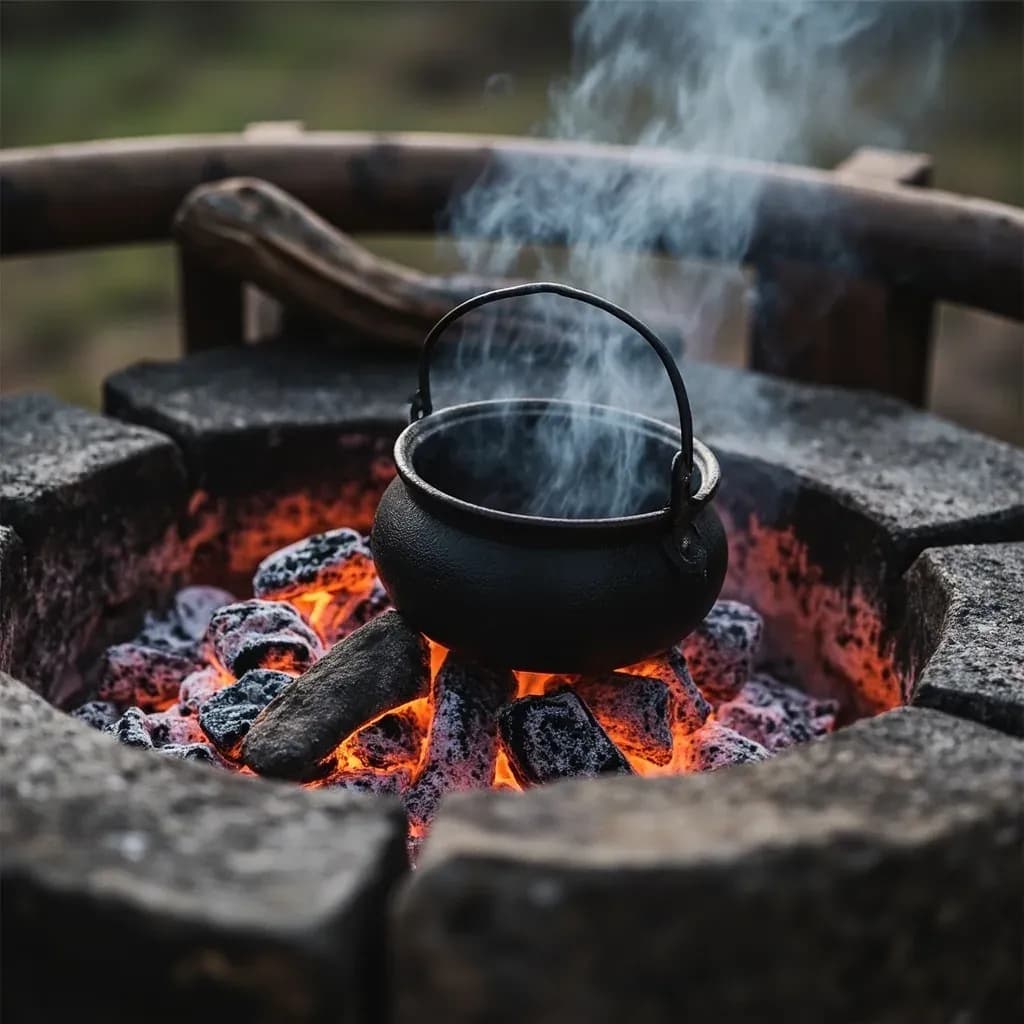
Open Campfire / Fire Ring
A contained outdoor wood or charcoal fire used to cook over coals while camping or outdoors.
A campfire is an outdoor fire, often in a ring of stones or a metal fire ring, used as a portable cooking heat source away from a kitchen. Once the flames burn down to a steady bed of hardwood coals or charcoal briquettes, cooks grill, roast on sticks, or set a pot or cast-iron Dutch oven over the heat. Reading the coal bed is key, since there is no temperature dial.
A campfire, in cooking terms, is a contained outdoor fire — usually a ring of stone, brick, or metal, sometimes a dug pit or a tripod setup — used as a heat source for grilling, roasting, simmering, and baking. What distinguishes it from a kitchen stove is the heat itself: a fire ring cooks on radiant heat from a bed of glowing coals, not from a regulated flame. The cook manages temperature by raising or lowering the grate, banking coals to one side, moving the pot across the fire's footprint, or adding fresh fuel — controls that are cruder than a thermostat but, once learned, allow nearly any cast-iron technique to work outdoors.
A well-built hardwood fire reaches usable cooking temperature in 30–45 minutes, with coals glowing orange-white at roughly 600–900 °F (315–480 °C) at the surface. The hottest zone sits directly above the coal bed; the area at the edge of the ring is moderate; the perimeter is barely warm. That gradient is the cook's main instrument — a high grate sears, a low grate or a wide-set pot simmers, and a lidded Dutch oven with coals on its lid bakes. Fuel choice matters as much as technique: seasoned hardwoods (oak, hickory, maple, beech, ash) burn clean and hot, while softwoods (pine, spruce, fir) smolder, spark, and coat food in resinous, acrid smoke.
Mastery comes down to two decisions. Cook on coals, not on leaping flames — flames blacken food with soot, while a solid bed of embers cooks evenly and predictably. And choose the right wood for the job. Most campfire failures — burnt exteriors, raw centers, sooty flavor, stubborn flare-ups — trace back to cooking too early, over flame, or with the wrong fuel. Get those right, and a fire ring will sear a steak, simmer a stew, roast a chicken on a spit, smoke a shoulder, and bake a loaf of bread with confidence that rivals a kitchen range.
Alternatives
Types & varieties
Food held in or just above the flames; good for skewers, marshmallows, and quick searing, but flare-ups and soot are common
The classic method: wait until flames die down to glowing coals, then cook on a grate; even, sustained radiant heat
A three-leg frame with a hanging hook or chain; ideal for suspending a Dutch oven, kettle, or even a whole animal over the fire
A horizontal or vertical spit turned by hand or motor; the historical method for whole pigs, lamb, and chickens
A permanent or semi-permanent circle of stones or bricks that contains fuel and reflects heat inward
Earth-oven style: a pit lined with hot stones, food buried, and covered — the basis of Hawaiian imu, Māori hāngi, and pit roasts worldwide
Two linked pits, one for the fire and one as an air intake/updraft duct, producing a hot, low-smoke burn — useful in exposed or regulated sites
Different wood-stacking patterns with different burn characteristics: teepee lights fast, log cabin burns long and even, star is fuel-efficient for slow cooking
Fire Lays: Matching the Structure to the Meal
The way wood is stacked changes how a fire burns — how fast it lights, how hot it gets, how long it lasts, and how much smoke it makes. Choosing a lay is the first cooking decision, made well before the grate goes on. Most fire rings benefit from starting with a fast-lighting lay and then feeding a longer-burning one as coals develop.
- Teepee: kindling and small sticks leaned into a cone around a tinder bundle. Lights fast, burns hot, but collapses quickly. Best for getting coals going before switching to another lay.
- Log cabin: two larger logs parallel on the ground, with smaller sticks stacked crosswise inside, leaving a hollow core for tinder. Lights in minutes, then settles into a long, even burn — ideal for sustained cooking over a grate.
- Lean-to: a single large log or split laid as a windbreak, with kindling leaned against it like a tent. Lights easily in wind and creates a hot, directional fire on one side — useful in breezy conditions or when you want a clear hot zone and a clear cool zone.
- Star (or cross): four to six logs radiating from a central hub, pushed inward as the inner ends burn. Extremely fuel-efficient and long-lasting; good for slow, low-heat cooking and overnight warmth with minimal attention.
- Banked fire: not a stacking pattern, but the essential fire-management technique that pairs with any lay. Coals are pushed to one side of the ring, leaving the other side empty. The hot side sears; the cool side holds or finishes gently. This is the two-zone setup that gives a fire ring the versatility of a kitchen range.
Common uses
Tips & pitfalls
- Wait for the flame phase to pass — cook on glowing coals, not on leaping flames, to avoid soot and flare-ups.
- Use only dry, seasoned hardwood; green wood smolders and deposits creosote on food.
- Build the fire 30–45 minutes before you plan to cook so coals form a solid, even bed.
- Set a grate on bricks or stones so you can adjust height and control heat quickly.
- Bank coals to one side to create a two-zone fire: a hot side for searing and a cool side for holding or gentle cooking.
- Keep a bucket of water or a shovel of dirt within reach, and never leave the fire unattended.
- Add smoke flavor with hardwood chunks (mesquite, hickory, cherry, apple) rather than softwoods or lumber scraps — use resinous hardwoods like mesquite sparingly to avoid bitter smoke.
- For Dutch-oven work, place coals on the lid as well as beneath — true oven-style top and bottom heat.
- Extinguish fully: drown, stir, drown again, and check that coals are cold to the touch before leaving the site.
- Check local fire restrictions before lighting, especially in summer dry seasons and on public land.
Good to know
- Cooking medium
- Heat radiated from a bed of wood or charcoal coals, not direct flame
- Time to cooking coals
- 30–45 minutes from a well-built hardwood fire
- Preferred fuel
- Seasoned hardwoods (oak, hickory, maple, beech, ash); softwoods like pine and spruce produce resin smoke and should be avoided
- Typical pit size
- 3–4 ft (≈1 m) diameter ring for group cooking; 2 ft for small tasks
- Safe clearance
- At least 15 ft (4.5 m) from structures, overhanging branches, and dry brush
- Heat zones
- Hottest directly above coals; moderate at ring edge; cool at the perimeter (useful for warming, holding, or slow finishing)
- Typical cooking temperature
- Coals glow orange-white at roughly 600–900 °F (315–480 °C); a flat hand held 4 inches above the grate gives a rough doneness gauge
- Key accessories
- A raised grill grate on stones or legs, or a tripod with an adjustable hook; long-handled tools and a water bucket are essential
- Regulations
- Many jurisdictions require a contained ring, a permit in dry seasons, and a fully extinguished fire (cold to the touch) before leaving the site
Also called
Fire Ring · Hardwood Coal Bed · Charcoal Briquettes · Campfire
Related

Stovetop
The everyday burners where most cooking actually happens

Oven
Enclosed dry heat for roasting, baking, and braising

Grill
Live-fire or gas grates for char, smoke, and high heat

Smoker
Low, slow heat and wood smoke for barbecue and brisket

Air Fryer
Countertop convection that crisps with little or no oil

Slow Cooker
Set-and-forget low heat for stews, beans, and braises

Pressure Cooker
Sealed steam pressure that cooks tough food in a fraction of the time

Rice Cooker
Foolproof, perfectly steamed rice every single time