Appliances & Heat
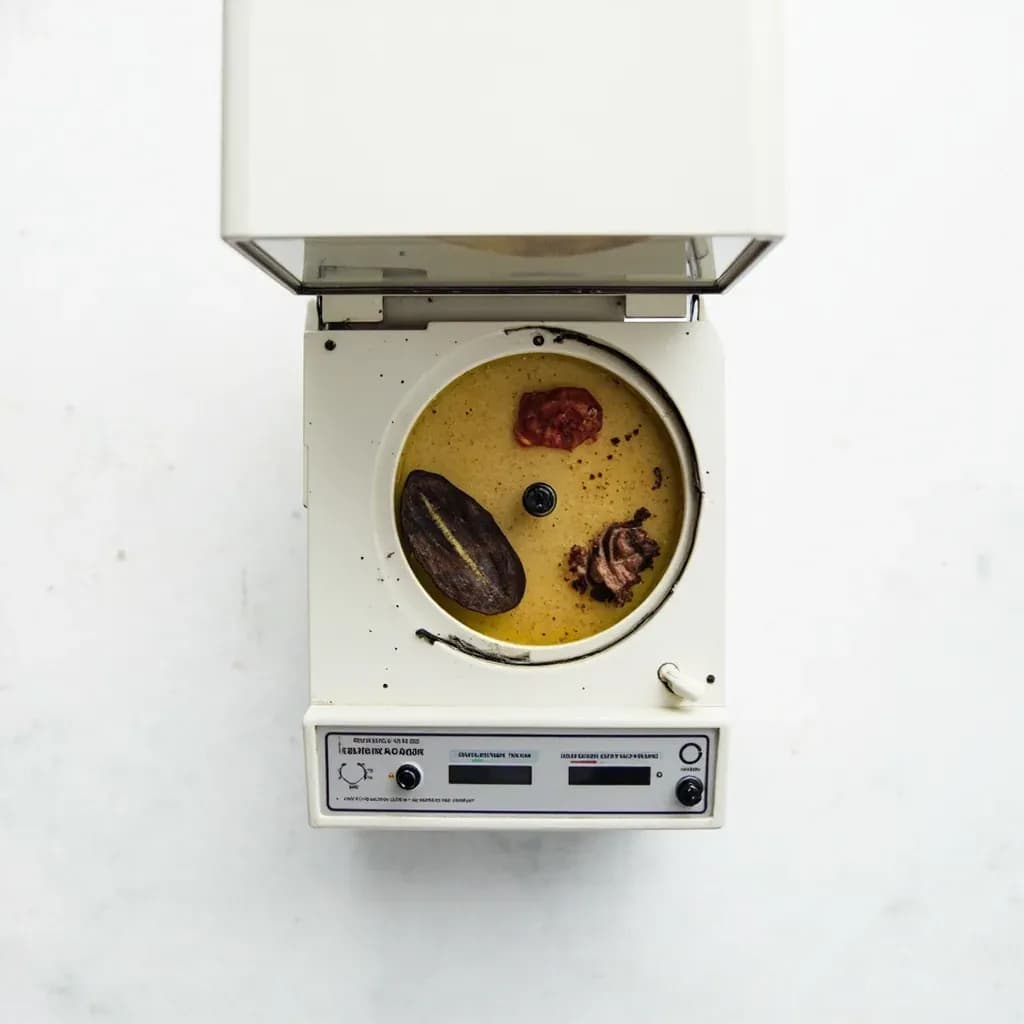
Laboratory Centrifuge
A high-speed spinning machine that separates liquids into clear layers by density for clarified juices and fats.
A laboratory centrifuge spins samples at high speed so denser solids and liquids settle out from lighter ones. In modernist cooking it clarifies juices, stocks, and purees into brilliantly clear liquids, and separates fats or pulp for concentrated flavors. The force it generates does in minutes what slow gravity settling would take days to achieve.
A laboratory centrifuge is a high-speed spinning machine that exploits density differences to split a mixture into clean layers — denser particles and liquids migrate outward under centrifugal force, while lighter fats and clarified liquids collect in distinct bands toward the top of the tube. In a kitchen, the cook loads small bottles of juice, stock, consommé, or rendered liquid into a swinging or fixed-angle rotor, balances them carefully, and lets a few minutes of rotation do work that would otherwise require a long raft, a gelation step, or patient filtration. The result is a perfectly clear supernatant and, sitting beneath it, a tightly packed pellet of flavor that is itself an ingredient.
What makes the centrifuge genuinely useful in a kitchen is cold clarification. Because separation is purely physical and happens in minutes, the liquid never warms up enough to dull bright acids, blow off top aromatics, or set delicate proteins. A tomato water spun at 4 °C tastes like the fruit picked that morning; a beef consommé comes out jewel-bright without the hour-long raft a classical kitchen would build. A refrigerated unit is essentially mandatory for serious work, because friction during a run can warm delicate samples by several degrees and undo the whole point of going cold.
The technique was popularized in fine dining by Heston Blumenthal at The Fat Duck and brought to wider attention by Grant Achatz at Alinea, Dave Arnold at Booker and Dax, and the Modernist Cuisine team. The trade-offs are real: a benchtop refrigerated centrifuge suitable for food work costs as much as a small piece of professional equipment, lives in a dedicated prep or test kitchen, and demands a balanced load and a clean rotor. For most cooks, agar or gellan clarification is simpler and cheaper; the centrifuge earns its place when clarity has to be absolute and heat is simply not allowed.
Alternatives
Types & varieties
The workhorse of restaurant labs; spins at moderate-to-high speeds while keeping samples cold, ideal for cold-clarifying juices and stocks.
Compact unit for very small volumes; useful for single-portion or experimental work but limited in capacity.
Larger and more expensive; chosen when chefs need to clarify bigger batches or separate heavier particulates.
The named process of spinning a finished consommé or stock at high speed to drop fine solids, yielding an almost perfectly clear liquid without gelation or filtration.
The Pellet Is an Ingredient
The dense, often vividly colored layer that packs onto the bottom of the tube is usually where the deepest flavor of the original mixture ends up. Skilled cooks treat it as a separate product rather than waste.
- Tomato, carrot, and beet juices leave a bright pellet that can be whisked into a glaze, folded into a pasta dough, or thinned with oil to paint a plate.
- Dashi and chicken-stock pellets are intensely savory — useful as a quick umami booster dissolved in a small amount of warm water.
- Wine and cider pellets concentrate tannin and color; a pinch can adjust a finished sauce the way a reduction would, without further cooking.
- Herb- and tea-infused waters spun in the centrifuge leave a fragrant sediment that rehydrates well into compound butters or vinaigrettes.
Centrifuge vs. Other Clarification Methods
A centrifuge sits at the expensive, fast, heat-free end of the clarification toolkit. The right method depends on what the cook is willing to spend in money, time, and equipment — and on what the liquid can tolerate.
- Agar clarification gels the liquid, trapping suspended solids in a soft set that is then broken and strained clear through cheesecloth — cheaper and gentler on equipment, though the agar carries away some volatile aromatics with the impurities it captures.
- Gellan clarification behaves similarly but works at lower concentrations and is often preferred for wines and delicate fruit juices.
- Egg-white raft clarification is the classical consommé method: long, slow, and gentle on flavor, but it does change the liquid's character and adds protein.
- Fine filtration through a cloth or membrane is the cheapest route, but rarely produces the absolute, photogenic clarity a centrifuge can.
- A centrifuge is the right call when heat would damage the liquid, the volume fits a rotor, and the clarity has to read across a wide dinner plate.
Common uses
Tips & pitfalls
- Always balance the rotor with tubes of equal weight placed directly opposite each other; an unbalanced load stresses bearings and gives poor, smeared separation.
- Pre-chill samples in the refrigerator or freezer before spinning — friction during a run can raise temperatures noticeably and cook delicate aromatics.
- Run emulsions in short pulses rather than a single long spin; extended force can pack solids into a cement-like layer that is difficult to re-emulsify.
- Decant the clarified layer gently rather than pouring; the sediment at the bottom is loosely packed and will cloud the liquid if disturbed.
- Do not fill tubes more than about three-quarters full — liquids expand under centrifugal force and can leak past the cap at speed.
- Save the sediment. The spun-down solids from fruit juices, stocks, and dashi carry intense flavor and work as glazes, sauce bases, or umami boosters.
- For fats, run warm (around 40–50 °C / 104–122 °F) so the fat stays liquid and the water phase separates cleanly; cold fat stays emulsified and refuses to split.
- Never spin carbonated liquids or sealed containers; pressure build-up is a real hazard that can rupture tubes inside the rotor.
Good to know
- Category
- Laboratory equipment adapted for modernist cuisine
- Typical speed
- Roughly 3,000–15,000 RPM, producing tens of thousands of × g of relative centrifugal force
- Working volume
- From a few milliliters up to about 500 mL per run in standard benchtop rotors
- Operating principle
- Denser particles and liquids migrate outward; lighter layers (clarified liquid, fats) collect at the top or in distinct bands
- Temperature control
- Refrigerated models are strongly preferred; even a short run can warm samples noticeably and damage delicate aromatics
- Notable proponents
- Heston Blumenthal, Grant Achatz, Dave Arnold, and the Modernist Cuisine team
- Typical cost
- Benchtop refrigerated units suitable for kitchen use generally run into the high four to low five figures USD
- Power
- Standard 110–240 V outlet; some high-speed units need a dedicated circuit
Also called
centrifuge · food centrifuge
Related

Stovetop
The everyday burners where most cooking actually happens

Oven
Enclosed dry heat for roasting, baking, and braising

Grill
Live-fire or gas grates for char, smoke, and high heat

Smoker
Low, slow heat and wood smoke for barbecue and brisket

Air Fryer
Countertop convection that crisps with little or no oil

Slow Cooker
Set-and-forget low heat for stews, beans, and braises

Pressure Cooker
Sealed steam pressure that cooks tough food in a fraction of the time

Rice Cooker
Foolproof, perfectly steamed rice every single time