Appliances & Heat
Char-Broiler
A radiant grill that chars food over hot grates above gas-heated rocks or charcoal.
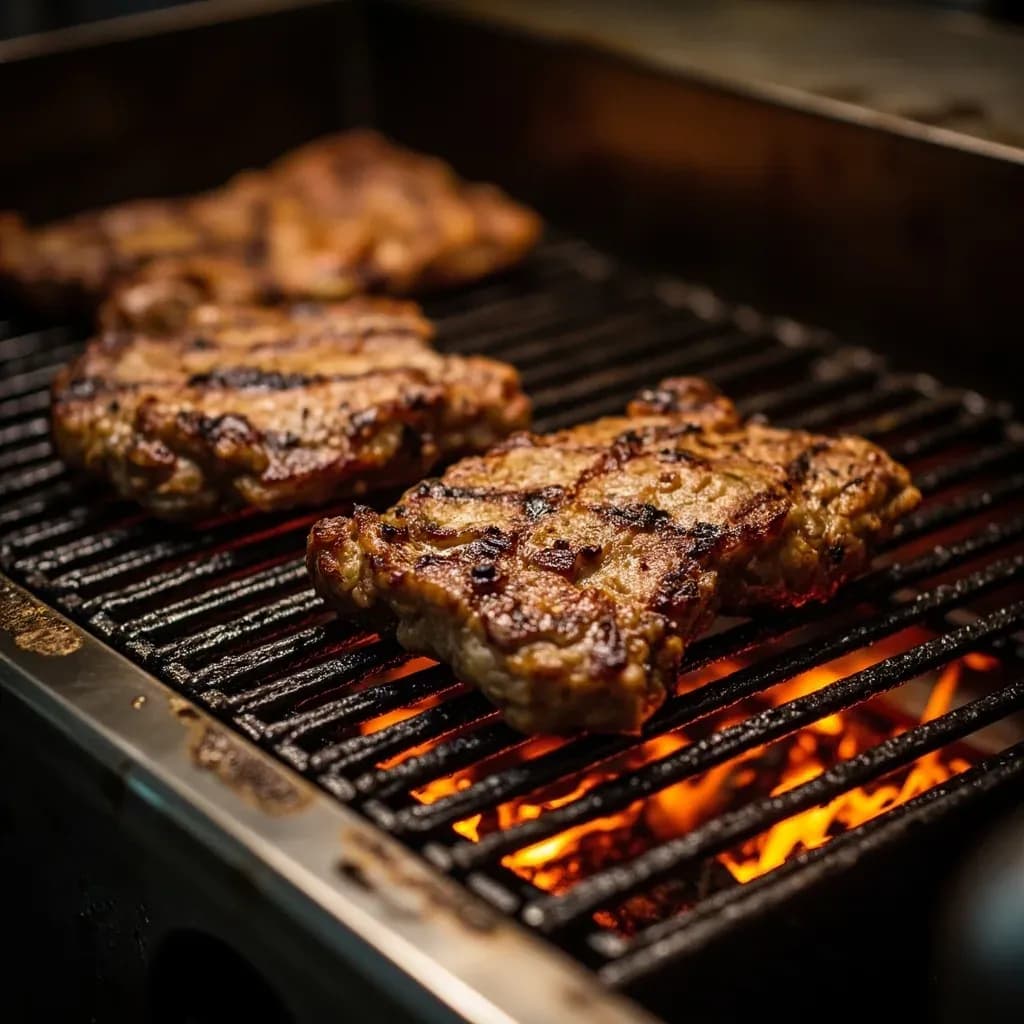
A char-broiler is a commercial cooking unit with cast-iron grates set above a heat source of gas-fired ceramic radiants, lava rock, or live charcoal. Grease drips onto the hot surface and flares to give grilled food its char marks and smoky taste. It is a kitchen workhorse for steaks, burgers, chicken, and vegetables, and charcoal pit versions cook the same way over an open ember bed.
A char-broiler is a stationary radiant-heat grill that anchors the hot line of almost every serious restaurant kitchen. It consists of a stainless steel cabinet housing powerful gas burners (or, less commonly, electric elements or infrared ceramic) topped by heavy cast-iron or steel grates. Between the burner and the grate sits a heat-transfer medium — classic lava rocks, modern ceramic briquettes, or high-end infrared ceramic tiles — that diffuses flame, evens out temperature, and vaporizes drippings into the smoke that gives char-broiled food its distinctive flavor. The result is a cooking surface that delivers searing radiant heat from below, building a deep Maillard crust on steaks, chops, and patties far faster than a flat-top griddle can.
In daily use, the appliance behaves like an indoor grill held at continuous high temperature. Cast iron grates retain heat and imprint the parallel char lines diners expect; drippings that fall onto the rocks or tiles flash into smoke, seasoning the food as it cooks. Older lava-rock designs flare readily and require frequent rock changes, while ceramic briquettes burn cleaner and last years. Infrared models, now favored in steakhouses, deliver very high, even radiant heat with substantially fewer flare-ups because the ceramic surface runs hot enough to vaporize grease before it pools.
A char-broiler is not the same thing as a flat-top griddle, which has a solid smooth plate rather than open grates, nor is it the same as a salamander broiler, which fires from above. Note also that Char-Broil® (hyphenated, capitalized, and trademarked) is a major outdoor consumer grill brand founded in 1948 by W.C. Bradley Co. in Columbus, Georgia — entirely separate from the generic indoor commercial appliance called a char-broiler.
Alternatives
Types & varieties
The traditional 1960s–80s design. Rocks absorb burner heat and vaporize drippings for pronounced smoke flavor, but flare easily and need periodic replacement as they crumble and saturate with grease.
Modern successor to lava rocks. Briquettes last years, distribute heat more evenly, and are far easier to clean or swap out individually.
Ceramic infrared tiles or screens above the burner deliver very high, even radiant heat with markedly reduced flare-ups; the steakhouses' choice for fast, consistent searing.
Heat source mounted above the food for top-browning, melting cheese, and glazing; grouped with char-broilers in catalogs but distinct in operation.
Leg-mounted, multi-burner, 36–72 inches wide; built for high-volume steakhouse and burger service.
Compact 12–24 inch unit for prep kitchens, smaller restaurants, and bars with limited hood space.
One side flat (griddle), the opposite side grooved (char-broiler); gives a mixed-menu kitchen both surfaces in one footprint.
Used where gas is restricted or unavailable. Lower peak temperatures and slower recovery than gas, but no open flame and simpler ventilation.
Heat-transfer media: rocks, briquettes, and infrared
The medium between burner and grate is what defines a char-broiler's personality. Lava rocks are the original choice and produce the most aggressive smoke flavor because grease pools in their crevices and burns off — which is also why they flare and need replacing every year or two in a busy kitchen. Ceramic briquettes solve the durability problem: they sit in a metal rack, distribute heat more evenly than loose rocks, and can be brushed clean or individually swapped. Infrared ceramic tiles run hotter than either, reaching temperatures that essentially incinerate drippings on contact, which means almost no flare-up and very fast sear times. The trade-off is that infrared units cost more up front and the tiles can crack if doused with cold water while hot.
- Lava rocks: best smoke, worst flare-ups, shortest lifespan
- Ceramic briquettes: balanced choice for most kitchens; even heat, easy maintenance
- Infrared tiles: hottest and cleanest searing; higher cost and care requirements
Char-broiler vs. griddle vs. salamander
Three appliances look similar in catalogs but cook very differently. A char-broiler has open grates over radiant heat and is used for high-heat searing with characteristic char marks. A flat-top griddle has a solid steel or chrome plate — no grates, no smoke — and is the right tool for smashburgers, eggs, pancakes, and onions where contact browning matters more than grill flavor. A salamander is an over-fired (top-down) broiler used to brown, melt, or glaze food that is already cooked; it cannot replace a char-broiler because it cannot sear from below. Many professional kitchens run all three side by side for exactly this division of labor.
- Char-broiler = open grates, under-fired, for char and smoke
- Griddle = solid plate, under-fired, for contact browning and breakfast items
- Salamander = open or radiant, over-fired, for finishing and melting
Common uses
Tips & pitfalls
- Preheat for a full 15–20 minutes; grates that are not uniformly hot will stick food and smear rather than char it.
- Oil the food, not the grates — oil on a cold grate burns off before the food arrives, while oiled food releases cleanly and limits drip-induced flare-ups.
- Between batches, scrape the grates with a heavy wire brush while still hot and empty the grease trough at the end of every service to prevent flare-ups and grease fires.
- Verify that hood filters are clean and make-up air is functioning before each service; char-broilers produce heavy smoke and grease-laden vapor that a clogged hood cannot handle safely.
- Use zone cooking: place items directly over a burner to sear, then slide them to the cooler edges of the grate to finish gently without overcooking.
- Season cast iron grates like cast-iron cookware — wipe a thin coat of oil on after cleaning; never use dish soap, which strips the seasoning.
- Replace lava rocks or saturated briquettes when they crumble or blacken with old grease; saturated media smoke heavily and lose the ability to vaporize drippings cleanly.
- For added smoke flavor, place hardwood chips or a small smoker box directly over the burners — works best with rock or briquette models, less effective under infrared tiles.
- Resist moving or pressing food; let it release naturally from the grate to preserve clean char marks and avoid tearing the crust.
- Allow a long cool-down before any wet cleaning — thermal shock from cold water can crack ceramic tiles and briquettes.
Good to know
- Heat source
- Natural gas or propane is standard; infrared ceramic and electric models also exist for restricted-ventilation kitchens
- Grate material
- Cast iron dominates for heat retention and char marks; steel and chrome-plated grates are lighter and easier to clean but hold less heat
- Heat-transfer medium
- Open flame, lava rocks, ceramic briquettes, or infrared ceramic tiles — each changes flavor, flare-up behavior, and maintenance
- BTU output
- Typically 15,000–30,000 BTU per burner; heavy-duty floor models reach ~40,000 BTU per burner
- Common widths
- Countertop and floor models come in 12, 24, 36, 48, 60, and 72 inch sizes
- Ventilation
- Requires a commercial exhaust hood with grease filters and make-up air; cannot be installed under a residential range hood
- Major manufacturers
- Vulcan, Wolf Range (ITW), Southbend, MagiKitch'n, Jade, Blodgett, and Montague
- Origin
- Cooking over flame and coals is ancient; enclosed gas-fired commercial char-broilers became standard in U.S. restaurants from the mid-20th century onward
Also called
Charbroiler · Charcoal Roasting Pit · Charcoal Pit
Related

Stovetop
The everyday burners where most cooking actually happens

Oven
Enclosed dry heat for roasting, baking, and braising

Grill
Live-fire or gas grates for char, smoke, and high heat

Smoker
Low, slow heat and wood smoke for barbecue and brisket

Air Fryer
Countertop convection that crisps with little or no oil

Slow Cooker
Set-and-forget low heat for stews, beans, and braises

Pressure Cooker
Sealed steam pressure that cooks tough food in a fraction of the time

Rice Cooker
Foolproof, perfectly steamed rice every single time