Appliances & Heat
Cantonese Roast Meat Oven
A tall vertical oven that hangs meats to roast for Cantonese char siu, roast duck, and crispy pork.
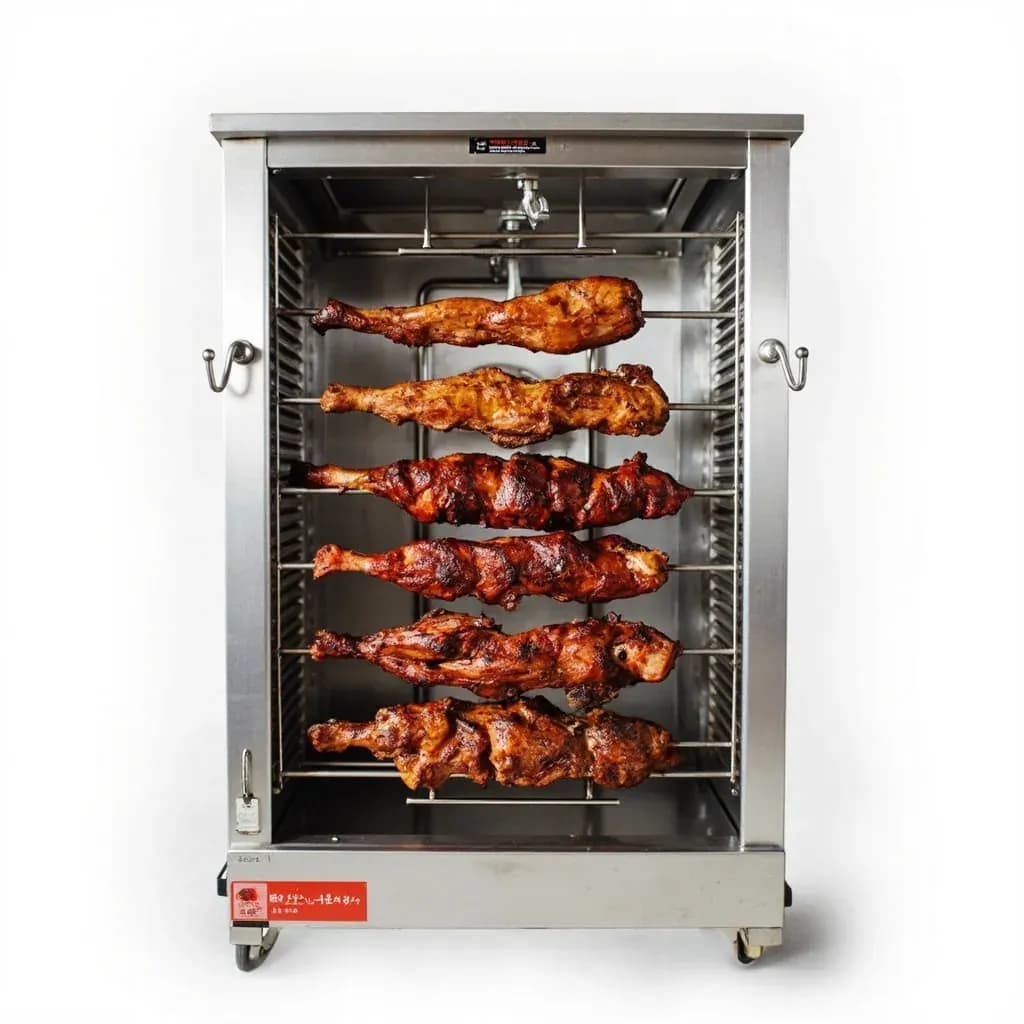
A Cantonese roast meat oven is a tall cylindrical or barrel oven, traditionally charcoal-fired and now often gas, in which seasoned meats hang on hooks over intense heat. The vertical design lets fat drip away and circulates heat around char siu pork, roast duck, and crackling-skinned pork belly. It is a defining tool of siu mei, the glazed roast meats hung in Cantonese restaurant windows.
The Cantonese roast meat oven is a piece of specialist equipment designed around one principle: meat hangs free in a column of moving hot air while radiant heat from the chamber walls sears its surface. Unlike a Western rotisserie, nothing turns — the meat is suspended from hooks or rails at the top of a tall, narrow box and is cooked by heat radiating inward from the back and side walls. This configuration lets fat drip cleanly away from the carcass, lets the lacquer glaze set without being smeared, and gives every piece the even, mahogany crust that defines siu mei, the Cantonese barbecue tradition.
The defining feature of this oven is not the temperature but the geometry. A tall vertical chamber with hanging meat means hot air rises past each piece, smoke and rendered fat are drawn upward into a hood, and the cook can monitor and remove individual hooks without disturbing the rest of the load. Char siu, roast duck, and crispy pork belly all behave differently in this environment — the radiant wall heat crisps skin, the upward airflow dries the surface so glaze adheres, and the height of the chamber gives the cook multiple zones of different intensity to work with.
Why this matters at home: a good convection oven cannot fully reproduce the result, because laid-flat meat sits in its own fat and bakes rather than roasts. Knowing what the real oven does — radiant wall heat, suspended meat, vertical airflow, late glaze — tells a home cook exactly what to fake.
Alternatives
Types & varieties
The traditional workhorse of Hong Kong and Guangdong siu mei shops; high radiant heat, fast recovery, runs on LPG or natural gas.
Common where gas is unavailable or for indoor mall stalls; more even heat and easier control, slower to recover when the door opens.
Smaller 4–8 hook units used in small restaurants, food trucks, and serious home siu mei kitchens.
Ceramic or quartz infrared tubes mimic radiant wall heat; prized for fast searing of the char siu lacquer.
Tall multi-shelf design used when many trays of siu yuk need finishing on racks after an initial hanging roast.
Modern Chinese ovens sometimes add a central rotating spit for whole pigs or ducks — a departure from the classic hanging method.
Heat zones inside the oven
Most commercial Cantonese ovens are not uniform in temperature from top to bottom. Because heat rises and the burner or elements sit on one wall, the upper third near the heat source runs hottest and the lower third noticeably cooler. Experienced cooks use this on purpose:
- Hang fatty cuts (char siu shoulder, whole duck) in the upper zone where the strongest radiant heat renders fat quickly and crisps skin.
- Hang leaner or more delicate items (white-cut chicken, soy sauce chicken) in the cooler lower zone to finish gently without drying out.
- Rotate hooks top-to-bottom mid-batch if pieces in the lower zone look underdone; this is easier than opening the door.
- Reserve the bottom rail or floor of the oven as a warm-holding zone for sliced-to-order siu mei waiting for service.
Working without one: home adaptations
There is no perfect substitute, but the principle can be approximated well enough for excellent home char siu and roast duck. The key is to recreate the three things the hanging oven gives you: radiant heat from the sides, a way for fat to drip clear, and a dry surface for the glaze to set on.
- Use the highest rack position in a convection or fan-assisted oven, with a heavy sheet pan on the floor to catch drips — this mimics the vertical airflow.
- Suspend meat from an S-hook hung over the top oven rail, or thread it onto a vertical rotisserie skewer that does not turn; both let air reach all sides.
- Finish siu yuk (crispy pork) on a wire rack set over a rimmed tray so air circulates under the skin during the final blast of high heat.
- Brush maltose or honey glaze on in the last 5–10 minutes only; earlier and the sugar burns before the meat is cooked.
- For duck, pierce the skin generously with a skewer and blot with paper towels before roasting — this stands in for the constant drip-drying effect of a hanging roast.
- A charcoal kettle grill with the lid closed can approach the radiant wall effect if meat is hung from the lid handle, though temperature control is far less precise.
Common uses
Tips & pitfalls
- Preheat the empty oven for at least 20–30 minutes so the walls are fully radiant; loading meat into a cold chamber steams rather than sears.
- Leave 5–8 cm (2–3 in) between hanging pieces — air must circulate, or the meat stews in its own vapor.
- Hang fatty cuts higher and leaner cuts lower; the top of the chamber is hottest in most designs.
- Empty and refill the drip tray between batches; old fat smokes, deposits on the walls, and taints the next batch with a bitter, greasy note.
- Pierce or score skin-side pieces (duck, siu yuk) so rendered fat escapes — trapped fat prevents crisping and leaves the skin rubbery.
- Glaze with maltose or honey syrup only in the last 5–10 minutes; earlier and the sugar burns black long before the interior is cooked.
- Open the door briefly and rarely — every opening costs 20–30 °F and stalls the browning you came for.
- Wipe walls weekly and descale or degrease the drip system; built-up carbon is a fire hazard and flavors everything bitter.
Good to know
- Origin
- Canton (Guangzhou) region of Guangdong Province; the hanging-roast technique is centuries old and dedicated vertical ovens became standard in siu mei shops in the 20th century.
- Also called
- Chinese BBQ oven, siu mei oven, char siu oven, Cantonese BBQ oven, hanging roast oven.
- Design
- Tall, narrow vertical chamber, usually rectangular, with hooks or rails at the top; heat radiates from the back and/or side walls rather than from above or below.
- Heat source
- Gas (most common in traditional shops), electric, or infrared ceramic/quartz tube elements in some modern units.
- Typical temperatures
- 375–500 °F (190–260 °C) at the walls, with air around the meat usually 300–400 °F (150–200 °C).
- Capacity
- Floor-standing commercial units hold 6–24 hooks or multiple hanging racks; countertop units hold 4–8 pieces.
- Ventilation
- Connected to a hood or canopy; smoke and rendered fat are exhausted upward, never recirculated.
- Compared to rotisserie
- Meat does not rotate; heat comes from chamber walls, not a central spit.
Also called
char-siu-oven · roast duck oven · siu mei oven · Chinese roasting oven
Related

Stovetop
The everyday burners where most cooking actually happens

Oven
Enclosed dry heat for roasting, baking, and braising

Grill
Live-fire or gas grates for char, smoke, and high heat

Smoker
Low, slow heat and wood smoke for barbecue and brisket

Air Fryer
Countertop convection that crisps with little or no oil

Slow Cooker
Set-and-forget low heat for stews, beans, and braises

Pressure Cooker
Sealed steam pressure that cooks tough food in a fraction of the time

Rice Cooker
Foolproof, perfectly steamed rice every single time