Appliances & Heat
Charcoal Chimney Starter
A vented metal cylinder that lights charcoal evenly with newspaper and no lighter fluid.
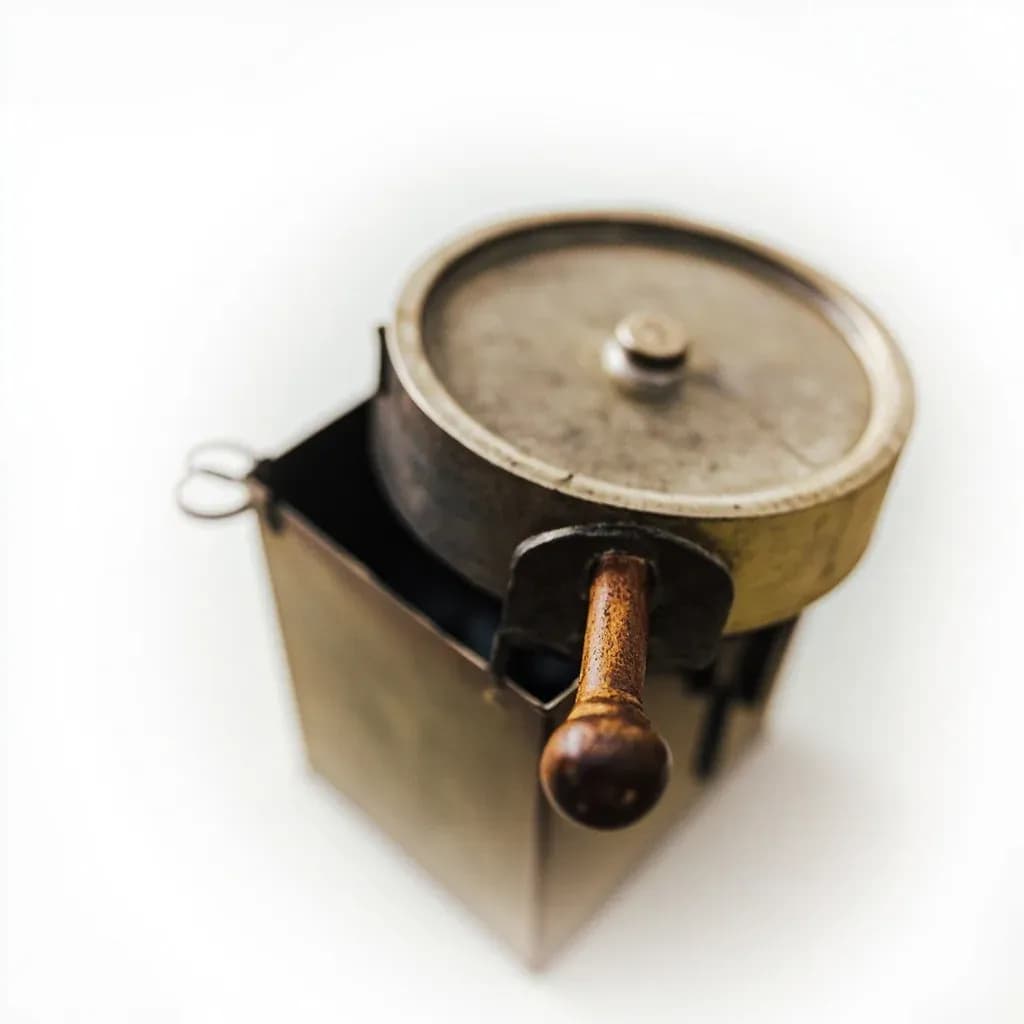
A charcoal chimney starter is a metal cylinder with a grate inside and a handle, used to ignite charcoal for grilling. Coals go on top, crumpled paper underneath, and the chimney draft brings the whole load to a glowing red in 15 to 20 minutes before being poured into the grill. It lights charcoal evenly and cleanly without lighter fluid, avoiding chemical off-flavors.
A charcoal chimney starter is a sheet-metal cylinder with an internal wire grate that holds a load of briquettes or lump charcoal above a lower fire chamber. Crumpled newspaper or a paraffin fire-starting cube is lit in the bottom; the rising hot gases draw fresh oxygen through vents at the base, and that convection current pulls flame upward through the coal bed until every piece is evenly ignited. The result is a uniform bed of ashed-over coals ready to pour into a grill in roughly 15 to 20 minutes, with no petroleum aftertaste from lighter fluid and far fewer flare-ups along the way.
The chimney replaced the older pile-and-squirt method of lighting charcoal, which was slow, smoky, and dangerous when fluid was added to already-burning coals. Attributed to inventor Henry Grieb in the late 1960s and popularized commercially by Weber in the 1970s, the design has been a fixture of backyard grilling ever since because it demands nothing more than paper, a match, and a little patience. A standard home model holds about 5 to 7 lb of briquettes — enough for a full kettle of direct-heat cooking — while larger stainless commercial versions hold closer to 10 lb and survive the repeated high-heat cycles of a busy cookout.
Because ignition happens from below inside a confined column, a chimney is unusually forgiving in wind, on damp days, and on grills where matches or long lighters are awkward to use. It is, in practical terms, a simple physics device that converts one of grilling's most unpredictable chores into a reliable, repeatable first step.
Alternatives
Types & varieties
The classic straight-sided design with an internal grate and bottom vents; the form most home grills are sized for.
Tapered profile that nests for compact storage; slightly less capacity but lighter to handle.
Extra side-vent holes (e.g., Weber Rapidfire) shorten ignition time to roughly 10–12 minutes by feeding more oxygen to the rising column.
Plug-in heating coil buried in the coal bed; not a true chimney, but the most common alternative where open-flame ignition is restricted.
Smaller-capacity chimney for tailgating, portable kettle grills, or tabletop grills where a full-size model would be overkill.
Heavier-gauge stainless steel used in restaurants and competition barbecue; resists warping across thousands of heat cycles.
Fuel and Flavor
A chimney works equally well with briquettes and lump charcoal, but the two behave differently inside it. Briquettes are uniform in size and density, so they ignite on a predictable schedule and produce steady, even heat — ideal for most backyard grilling. Lump charcoal ignites faster, burns hotter, and leaves less ash, which suits the high, radiant temperatures needed for steakhouse-style searing. Whatever the fuel, the absence of lighter fluid is the real flavor payoff: petroleum residue vaporizes off the coals onto food during the cook, and a chimney makes that contamination unnecessary.
- Briquettes give the most predictable ignition time and a steady burn — a good default for indirect cooking and long sessions.
- Lump charcoal lights faster in a chimney and reaches higher peak temperatures, which suits searing and kamado-style grilling.
- Wood chips and small chunks are too small for a chimney — add them in a foil pouch or smoker box once the coals are in the grill, or use fist-sized chunks placed directly on the lit coals.
Common uses
Tips & pitfalls
- Crumple 2–3 full sheets of newspaper loosely and wedge them under the grate into the bottom chamber; airflow matters more than paper volume, so tight wads actually light worse than loose ones.
- Do not pack the chimney to the brim — leave 1–2 in of headspace at the top so flames can rise and ignite the upper pieces evenly.
- Wait for a uniform gray ash coating across the coals, not just a red glow on the bottom; under-ashed coals give an acrid, smoky flavor and very uneven heat.
- Set the chimney on brick, pavers, the grill's lower grate, or a metal tray — never directly on a wooden deck, grass, or vinyl siding.
- Pour lit coals with heat-resistant grilling gloves or two long tongs gripping the bottom ring; tipping bare-handed is the single most common grilling burn.
- Skip lighter fluid. It leaves petroleum residue on the coals, can flare during the pour, and is never necessary with a chimney.
- A paraffin wax fire-starting cube lights faster than newspaper and still works when paper is damp.
- In windy conditions, drop a single charcoal briquette in the bottom of the chimney as a wind block, or light the paper through the bottom vents with a long-stem lighter or match.
- Clean the ash out of the chimney after every use; trapped ash blocks the bottom vents and lengthens the next lighting considerably.
Good to know
- Also known as
- Charcoal chimney, chimney starter, charcoal starter
- Inventor (attributed)
- Henry Grieb, c. late 1960s; popularized commercially by Weber in the 1970s
- Typical material
- Sheet steel; high-end models in stainless steel
- Typical capacity
- 5–7 lb of briquettes; commercial models hold ~10 lb
- Average ignition time
- 15–20 minutes from lighting paper to fully ashed-over coals
- Indicator of readiness
- Coals covered with a light gray ash (about 60–70% ashed over)
- Common sizes
- Standard (~7 in diameter × 12 in tall) and compact (~5 in × 9 in) for smaller grills
- Safe surface
- Brick, concrete, metal grate, or other non-combustible surface only — never a wooden deck
Also called
chimney starter · charcoal starter
Related

Stovetop
The everyday burners where most cooking actually happens

Oven
Enclosed dry heat for roasting, baking, and braising

Grill
Live-fire or gas grates for char, smoke, and high heat

Smoker
Low, slow heat and wood smoke for barbecue and brisket

Air Fryer
Countertop convection that crisps with little or no oil

Slow Cooker
Set-and-forget low heat for stews, beans, and braises

Pressure Cooker
Sealed steam pressure that cooks tough food in a fraction of the time

Rice Cooker
Foolproof, perfectly steamed rice every single time