Prep Tools
Cheese Grater
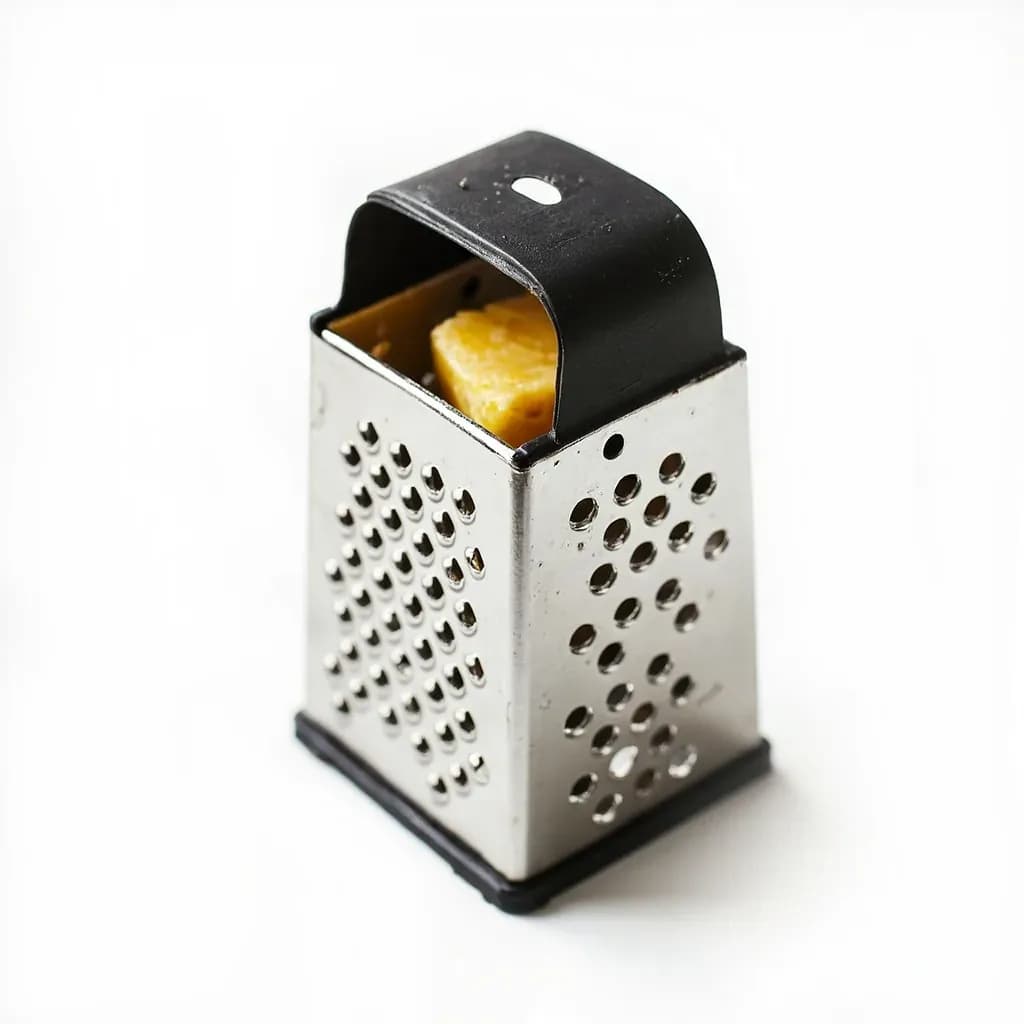
A perforated metal tool that shreds hard cheese into fine or coarse strands for cooking and finishing.
A cheese grater rubs a block of cheese against sharp raised holes to produce shreds for melting, topping, and finishing dishes. Box graters offer several hole sizes for coarse mozzarella or fine Parmesan, and the same tool grates vegetables, chocolate, and citrus zest. Grating fresh from the block tastes better than pre-shredded cheese, which is coated with starch to keep it from clumping.
A cheese grater is a hand-operated cutting tool whose working surface is a sheet of metal punched, stamped, or photo-etched with sharp raised edges. As a hard lump of cheese is drawn across those edges, thin slices are shaved off the block — the geometry of the holes (or teeth, in a rasp) determines the size and texture of the shred. It sounds simple, but the grater's job in a kitchen is to do something no knife can: convert a hard, brittle wedge of cheese into a fluffy, high-surface-area pile in seconds, with very little pressure from the cook.
That conversion matters because of how cheese melts and seasons. A fine grating of Parmesan or Pecorino collapses into a sauce almost on contact with hot pasta water, while a coarser shred of cheddar sits in recognizable ribbons on top of a baked potato. The same principle — increasing surface area — is what makes a grating of cold butter disappear into flour for pastry, or a dusting of nutmeg dissolve into a béchamel. A grater is, in this sense, a tool for controlling texture and timing as much as it is a tool for cutting.
The category has settled into two dominant forms: the tall four-sided box grater, a late-19th- to early-20th-century American design descended from earlier tin graters and useful for volume and varied cuts, and the narrow rasp-style Microplane, adapted from a 1940s woodworking tool for kitchen use in the 1990s and prized for very fine, feathery shavings. Which one to reach for is dictated mostly by the cheese and the dish — the rest of this entry sorts that out.
Alternatives
Types & varieties
The classic American upright grater, roughly 8–10 inches (20–25 cm) tall, with sides offering fine, medium, and coarse grating plus a slicing slot. Usually comes with a detachable base or catch tray.
A handheld sheet of punched or stamped metal with a handle — inexpensive, compact, and good for small jobs like a few tablespoons of Parmesan.
A narrow photo-etched rasp that produces very fine, feathery shavings. The go-to for hard cheese, citrus zest, nutmeg, ginger, and garlic.
A hand-cranked drum with a fitted blade; the cheese sits inside or feeds against the drum. Good for small, hard cheeses and for cooks with limited hand strength.
A box-grater variant with extra-large holes that produce fluffy, long shreds suited to melting over burgers, chili, or nachos.
A motor-driven rotary grater, useful for large volumes; harder to clean and prone to clogging with soft or oily cheeses.
Lighter and cheaper than stainless; dulls and rusts faster. Mostly seen as vintage kitchenware rather than a modern recommendation.
The Microplane shift
The single biggest change in home grating in the last thirty years is the move from punched metal to photo-etched rasps. A traditional grater cuts by punching a hole in sheet metal and folding the burr outward — those punched edges work fine but produce a shred that can be a little wet and ragged. A Microplane-style blade is chemically etched into hardened steel, creating rows of tiny, uniform, knife-like teeth. The result is a much finer, drier shaving and almost no effort from the cook: a light pass is enough. For hard aged cheeses especially, this is the difference between grated cheese and shaved cheese, and it has reshaped how cooks finish dishes like carbonara, cacio e pepe, and Caesar salad.
Choosing the right grater for the job
Match the tool to the cheese and the cut you want.
- Microplane (fine rasp): hard aged cheese for finishing or melting into sauces; citrus zest; whole nutmeg; fresh ginger and garlic.
- Box grater, coarse holes: aged cheddar and other firm, well-chilled semi-hard cheeses for casseroles, tacos, and baked dishes where you want visible shreds.
- Box grater, fine holes: hard cheese for recipes that call for grated (rather than shaved) cheese, or for a quick snowy topping.
- Box grater, slicing slot: carrots, zucchini, cucumber, and other firm vegetables when you want even planks instead of shreds.
- Rotary grater: small volumes of hard cheese, or for cooks who find a box grater physically uncomfortable to use.
Common uses
Tips & pitfalls
- Chill hard cheese in the freezer for 10–15 minutes before grating — firmer cheese is far easier and safer to shred, and produces cleaner pieces
- Always use the safety guard or food pusher on a box grater; the grated-cheese guard is a fingertip saver and worth the few extra seconds
- Let the blade do the work — pressing hard on a Microplane just bends the rasp; a light, even pass gives the cleanest shavings
- Do not grate soft or semi-soft cheeses (mozzarella, brie, cream cheese, fresh chèvre) on a box grater; they smear, clog the holes, and are nearly impossible to clean out
- Lightly oil the back of a Microplane with a neutral oil to reduce static cling and keep fine shreds from sticking to the blade
- Clean immediately after grating sticky or oily cheeses by running the grater under hot water; a stiff brush works better than a sponge for punched holes
- Reach for a Microplane when you want cheese to melt instantly into a sauce, and a box grater when you want longer shreds for visual topping
- Store box-grater inserts together in a single bag or bin so the finer holes do not get lost between uses
Good to know
- Type
- Hand-operated food preparation tool with sharp perforated or ridged metal surfaces
- Primary material
- Stainless steel blades with wood, plastic, or stainless steel frames and handles
- Standard cut sizes
- Fine, medium, and coarse grating, plus a slicing slot on most box graters
- Best for
- Hard and semi-hard cheeses such as Parmesan, Pecorino Romano, aged cheddar, Grana Padano, and Asiago
- Yield rule of thumb
- About 1 oz (28 g) of hard cheese yields roughly ¼ cup grated
- Microplane origin
- Adapted from a 1940s woodworking rasp; introduced for kitchen use in the early-to-mid 1990s
- Cleaning
- Most stainless box graters and Microplanes are dishwasher-safe, though hand-washing preserves edge sharpness
- Storage
- Dry storage; many box graters nest with their removable inserts kept together
Also called
Rallador · Box Grater · Grater
Related

Peeler
Swift blade for stripping skin off fruit and vegetables

Grater
Sharp-toothed surface for shredding cheese and vegetables

Microplane
Ultra-fine rasp for citrus zest, garlic, and hard cheese

Mixing Bowl
All-purpose bowl for combining, whisking, and tossing

Whisk
Looped wires that beat air into eggs, cream, and sauces

Spatula
Flat blade for flipping, lifting, and scraping

Slotted Spoon
Pierced spoon that lifts solids and drains the liquid behind

Wooden Spoon
Gentle, heat-friendly spoon for stirring anything